


Consumer Adoption Process Introduction Powerpoint Presentation Slides




Try Before you Buy Download Free Sample Product
 Impress Your
 Audience
 100%
100% Editable
 Save Hours
 of Time


Introducing our PowerPoint presentation Consumer Adoption Process Introduction. It focuses on the importance of a streamlined consumer adoption process for the success of any product. Firstly, the User Experience Mapping PPT deck emphasizes the five stages of the consumer adoption journey product awareness, product interest, product evaluation, product trial, and customer success. It provides slides dedicated to driving product awareness through marketing and promotional campaigns. Furthermore, the Product Adoption module covers the stages of product interest and evaluation, ensuring the availability of product information in the market, including product comparison and review pages. It also includes slides on the product trial stage, where customers test the products performance and expectations are set and delivered. Additionally, Customer Conversion Rate PPT slides include customer success journey, focusing on retaining good-fit customers and increasing customer loyalty, along with slides on tools and techniques such as user experience maps and product adoption software. Lastly, to track and assess consumer adoption, the deck offers slides on consumer adoption tracking solutions and dashboards for monitoring consumer adoption rate, purchase frequency, and conversion rate. Get access to this 100 percent editable template now.
People who downloaded this PowerPoint presentation also viewed the following :
Content of this Powerpoint Presentation
Slide 1: This slide introduces Consumer Adoption Process Introduction. State your company name and begin.
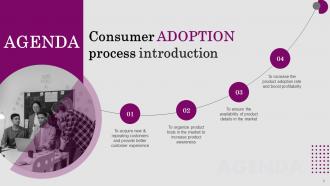
Slide 2: This is an Agenda slide. State your agendas here.
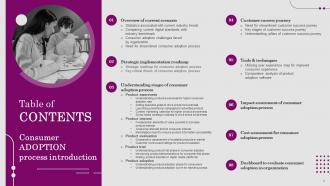
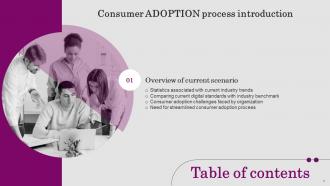
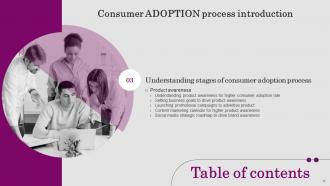
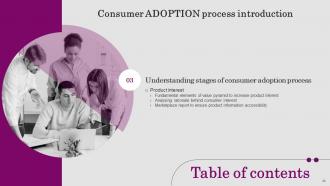
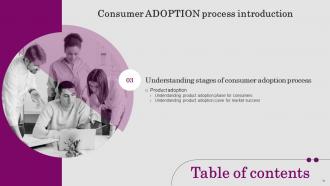
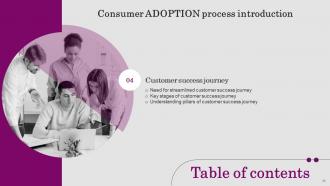
Slide 3: This slide shows Table of Content for the presentation.
Slide 4: This slide shows title for topics that are to be covered next in the template.
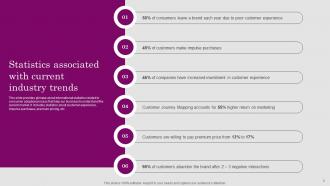
Slide 5: This slide provides glimpse about international statistics related to consumer adoption process.
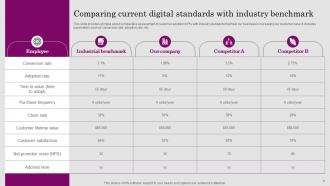
Slide 6: This slide presents comparative assessment of customer adoption KPIs with industry standards.
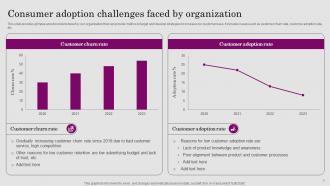
Slide 7: This slide describes about problems faced by organization that can provide metrics to target and develop strategies to increase customer base.
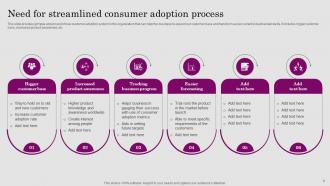
Slide 8: This slide provides glimpse about need of new customer adoption system in the organization.
Slide 9: This slide shows title for topics that are to be covered next in the template.
Slide 10: This slide displays timeline for new customer adoption system.
Slide 11: This slide provides key considerations of new customer adoption system.
Slide 12: This slide shows title for topics that are to be covered next in the template.
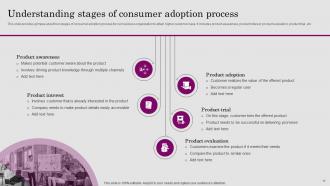
Slide 13: This slide describes about four stages of consumer adoption process for our business organization to attain higher customer base.
Slide 14: This slide shows title for topics that are to be covered next in the template.
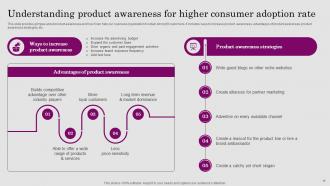
Slide 15: This slide displays product awareness and how it can help our business organization to retain strong fit customers.
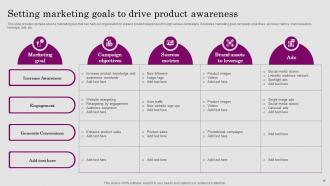
Slide 16: This slide provides a marketing plan that can help our organization to expand product awareness through various campaigns.
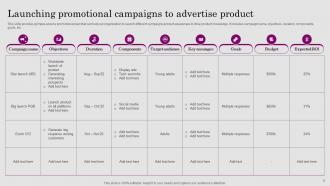
Slide 17: This slide presents a promotional plan that can help our organization to launch different campaigns product awareness to drive product knowledge.
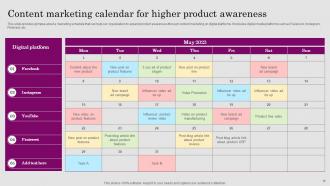
Slide 18: This slide descrbes a marketing schedule that can help organization to expand product awareness through content marketing on digital platforms.
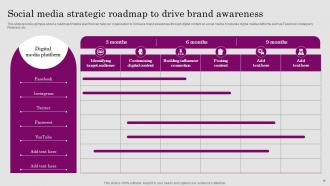
Slide 19: This slide displays a roadmap timeline plan that can help organization to increase brand awareness through digital content on social media.
Slide 20: This slide shows title for topics that are to be covered next in the template.
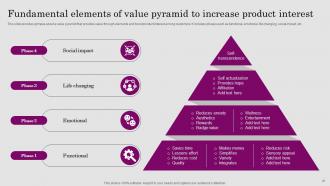
Slide 21: This slide displays a value pyramid that provides value through elements and boost product interest among customers.
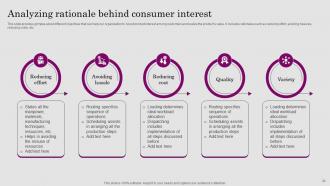
Slide 22: This slide provides different objectives that can help organization to boost product interest among customers.
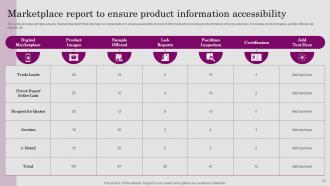
Slide 23: This slide displays a market data report that can help organization to ensure availability of product information.
Slide 24: This slide shows title for topics that are to be covered next in the template.
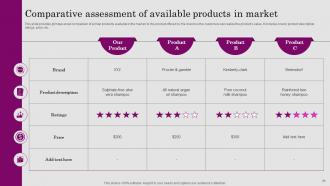
Slide 25: This slide provides comparison of similar products available in the market, to the product offered by the brand so the customers can realize the product’s value.
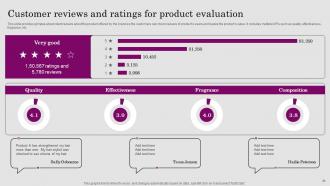
Slide 26: This slide displays client reviews about the product offered by the brand so the customers can check reviews of products.
Slide 27: This slide shows title for topics that are to be covered next in the template.
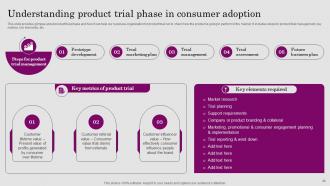
Slide 28: This slide provides glimpse about product trial phase and how it can help business organization.
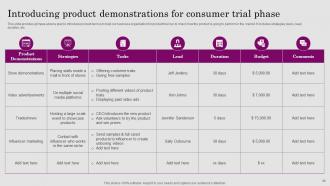
Slide 29: This slide displays a plan to introduce product demos to help business organization for product trial run.
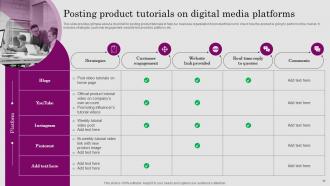
Slide 30: This slide presents a checklist for posting product tutorials to help business organization for product trial run.
Slide 31: This slide shows title for topics that are to be covered next in the template.
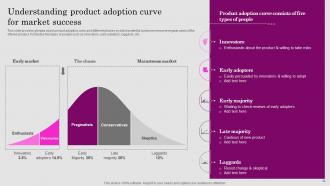
Slide 32: This slide displays product adoption curve and different phases by which potential customers become regular users of the offered product.
Slide 33: This slide shows title for topics that are to be covered next in the template.
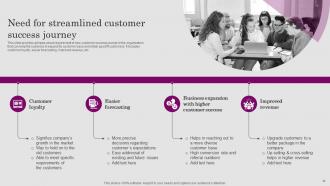
Slide 34: This slide presents requirement of new customer success journey in the organization that can help the business to expand its customer base.
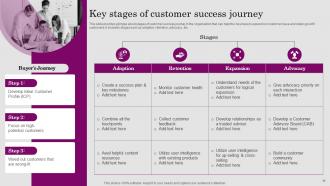
Slide 35: This slide describes stages of customer success journey in the organization that can help the business to expand customer base.
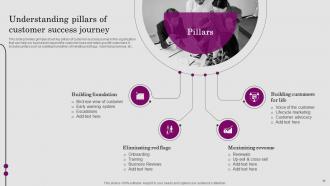
Slide 36: This slide displays key pillars of customer success journey in the organization.
Slide 37: This slide shows title for topics that are to be covered next in the template.
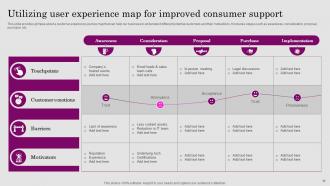
Slide 38: This slide provides customer experience journey map that can help our business to understand different potential customers and their motivations.
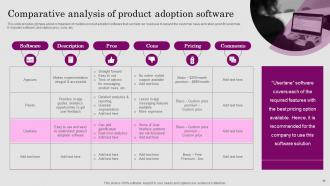
Slide 39: This slide presents comparison of multiple product adoption software that can help business to expand the customer base and retain good fit customers.
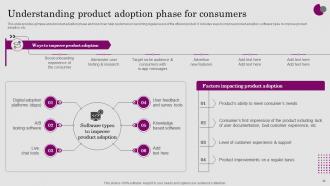
Slide 40: This slide describes product adoption phase and how it can help customers in becoming regular users of the offered product.
Slide 41: This slide shows title for topics that are to be covered next in the template.
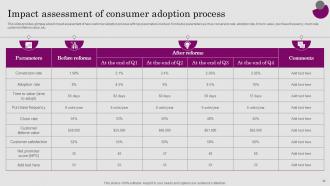
Slide 42: This slide displays impact assessment of new customer adoption process with key parameters involved.
Slide 43: This slide shows title for topics that are to be covered next in the template.
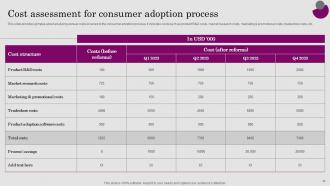
Slide 44: This slide describes analyzing annual costs incurred in the consumer adoption process.
Slide 45: This slide shows title for topics that are to be covered next in the template.
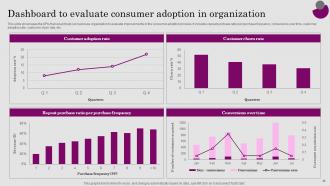
Slide 46: This slide showcases the KPIs that would help our business organization to evaluate improvements in the consumer adoption process.
Slide 47: This slide shows all the icons included in the presentation.
Slide 48: This slide is titled as Additional Slides for moving forward.
Slide 49: This is Our Vision, Mission & Goal slide.
Slide 50: This is Our Team slide with names and designation.
Slide 51: This slide provides 30 60 90 Days Plan with text boxes.
Slide 52: This slide shows SWOT analysis describing- Strength, Weakness, Opportunity, and Threat.
Slide 53: This slide shows Post It Notes for reminders and deadlines. Post your important notes here.
Slide 54: This slide depicts Venn diagram with text boxes.
Slide 55: This slide displays Mind Map with related imagery.
Slide 56: This slide presents Roadmap with additional textboxes.
Slide 57: This is a Thank You slide with address, contact numbers and email address.
Consumer Adoption Process Introduction Powerpoint Presentation Slides with all 62 slides:
Use our Consumer Adoption Process Introduction Powerpoint Presentation Slides to effectively help you save your valuable time. They are readymade to fit into any presentation structure.





FAQs for Consumer Adoption Process Introduction
So there's this whole process customers go through - awareness, interest, evaluation, trial, then adoption. They hear about your product first, get curious, then start comparing it to other options. Trial phase is honestly where most people make or break it. If they actually test it out and like the experience, boom - they become regular users. Oh, and knowing which stage someone's at helps you figure out what to say to them. Like, don't pitch someone who's never heard of you the same way you'd talk to someone ready to try it.
Honestly, people's personalities make a massive difference in adoption speed - we're talking months vs years between early adopters and the folks who wait forever. Risk-takers and curious types jump on new stuff immediately. Income and age matter too, though my neighbor's grandma had AirPods before half my friends did, so who knows. Education helps since you understand what you're buying. Social circles are huge - if your friends are tech nerds, you'll hear about things first. When you're launching something, don't treat cautious buyers like thrill-seekers. Different messaging for different people.
So marketing speeds up how people adopt stuff by tackling their mental roadblocks at each stage. Start with awareness campaigns for early adopters - they're hungry for new things anyway. Then use testimonials and social proof when you're trying to win over the mainstream crowd who need that extra push. Timing's crucial though, like seriously don't be pushy too early or you'll just annoy people. Your messaging has to shift as you go - first it's all about being innovative and cool, later it's more about being reliable and what everyone else is doing. Figure out where your audience sits on that adoption curve first.
So there are five things that make products catch on fast. People need to see clear benefits over what they're already using - that's relative advantage. Compatibility matters too; if it fits their current habits, there's less resistance. Honestly, complexity kills adoption faster than anything else. Look at the iPhone vs those clunky early smartphones. You also want trialability - let people test it out first. And observability means others can actually see the benefits when someone's using it. Bottom line? Make your advantages obvious, keep it simple to use, and let people try before they buy. Those three will speed things up big time.
Honestly, it comes down to a few key things. People need to see clear benefits - like, will this actually make my life easier? Risk tolerance matters too since some folks just hate trying new stuff. Social proof is massive though - if their friends or people they trust are using it, they're way more likely to jump in. Trust in your brand is obviously crucial. But here's what kills adoption every time: complexity. Make something too confusing and people will nope out immediately, even if it's amazing. My advice? Show benefits super clearly and reduce the scary factor with free trials or demos. Let existing users do the convincing for you.
Dude, social influence is huge for product adoption. Your friends and family using something? You'll probably try it too. Peer pressure honestly beats most marketing campaigns. But here's the flip side - if your crowd thinks it's stupid or sketchy, you won't touch it even if it rocks. Nobody adopts stuff in a vacuum, right? We're always checking what everyone else thinks first. Oh, and here's something I learned the hard way - map out those social dynamics before launching anything. saves you tons of headaches later.
So early adopters are basically the people camping out for new iPhones - they love being first and don't mind the risk. Laggards? Total opposite. They're your dad who finally ditched his flip phone last month lol. Early adopters get hyped from tech blogs and reviews, but laggards won't budge until their neighbors are raving about something. Marketing's totally different too - show early adopters the cool new features and exclusivity angle. For laggards, you gotta prove it works and let other people do the convincing. Honestly makes sense when you think about it.
Honestly, surveys and focus groups are your best starting point - just ask people if they even know the problem exists first. Then get into whether they'd actually pay for a solution. Beta testing is absolutely crucial though, like way more important than people think. Get a prototype in front of real users ASAP. I'd also check social media buzz and Google search trends around your topic - that'll show you if interest is building. Oh, and segment your audience because early adopters will always seem way more excited than regular consumers. Maybe try a small pilot launch to get actual sales data instead of just opinions?
Honestly, just make it stupid easy for people to try without any risk. Free samples, trials, that whole thing - let them mess around with it first. Money-back guarantees help too since people hate feeling trapped. Find those early adopter types who actually like trying new stuff, then use their stories to convince everyone else. Influencer partnerships work pretty well for this - people trust seeing real users way more than ads. User-generated content is gold for the same reason. The whole game is removing friction from that first attempt, then actually delivering so they don't bail immediately.
So here's the thing about brand loyalty - it's kind of a double-edged sword. Your loyal customers will basically skip right over all that research phase stuff and just try whatever you put out because they already trust you. Makes launching new products way easier with them. But getting someone else's loyal customers? That's honestly where it gets brutal. They won't even look at your stuff most of the time. I've seen companies bang their heads against the wall trying to crack that. You're better off focusing on your own people for quick wins, then accepting it'll take forever to steal customers from competitors who've built real relationships.
Digital stuff spreads way faster because people can try it instantly - free trials, demos, whatever. Physical products? Way more friction since you can't really test them without buying or going to a store first. Apps go viral overnight, but good luck doing that with a toaster, you know? The downside is everyone can switch to competitors just as easily with digital. I'd focus on making trials super easy for digital products. For physical ones, lean hard into reviews and showing real benefits people can actually see.
Yeah, consumer education is huge for getting people to actually try new tech. Most folks are naturally skeptical - honestly, can you blame them? Education cuts through that by explaining benefits and addressing concerns before they even ask. The trick is making it relevant to what they actually need, not just rattling off a bunch of features. Start with your early adopters though. They're way easier to convince, and once they're hooked, they'll do half the work for you by spreading the word. It's like having free marketing that people actually trust.
Honestly, UX can totally make or break everything. I've watched amazing products completely bomb just because their onboarding was a mess - like, people couldn't even figure out how to get started. When your product feels confusing or clunky, users will bail so fast. But get the experience right? People stick around AND tell their friends about it. The key is making everything feel obvious and friction-free. Short learning curve = faster adoption. It's wild how much smoother things go when users actually feel confident using what you've built.
Okay so here's what's worked for me - get feedback at different points, like right after onboarding and maybe 30 days later when the excitement dies down. Surveys are fine, but honestly? The behavior stuff tells you way more than what people claim they're doing. Look at where users bail out completely or which features nobody touches. Support tickets are gold too since they show real pain points. Oh and this part matters - when you actually fix something based on their feedback, tell them about it! People love knowing they were heard. Most companies skip that last step which is kinda dumb.
Honestly, just be straight up with people during onboarding. Don't pull any of that manipulative BS with dark patterns - users can smell that from a mile away. They're basically inviting your product into their daily routine, so tell them the real deal about costs and data stuff upfront. Let them learn at their own speed instead of cramming every feature down their throats right away. I've seen so many companies rush this part and wonder why retention sucks. Building actual trust takes longer but that's how you get customers who stick around instead of bailing after week one.
-
If you have visited their site and failed to find the products, try reaching the customer service because it will be the case that you didn't use the search bar well.
-
The best and engaging collection of PPTs I’ve seen so far. Great work!