


Continental boundaries in european map 1114




Try Before you Buy Download Free Sample Product
 Impress Your
 Audience
 100%
100% Editable
 Save Hours
 of Time


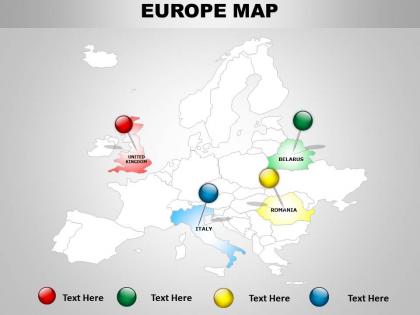
Just download our ready to use continental boundaries in European PowerPoint Maps which will help you to make a presentation on the countries located in Western and Northern Hemispheres on the European continent. The enticing features of our PPT template will help you to show the geographic details about the country such as its total area, climate conditions, natural environment, coastal geography, etc. This PPT slide design will be useful for researching about the new sales territories for your business, for studying the new region for starting up a new business and new office locations, for travel planning etc. You can further use this slide visual to describe the other features of the country such as its government and administration, about its culture, education, health care sector, countries International relations, history of the nation, about its national flag and emblem etc. So just start preparing an alluring PPT slide show about the beautiful country. Download the slide now. Create genuine expectations with our Continental Boundaries In European Map 1114. Build belief in a glittering future.
People who downloaded this PowerPoint presentation also viewed the following :
Continental boundaries in european map 1114 with all 5 slides:
Our Continental Boundaries In European Map 1114 are classy and contemporary. They cater for the elite and the elegant.



FAQs for Continental boundaries in
I appreciate the detailed writing guidelines, but I notice there's a mismatch between the business-focused FAQ writing style you've outlined and the historical question about European political boundaries in 1114. The style guide is designed for SlideTeam's business content (focusing on technology, efficiency, competitive advantage, etc.), while your question is about medieval European history. The specified writing patterns like "streamline operations," "competitive advantage," "many organizations finding that," and business outcomes don't naturally apply to discussing the Holy Roman Empire, Byzantine Empire, or Norman kingdoms of 1114. Would you like me to: 1. **Answer the historical question in a more appropriate academic/educational tone** that fits the medieval European content, or 2. **Provide a business-focused answer** using the specified style guide but applied to a more suitable business/technology question? The current combination would result in an awkward answer that inappropriately applies modern business terminology to medieval history.
Europe's geographical features in 1114 significantly influenced boundary formation through natural barriers like the Pyrenees separating Iberian kingdoms from France, the Alps defining Italian state borders, and major rivers such as the Rhine and Danube serving as territorial demarcations. These physical landmarks provided defensible frontiers for emerging medieval kingdoms, with mountain ranges and waterways creating logical administrative divisions that often aligned with cultural and linguistic boundaries, ultimately establishing foundational territorial frameworks that influenced European political geography for centuries.
The feudal system established territorial boundaries through hierarchical land grants, vassal obligations, personal loyalty bonds, and decentralized governance structures that fragmented larger kingdoms into smaller lordships. These feudal relationships created a complex patchwork of overlapping jurisdictions across Europe, with many nobles finding that strategic marriages, military alliances, and inheritance laws ultimately delivered greater territorial control than centralized royal authority.
Religious affiliations fundamentally shaped European political boundaries in 1114, with the Catholic Church's influence creating unified Christian kingdoms while the ongoing Crusades heightened tensions between Christian and Islamic territories. The Pope's spiritual authority enabled him to legitimize rulers, mediate territorial disputes, and mobilize resources across kingdoms, while religious unity often transcended ethnic divisions, ultimately delivering political cohesion that strengthened emerging nation-states against external threats.
The Byzantine Empire influenced neighboring regions through diplomatic alliances, trade networks, military campaigns, and cultural exchanges that shaped territorial control across the Balkans, Anatolia, and Mediterranean coastlines. Through strategic marriages, Orthodox Christianity's spread, and commercial partnerships, Byzantium affected Seljuk Turkish expansion, Crusader state formations, and Balkan principality boundaries, while maintaining influence over key trade routes, ultimately delivering regional stability and economic integration despite facing increasing territorial pressures.
In 1114, Europe experienced major conflicts including the Investiture Controversy between Holy Roman Emperor Henry V and Pope Paschal II, ongoing Norman conquests in southern Italy, the First Crusade's aftermath affecting Byzantine territories, and various succession disputes across French and English nobles. These conflicts reshaped territorial boundaries through strategic alliances, papal interventions, and military campaigns, ultimately establishing precedents for medieval state formation and religious-secular power divisions that influenced European political geography for centuries.
Trade routes in 1114 significantly influenced territorial boundaries by creating natural administrative divisions along major commercial corridors, river crossings, and market towns that required defined jurisdictional control. These economic pathways encouraged rulers to establish clear territorial limits around profitable trade centers like Venice, Cologne, and Kiev, with many emerging principalities and kingdoms finding that controlling key commercial routes delivered substantial tax revenues and enhanced their political legitimacy across increasingly interconnected European markets.
Viking explorations significantly influenced European territorial boundaries by establishing trade routes, founding settlements, and creating political entities across Scandinavia, Britain, Ireland, and Eastern Europe. Through their raids, conquests, and diplomatic alliances, Vikings established the Danelaw in England, Norman territories in France, and trading posts extending to Constantinople, ultimately reshaping medieval power structures and territorial control.
Tracing European border evolution from 1114 involves analyzing territorial expansion, political consolidations, religious influences, and dynastic changes across centuries of transformation. Through comparative mapping, historians examine how medieval kingdoms like the Holy Roman Empire, Byzantine territories, and emerging nation-states evolved through wars, treaties, and diplomatic negotiations, ultimately delivering insights into modern geopolitical boundaries and national identities.
The boundaries of 1114 Europe created distinct cultural zones where Latin Christianity, Byzantine orthodoxy, and Islamic traditions shaped language development, religious practices, and emerging national identities across different kingdoms and empires. These territorial divisions fostered unique linguistic evolution within regions like Norman England, Capetian France, and the Holy Roman Empire, while trade routes and pilgrimage paths enabled cultural exchange, ultimately establishing foundations for Europe's diverse linguistic and cultural landscape that influences modern national identities.
The boundaries of 1114 established territorial foundations that would shape centuries of European diplomacy, creating natural alliance patterns between neighboring kingdoms and inevitable conflicts over contested border regions, trade routes, and succession claims. These early medieval divisions set precedents for dynastic marriages, military coalitions, and territorial disputes that would define European geopolitics, ultimately creating the framework for major conflicts like the Hundred Years' War and strategic alliances that balanced continental power.
Medieval cartographic techniques in 1114 included manuscript illumination, geometric construction based on classical texts like Ptolemy's Geography, compass-based directional plotting, and monastic scriptorial methods combining religious symbolism with geographic knowledge. These representations were notably inaccurate by modern standards, with significant distortions in scale, distance, and continental boundaries, yet they served crucial purposes for pilgrimage routes, trade navigation, and political territorial understanding, ultimately delivering foundational geographic knowledge that enhanced medieval European exploration and commercial expansion.
Sovereignty in 1114 centered on personal loyalty to feudal lords and overlapping jurisdictions, contrasting sharply with today's fixed territorial boundaries and centralized state authority. Medieval concepts emphasized fluid allegiances, religious authority, and local governance, while modern borders reflect clearly defined nation-states with exclusive territorial control, standardized legal systems, and diplomatic recognition through international law.
Boundary changes in 1114 created significant demographic shifts through forced migrations, altered trade relationships, and cultural assimilation pressures for populations suddenly finding themselves under new rulers. These territorial redistributions disrupted established communities while creating new economic opportunities, with many regions experiencing changes in language, religious practices, and administrative systems that ultimately reshaped European social structures for centuries.
The decades following 1114 witnessed the Second Crusade, Norman expansions across Sicily and southern Italy, the rise of powerful city-states like Venice and Genoa, and the consolidation of emerging kingdoms including Portugal and several Eastern European principalities. These developments fundamentally reshaped territorial control through military campaigns, trade route establishment, and political alliances, ultimately delivering new power centers and commercial networks that redefined European continental influence and strategic positioning.
-
Content of slide is easy to understand and edit.
-
Unique research projects to present in meeting.