


Continuous Delivery And Integration With Devops Powerpoint Presentation Slides





Try Before you Buy Download Free Sample Product
 Impress Your
 Audience
 100%
100% Editable
 Save Hours
 of Time


The DevOps lifecycle is a comprehensive approach to software development and operations that focuses on collaboration, automation, and continuous improvement. Implementing DevOps Lifecycle Stages for Higher Development Efficiency deck covers DevOps overview, its lifecycle, core principles, evolution history, key statistics, and market analysis. The deck Continuous Delivery and Integration with DevOps focuses on multiple functions of DevOps methodology plan, code, build, siloed development, release, deploy, operate, and monitor. It addresses various phases of DevOps framework including continuous improvement, continuous integration, continuous testing, continuous deployment, continuous feedback, continuous monitoring, and continuous operations with an overview, working process, and tools. The deck will cover slides about different phases of continuous improvement, levels of software testing, and types of feedback loops. It caters to slides about the DevOps team with roles and responsibilities, an organization chart, and RACI matrix. It includes an impact assessment of adopting the DevOps lifecycle. Download this now.
People who downloaded this PowerPoint presentation also viewed the following :
Content of this Powerpoint Presentation
Slide 1: This slide showcase title Continuous Delivery and Integration with DevOps.
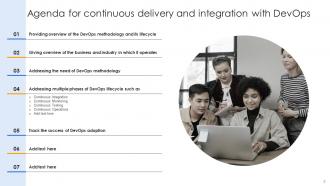
Slide 2: This slide showcase title AGENDA.
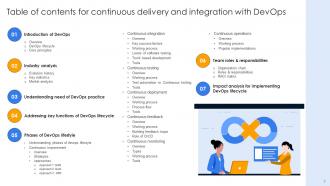
Slide 3: This slide exhibit table of content.
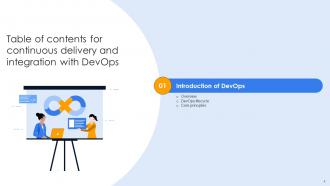
Slide 4: This slide exhibit table of content that is to be discuss further.
Slide 5: This slide provides glimpse about summary of DevOps that can help organization innovate faster by streamlining & automating the software development.
Slide 6: This slide provides glimpse about DevOps lifecycle that can help organization to increase speed, efficiency, output & minimize number of steps in software development.
Slide 7: This slide provides glimpse about four essential principles that guide efficiency and effectiveness of software development lifecycle (SDLC).
Slide 8: This slide exhibit table of content that is to be discuss further.
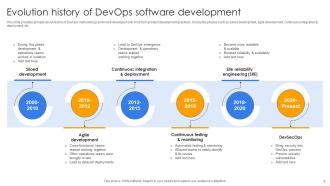
Slide 9: This slide provides glimpse about history of DevOps methodology and how it developed over time from product development practices.
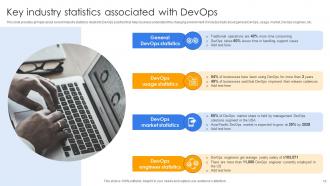
Slide 10: This slide provides glimpse about current industry statistics related to DevOps practice that help business understand the changing environment.
Slide 11: This slide provides glimpse about summary of DevOps for understanding its growing market and utilizing the opportunities.
Slide 12: This slide exhibit table of content that is to be discuss further.
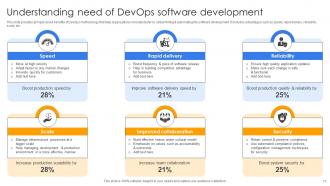
Slide 13: This slide provides glimpse about benefits of DevOps methodology that help organizations innovate faster by streamlining & automating the software development.
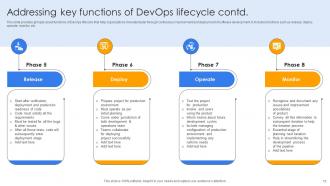
Slide 14: This slide provide glimpse about functions of DevOps lifecycle that help organizations innovate faster through continuous improvement and deployment of software.
Slide 15: This slide provides glimpse about functions of DevOps lifecycle that help organizations innovate faster through continuous improvement and deployment of software.
Slide 16: This slide exhibit table of content that is to be discuss further.
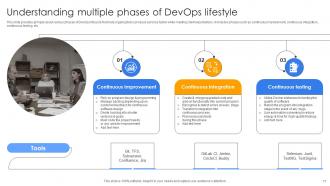
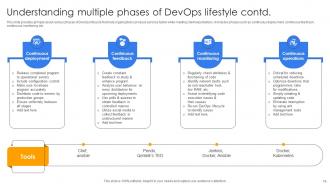
Slide 17: This slide provides glimpse about various phases of DevOps lifecycle that help organizations produce services faster while meeting client expectations.
Slide 18: This slide provides glimpse about various phases of DevOps lifecycle that help organizations produce services faster while meeting client expectations.
Slide 19: This slide exhibit table of content that is to be discuss further.
Slide 20: This slide provides glimpse about summary of continuous improvement and its criticality in defining the overall strategy of software development.
Slide 21: This slide provides glimpse about different strategies of continuous improvement that help building culture of continuous learning & experimentation.
Slide 22: This slide provides glimpse about three perspectives on iterative changes for maintaining continuous improvement culture.
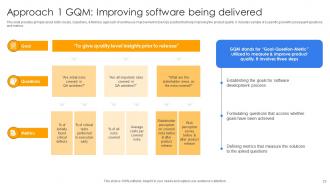
Slide 23: This slide provides glimpse about GQM (Goals, Questions, & Metrics) approach of continuous improvement in DevOps practice that help improving the product quality.
Slide 24: This slide provides glimpse about QAM (Quality to Activity Mapping) approach of continuous improvement in DevOps practice that help improving the process quality.
Slide 25: This slide provides glimpse about QPM approach of continuous improvement in DevOps practice that help improving the quality with people involved.
Slide 26: This slide exhibit table of content that is to be discuss further.
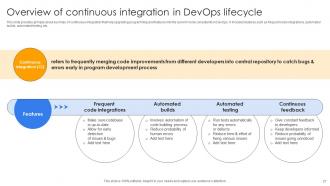
Slide 27: This slide provides glimpse about summary of continuous integration that help upgrading programming and features into the current mode consistently in DevOps.
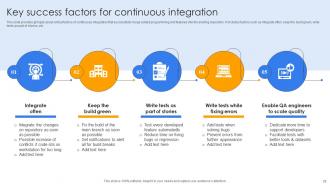
Slide 28: This slide provides glimpse about critical factors of continuous integration that successfully merge added programming and features into the existing repository.
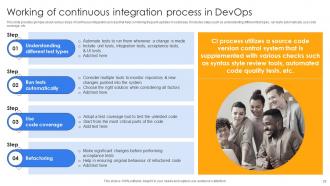
Slide 29: This slide provides glimpse about various steps of continuous integration process that help combining frequent updates in codebase.
Slide 30: This slide provides glimpse about essential part of the continuous integration process in DevOps methodology.
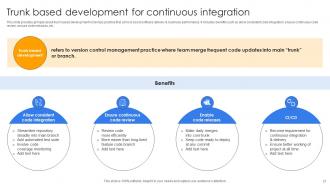
Slide 31: This slide provides glimpse about trunk based development in DevOps practice that aims to boost software delivery & business performance.
Slide 32: This slide provides glimpse about various tools of continuous integration process in DevOps methodology that help integrating new upgrades into repository.
Slide 33: This slide exhibit table of content that is to be discuss further.
Slide 34: This slide provides glimpse about summary of continuous testing that help checking the software for issues & faults in DevOps software development lifecycle.
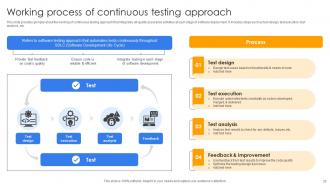
Slide 35: This slide provides glimpse about the working of continuous testing approach that integrates all quality assurance activities at each stage of software deployment.
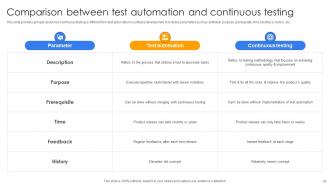
Slide 36: This slide provides glimpse about how continuous testing is different from test automation in software development.
Slide 37: This slide provides glimpse about various tools of continuous testing process in DevOps methodology that help checking software for any bugs or other issues.
Slide 38: This slide exhibit table of content that is to be discuss further.
Slide 39: This slide provides glimpse about summary of continuous deployment that help ensuring operational servers release code accurately & smoothly in DevOps lifecycle.
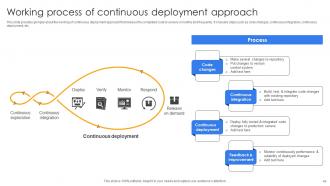
Slide 40: This slide provides glimpse about the working of continuous deployment approach that release the completed code to servers smoothly and frequently.
Slide 41: This slide provides glimpse about the flowchart of continuous deployment approach that ensure distributing code smoothly to computers & plan servers upgrades.
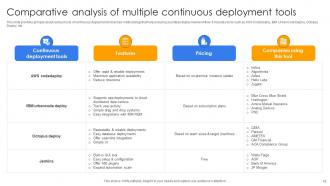
Slide 42: This slide provides glimpse about various tools of continuous deployment in DevOps methodology that help ensuring seamless deployment workflow.
Slide 43: This slide exhibit table of content that is to be discuss further.
Slide 44: This slide provides glimpse about summary of continuous feedback that help creating consistent user inputs to enhance the software code.
Slide 45: This slide provides glimpse the working of continuous feedback approach that help collecting and analyzing consistent valuable intelligence for any flaw or fault.
Slide 46: This slide provides glimpse about feedback loops in DevOps Software development lifecycle (SDLC) for boosting efficiency.
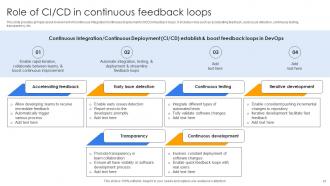
Slide 47: This slide provides glimpse about involvement of Continuous Integration/Continuous Deployment (CI/CD) in feedback loops.
Slide 48: This slide exhibit table of content that is to be discuss further.
Slide 49: This slide provides glimpse about summary of continuous monitoring that help frequently check the functionalities & attributes of software code.
Slide 50: This slide provides glimpse about various types of continuous monitoring approach in DevOps software development lifecycle (SDLC) that help identifying network faults.
Slide 51: This slide provides glimpse about the working of continuous monitoring that assist team in identifying app execution problems & their causes.
Slide 52: This slide provides glimpse about various tools of continuous monitoring in DevOps methodology that help find & correct network safety vulnerabilities.
Slide 53: This slide exhibit table of content that is to be discuss further.
Slide 54: This slide provides glimpse about summary of continuous operations and its criticality in decreasing scheduled downtime.
Slide 55: This slide provides glimpse about the working of continuous operations that help simplifying the procedure of initiating & upgrading the software.
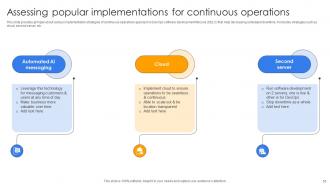
Slide 56: This slide provides glimpse about various implementation strategies of continuous operations approach in DevOps software development lifecycle.
Slide 57: This slide exhibit table of content that is to be discuss further.
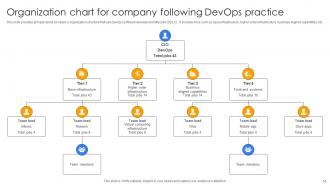
Slide 58: This slide provides glimpse about company’s organization structure that use DevOps software development lifecycle (SDLC).
Slide 59: This slide provides glimpse about tasks of different DevOps team members.
Slide 60: This slide provides glimpse about RACI matrix for different DevOps team members that help defining their essential roles.
Slide 61: This slide exhibit table of content that is to be discuss further.
Slide 62: This slide provides glimpse about tracking the impact of implementing DevOps software development lifecycle (SDLC).
Slide 63: This slide exhibit table of content that is to be discuss further.
Slide 64: This slide exhibit table of content that is to be discuss further.
Slide 65: This slide showcase Continuous software access monitoring in DevOps.
Slide 66: This slide showcase DevOps pipeline with continuous monitoring and deployment.
Slide 67: This slide showcase Adoption strategy of DevOps software development lifecycle
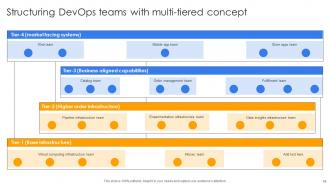
Slide 68: This slide showcase Structuring DevOps teams with multi-tiered concept.
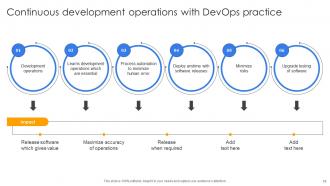
Slide 69: This slide showcase Continuous development operations with DevOps practice.
Slide 70: This slide showcaseHigh velocity and continuous deployment with DevOps.
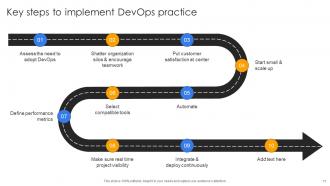
Slide 71: This slide showcase Key steps to implement DevOps practice.
Slide 72: This slide showcase Components of DevOps continuous feedback process.
Slide 73: This slide showcase Holistic DevOps framework for overall development.
Slide 74: This slide showcase Multi-cloud service management on DevOps.
Slide 75: This slide showcase Key steps for DevOps services framework.
Slide 76: This is thank you slide & contains contact details of company like office address, phone no., etc.
Continuous Delivery And Integration With Devops Powerpoint Presentation Slides with all 84 slides:
Use our Continuous Delivery And Integration With Devops Powerpoint Presentation Slides to effectively help you save your valuable time. They are readymade to fit into any presentation structure.









































FAQs for Continuous Delivery And Integration With Devops
Continuous Delivery in DevOps environments revolves around automated testing, frequent integration, deployment pipeline automation, configuration management, and monitoring feedback loops. These principles streamline software releases by minimizing manual interventions, reducing deployment risks, and enabling faster time-to-market, with many organizations finding that this approach delivers improved quality, enhanced collaboration, and significant competitive advantage.
Continuous Delivery ensures code changes are always deployment-ready through automated testing and integration, while Continuous Deployment automatically releases every change that passes tests to production. While Continuous Delivery requires manual approval for production releases, Continuous Deployment eliminates human intervention entirely, with many organizations finding that the strategic combination of both approaches ultimately delivers faster innovation cycles and enhanced operational efficiency.
Automation serves as the backbone of Continuous Delivery by streamlining code integration, testing, deployment, and monitoring processes throughout the development pipeline. It eliminates manual bottlenecks, reduces human error, and enables rapid, reliable software releases, with many organizations finding that automated workflows deliver faster time-to-market and improved operational efficiency.
Common challenges include complex legacy system integration, insufficient automated testing coverage, cultural resistance to frequent deployments, inadequate infrastructure scalability, and skill gaps in DevOps practices. Organizations often struggle with coordinating cross-functional teams and maintaining quality standards, though many find that gradual implementation with strong leadership support ultimately delivers faster releases and improved operational efficiency.
Continuous Delivery enhances collaboration between development and operations teams by establishing shared responsibilities, automated deployment pipelines, and unified monitoring systems that break down traditional silos. Through integrated workflows and collaborative tools, teams work together on code integration, testing, and release processes, ultimately delivering faster deployments, reduced conflicts, and improved system reliability across organizations.
Teams should track deployment frequency, lead time for changes, mean time to recovery, and change failure rate as core metrics for Continuous Delivery effectiveness. Additionally, monitoring customer satisfaction scores, system performance indicators, and business value delivery helps organizations understand how streamlined deployment processes translate into improved user experiences and competitive advantage.
Microservices architecture and Continuous Delivery complement each other by enabling independent service deployments, reducing deployment risks through smaller code changes, and allowing teams to release features faster without affecting entire systems. This strategic combination streamlines development workflows, enhances operational efficiency, and delivers greater scalability, with many organizations finding that microservices significantly accelerate their delivery pipelines.
Essential Continuous Delivery automation tools include Jenkins, GitLab CI/CD, Azure DevOps, Docker, Kubernetes, Terraform, and monitoring platforms like Prometheus. These technologies streamline deployment processes by automating testing, orchestrating containers, managing infrastructure as code, and providing real-time visibility, with many organizations finding that strategic tool combinations reduce deployment times while enhancing reliability and operational efficiency.
Continuous Delivery improves software quality through automated testing, frequent code integration, and rapid bug detection, while enhancing customer satisfaction by delivering features faster and more reliably. Through streamlined deployment pipelines, organizations like Netflix and Amazon achieve reduced time-to-market, fewer production issues, and consistent user experiences, ultimately delivering competitive advantage in increasingly demanding digital markets.
Successful Continuous Delivery requires automated testing throughout pipelines, version control for all code and configurations, small frequent deployments, and comprehensive monitoring systems. These practices streamline software releases by reducing manual errors, accelerating feedback cycles, and maintaining system stability, with many organizations finding that strategic automation ultimately delivers faster time-to-market and enhanced competitive advantage.
Continuous Delivery supports agile methodologies by enabling frequent, automated deployments, rapid feedback loops, and iterative development cycles that align with sprint-based workflows. This approach streamlines code integration, reduces deployment risks, and accelerates time-to-market, with many development teams finding that automated pipelines ultimately deliver faster feature releases and enhanced collaboration between development and operations.
Continuous Delivery pipeline security considerations include automated security testing, vulnerability scanning, secure code reviews, access controls, secrets management, and compliance validation at each deployment stage. These security measures streamline risk mitigation by integrating threat detection, enforcing authentication protocols, and maintaining audit trails, with many organizations finding that automated security gates ultimately deliver faster, more secure releases while reducing manual oversight requirements.
Organizations manage feature toggles effectively through strategic categorization, automated lifecycle management, and comprehensive monitoring systems. These practices enable controlled feature rollouts, A/B testing capabilities, and rapid rollbacks when needed, with many software teams finding that proper toggle governance reduces deployment risks while accelerating delivery cycles and maintaining system stability.
Continuous Delivery significantly increases release frequency while enhancing deployment stability through automated testing, staged deployments, and rollback capabilities. By enabling smaller, incremental changes with comprehensive quality gates, organizations like Netflix and Amazon deploy thousands of times daily with minimal downtime, ultimately delivering faster feature releases and improved system reliability.
Continuous Delivery facilitates faster recovery through automated rollback mechanisms, feature flags for instant deactivation, smaller deployment batches that isolate issues, and comprehensive monitoring systems that detect problems quickly. These practices enable organizations to minimize downtime by reverting to stable versions within minutes rather than hours, with many financial services and e-commerce companies finding significantly reduced mean time to recovery.
-
Fantastic collection. Loved how we can personalize these templates as per the requirements.
-
Editable, diversified, compatible with MS PPT and Google Slides, and on top of that finest graphics!! I mean in the words of the famous Ross Geller, “What more do you want!”