


Continuous Integration And Continuous Deployment Powerpoint Ppt Template Bundles





Try Before you Buy Download Free Sample Product
 Impress Your
Audience
 100%
Editable
 Save Hours
of Time


This Continuous Integration and Continuous Deployment presentation contains CI or CD pipeline, stages of CI or CD pipeline and best practices. This mini deck also includes security dashboard and roadmap for continuous integration and continuous deployment. This presentation include tools for CI or CD, performance metrics and test mapping in CI or CD lifecycle. It also highlights the business benefits and components of CI or CD strategy. This deck also contains audit report for continuous integration and continuous deployment. It also describes the parameters for choosing tools for CI or CD automation, challenges and mitigation strategies for CI or CD and methods to optimize CI or Cd strategy. This mini deck on continuous integration and continuous deployment is a complete comprehensive deck which covers all aspects of CI or CD including pipeline, strategy and testing.
People who downloaded this PowerPoint presentation also viewed the following :
Content of this Powerpoint Presentation
Slide 1: This slide introduces Continuous Integration and Continuous Deployment. State your company name and begin.
Slide 2: This slide describes the continuous integration and continuous deployment pipeline structure which include commit change, trigger build, build, etc.
Slide 3: This slide depicts the continuous integration and continuous delivery observability monitoring dashboard which include repositories, recent builds and status.
Slide 4: This slide highlights the best practices for continuous integration and continuous deployment which include test identification and categorization, automate tests, etc.
Slide 5: This slide depicts the roadmap for continuous integration and continuous deployment which include determine project management strategy, etc.
Slide 6: This slide lists out the four main stages of continuous integration and continuous deployment pipeline which include source stage, build stage, test stage and deploy stage.
Slide 7: This slide represents the tools used for the integration of continuous integration and continuous deployment and lists out its features.
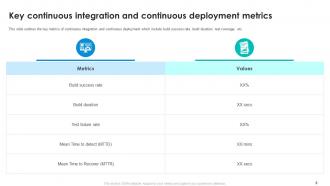
Slide 8: This slide outlines the key metrics of continuous integration and continuous deployment which include build success rate, build duration, test coverage, etc.
Slide 9: This slide describes the segments of enterprise continuous integration and continuous deployment which include platform, infrastructure, database scripts, etc.
Slide 10: This slide demonstrates the different testing types mapped at different levels of continuous integration and continuous deployment lifecycle.
Slide 11: This slide describes the business benefits of continuous improvement and continuous delivery which include faster deployment, improve development visibility, etc.
Slide 12: This slide demonstrates the components of continuous integration and continuous deployment strategy which include version control, automated build, etc.
Slide 13: This slide demonstrates the principles for successful CI CD production deployment which include design system which supports iterative releases,
Slide 14: This slide describes the challenges and mitigation strategies for problems faced in continuous integration and continuous deployment strategy.
Slide 15: This slide highlights the key elements of continuous integration and continuous deployment process which include static code analysis, automated testing, code submission and validation.
Slide 16: This slide represents the methods to optimize continuous integration and continuous deployment strategy which includes automate build and deployment for reliability.
Slide 17: This slide shows Icon for DevOps continuous integration and continuous deployment.
Slide 18: This slide presents Continuous integration and continuous deployment pipeline icon.
Slide 19: This slide displays Continuous integration and continuous deployment icon.
Slide 20: This slide contains all the icons used in this presentation.
Slide 21: This slide is titled as Additional Slides for moving forward.
Slide 22: This slide contains Puzzle with related icons and text.
Slide 23: This is a Financial slide. Show your finance related stuff here.
Slide 24: This slide depicts Venn diagram with text boxes.
Slide 25: This slide shows Lego with related icons and text.
Slide 26: This is a Thank You slide with address, contact numbers and email address.
Continuous Integration And Continuous Deployment Powerpoint Ppt Template Bundles with all 34 slides:
Use our Continuous Integration And Continuous Deployment Powerpoint Ppt Template Bundles to effectively help you save your valuable time. They are readymade to fit into any presentation structure.












FAQs for Continuous Integration And Continuous Deployment Powerpoint
CI/CD delivers accelerated deployment cycles, enhanced code quality through automated testing, reduced integration conflicts, and improved collaboration between development teams. These practices streamline software delivery by enabling faster bug detection, minimizing manual errors, and ensuring consistent releases, with many organizations finding that automated pipelines ultimately reduce time-to-market while enhancing operational efficiency.
CI/CD pipelines enhance collaboration by creating shared visibility into code changes, automated testing results, and deployment statuses across development and operations teams. Through integrated workflows, teams can coordinate releases more effectively, identify issues faster, and maintain consistent communication channels, with many organizations finding that automated pipelines reduce handoff friction and enable seamless cross-functional cooperation.
Common CI/CD tools include Jenkins, GitLab CI/CD, GitHub Actions, Azure DevOps, and CircleCI, each offering distinct capabilities for automation and deployment management. Jenkins provides extensive plugin flexibility, GitLab delivers integrated source control, GitHub Actions excels in workflow automation, while Azure DevOps and CircleCI streamline cloud-native deployments, with many organizations finding that strategic tool selection significantly enhances development velocity and operational efficiency.
Organizations measure CI/CD success through deployment frequency, lead time for changes, mean time to recovery, and change failure rate, alongside metrics like build success rates and automated test coverage. These measurements enable teams to track operational efficiency, identify bottlenecks, and optimize release cycles, with many enterprises finding that consistent monitoring ultimately delivers faster feature delivery and improved system reliability.
Automated testing serves as the quality gatekeeper in CI/CD pipelines, validating code functionality, performance, and security at every stage through unit tests, integration tests, and end-to-end testing. These comprehensive testing layers enable organizations to catch defects early, reduce deployment risks, and maintain consistent software quality, with many development teams finding that automated testing accelerates release cycles while ensuring reliability.
Version control systems serve as the foundation of CI/CD workflows by automatically triggering builds when developers commit code changes, maintaining branching strategies for different environments, and tracking deployment histories across development stages. Through integration with platforms like Jenkins or GitLab CI, organizations streamline code merges, automate testing sequences, and enable rapid rollbacks, ultimately delivering faster release cycles and enhanced collaboration while minimizing deployment risks.
Common CI/CD adoption challenges include legacy system integration, cultural resistance to frequent deployments, inadequate testing automation, complex dependency management, and insufficient monitoring capabilities. These obstacles often require strategic combination of technical upgrades and organizational change management, with many enterprises finding that gradual implementation across development teams ultimately delivers smoother transitions and sustainable competitive advantage.
CI/CD practices accelerate time-to-market by automating testing, integration, and deployment processes, eliminating manual bottlenecks and reducing release cycles from weeks to hours. Through automated pipelines, organizations streamline code validation, minimize human error, and enable rapid feature delivery, with many software companies finding that continuous deployment ultimately delivers competitive advantage and faster customer value realization.
CI/CD practices improve code quality through automated testing, code reviews, static analysis, integration checks, and deployment validations that catch issues early in development cycles. These systematic approaches streamline quality assurance by identifying bugs before production, enabling faster rollbacks, and maintaining consistent coding standards, with many development teams finding that automated pipelines ultimately deliver more reliable software and reduced debugging time.
Implementing CI/CD in legacy systems requires gradual modernization through containerization, API integration, automated testing frameworks, and phased migration strategies that preserve existing functionality. Organizations like banks and manufacturing companies successfully modernize by creating wrapper services, implementing database versioning, and establishing staging environments, ultimately delivering faster deployments and reduced maintenance costs while minimizing operational disruption.
CI/CD security considerations include secure code scanning, vulnerability assessments, access controls, secrets management, and container security. These practices streamline deployment while minimizing risks through automated testing, encrypted credential storage, and role-based permissions, with many organizations finding that integrated security ultimately delivers faster, more reliable releases and enhanced operational confidence.
Containerization and microservices architecture revolutionize CI/CD strategies by enabling independent deployment pipelines, automated scaling, and isolated testing environments for each service component. These technologies streamline development workflows through faster build times, parallel processing capabilities, and simplified rollback procedures, with many organizations finding that containerized microservices ultimately deliver enhanced deployment frequency and significantly reduced system downtime.
Rollback strategies in Continuous Deployment are crucial for maintaining system stability, minimizing downtime, and reducing business risk when deployments fail. They enable organizations to quickly revert to previous stable versions, preserve customer experiences, and maintain operational continuity, with many companies finding that robust rollback capabilities ultimately deliver faster recovery times and greater confidence in frequent deployment cycles.
Organizations ensure regulatory compliance in CI/CD through automated compliance checks, policy-as-code implementations, audit trail generation, and integrated security scanning at every pipeline stage. Financial services and healthcare institutions particularly benefit from these automated governance frameworks, which streamline compliance verification, reduce manual oversight requirements, and maintain continuous regulatory alignment while accelerating deployment cycles.
Future CI/CD trends include AI-driven pipeline optimization, GitOps for infrastructure management, serverless deployment architectures, enhanced security integration, and progressive delivery techniques like canary releases. These advancements streamline development cycles, reduce manual oversight, and enable faster feature rollouts, with many organizations finding that adopting these practices delivers significantly improved deployment reliability and competitive responsiveness.
-
This visual representation is stunning and easy to understand. I like how organized it is and informative it is.
-
Excellent products for quick understanding.