

Corporate balanced scorecard diagram powerpoint templates




Try Before you Buy Download Free Sample Product
 Impress Your
 Audience
 100%
100% Editable
 Save Hours
 of Time


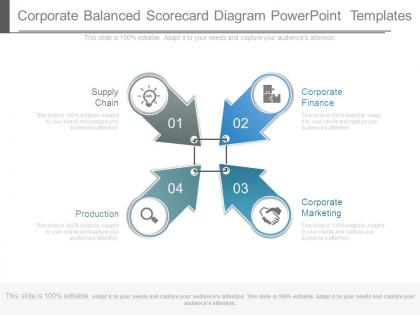
Gauge the atmosphere with our Corporate Balanced Scorecard Diagram Powerpoint Templates. Get a feel of the audience attitude.
People who downloaded this PowerPoint presentation also viewed the following :
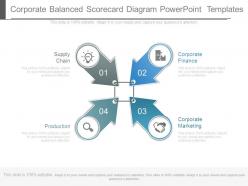
Corporate balanced scorecard diagram powerpoint templates with all 7 slides:
Your eminence gets firmly established with our Corporate Balanced Scorecard Diagram Powerpoint Templates. They help acquire authority.

FAQs for Corporate balanced scorecard
The key components of a corporate balanced scorecard include financial perspective, customer perspective, internal business processes, and learning and growth perspective. These four perspectives work together by measuring financial outcomes, customer satisfaction metrics, operational efficiency indicators, and employee development capabilities, ultimately delivering comprehensive performance visibility and strategic alignment across organizations seeking balanced growth measurement.
Organizations effectively align strategic objectives with balanced scorecard frameworks by translating high-level goals into specific, measurable targets across financial, customer, internal process, and learning perspectives, ensuring each objective connects directly to strategic priorities. Through cascading scorecards from corporate to departmental levels, companies like manufacturing firms and healthcare systems create accountability structures that drive strategic execution, ultimately delivering improved performance visibility and enhanced organizational focus.
The balanced scorecard improves organizational communication by establishing shared performance language, aligning departmental objectives with strategic goals, and creating transparent reporting mechanisms across all levels. Through quarterly reviews and standardized metrics, teams in manufacturing, healthcare, and financial services find clearer accountability structures, enhanced cross-functional collaboration, and ultimately stronger strategic execution throughout their organizations.
Companies measure non-financial performance indicators through the balanced scorecard's customer, internal process, and learning perspectives, tracking metrics like customer satisfaction scores, employee retention rates, innovation indices, and process efficiency measures. These indicators enable organizations to assess strategic progress beyond financial outcomes, with many finding that balanced measurement systems ultimately drive sustainable competitive advantage and long-term value creation.
Technology streamlines balanced scorecard implementation by automating data collection, enabling real-time performance tracking, and providing advanced analytics dashboards for comprehensive insights. These digital platforms enhance strategic alignment through integrated reporting systems, predictive modeling capabilities, and seamless stakeholder communication, with many organizations finding that automated scorecards deliver faster decision-making and improved operational efficiency.
Organizations ensure continuous improvement through the balanced scorecard by establishing regular performance reviews, setting dynamic targets that evolve with business needs, and creating feedback loops across all four perspectives. This systematic approach enables companies to identify performance gaps, adjust strategies based on real-time data, and maintain competitive advantage through ongoing optimization and strategic alignment.
Companies face challenges including resistance to change from employees, difficulty identifying relevant KPIs across financial, customer, internal process, and learning perspectives, resource constraints for implementation, and integrating data from disparate systems. While these obstacles can initially slow adoption, organizations in manufacturing, healthcare, and financial services find that addressing cultural alignment, establishing clear metrics, and ensuring executive sponsorship ultimately delivers enhanced strategic focus and improved performance measurement capabilities.
The balanced scorecard facilitates strategic planning by translating vision into measurable objectives across financial, customer, internal process, and learning perspectives, creating comprehensive organizational alignment. Through systematic performance tracking and strategic mapping, organizations streamline decision-making, enhance accountability, and accelerate goal achievement, with many companies finding that this integrated approach ultimately delivers improved operational efficiency and sustainable competitive advantage.
Best practices for setting balanced scorecard KPIs include aligning metrics with strategic objectives, ensuring measurability and specificity, balancing leading and lagging indicators, and maintaining clear ownership across departments. These practices enable organizations to track performance comprehensively, with companies in manufacturing and financial services finding that well-defined KPIs streamline decision-making, enhance accountability, and ultimately deliver measurable competitive advantage.
The balanced scorecard integrates seamlessly with frameworks like Six Sigma, Lean Management, OKRs, and Total Quality Management by aligning strategic objectives across financial, customer, internal process, and learning perspectives. Organizations in manufacturing, healthcare, and financial services combine these approaches to create comprehensive performance systems, with many finding that this strategic integration enhances operational efficiency while delivering measurable competitive advantage.
A balanced scorecard transforms organizational culture by aligning employee behaviors with strategic objectives, promoting cross-functional collaboration, and establishing performance transparency across all levels. This comprehensive framework enables companies to shift from short-term thinking to long-term strategic focus, with many organizations finding that employees become more engaged and accountable when they understand how their work contributes to overall success.
Feedback from balanced scorecards drives employee engagement by creating transparency around performance expectations, connecting individual contributions to organizational goals, and providing regular recognition opportunities. When employees understand how their work impacts financial, customer, internal process, and learning metrics, they feel more purposeful and invested, with many organizations finding that scorecard-driven feedback systems significantly enhance motivation and retention.
Corporate balanced scorecards offer comprehensive performance visibility beyond financial metrics, incorporating customer satisfaction, internal processes, and learning growth perspectives. Unlike traditional measures focusing solely on financial outcomes, balanced scorecards enable organizations to align strategic objectives with operational activities, identify leading performance indicators, and drive long-term sustainable growth while maintaining short-term financial accountability.
Businesses customize balanced scorecards by adapting metrics to industry-specific challenges, regulatory requirements, operational priorities, and competitive dynamics while maintaining the four core perspectives. Manufacturing companies might emphasize safety and quality metrics, while financial services focus on risk management and compliance measures, with many organizations finding that industry-tailored scorecards deliver more relevant insights and strategic alignment.
Notable case studies include Mobil Oil's dramatic turnaround achieving industry-leading profitability, Hilton Hotels' enhanced guest satisfaction and revenue growth, and UPS's operational efficiency improvements across global logistics networks. These implementations demonstrate how balanced scorecards enable organizations to align strategic objectives with measurable outcomes, streamline performance monitoring, and enhance decision-making processes, ultimately delivering sustained competitive advantage.
-
Much better than the original! Thanks for the quick turnaround.
-
Great product with highly impressive and engaging designs.