

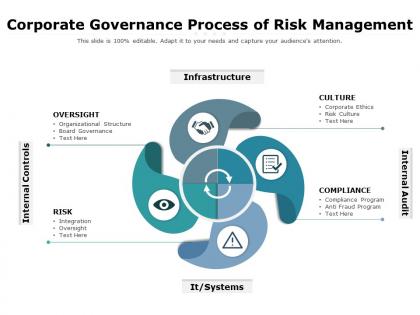
Corporate governance process of risk management




Try Before you Buy Download Free Sample Product
 Impress Your
 Audience
 100%
100% Editable
 Save Hours
 of Time


Handle criticism with our Corporate Governance Process Of Risk Management. Demonstrate ability to absorb adverse comments.
People who downloaded this PowerPoint presentation also viewed the following :
Corporate governance process of risk management with all 2 slides:
Handle difficulties with our Corporate Governance Process Of Risk Management. They are bound to help find answers.

FAQs for Corporate governance process
Key components of an effective risk management governance framework include risk appetite statements, governance structures, risk policies and procedures, monitoring systems, and accountability mechanisms. These elements work together by establishing clear oversight responsibilities, defining risk tolerance levels, and implementing systematic identification processes, ultimately delivering enhanced decision-making capabilities and regulatory compliance across organizations.
Organizational culture significantly influences risk management governance by shaping employee attitudes toward risk-taking, transparency in reporting potential issues, and adherence to established protocols and procedures. Companies with strong risk-aware cultures, particularly in financial services and healthcare sectors, demonstrate enhanced compliance rates, faster incident response times, and more proactive threat identification, ultimately delivering better regulatory outcomes and competitive advantage.
Technology enhances risk management governance through automated monitoring systems, real-time analytics, predictive modeling, integrated reporting platforms, and compliance tracking tools. These solutions streamline risk identification and assessment processes, enable faster decision-making, and provide comprehensive visibility across operations, with many financial institutions and healthcare organizations finding that automated governance frameworks significantly reduce operational risks while improving regulatory compliance.
Organizations align risk management governance with strategic objectives by integrating risk assessment into strategic planning processes, establishing clear risk appetite statements that reflect business goals, and creating governance structures where risk committees directly inform executive decision-making. This strategic combination enables companies to pursue growth opportunities while maintaining operational resilience, with many financial services and manufacturing firms finding that aligned governance frameworks ultimately deliver competitive advantage and enhanced stakeholder confidence.
Common challenges in implementing risk management governance include inadequate leadership commitment, insufficient resources and expertise, poor communication across departments, resistance to cultural change, and lack of integration with existing business processes. These obstacles often result in fragmented risk oversight, inconsistent policy enforcement, and delayed decision-making, with many organizations finding that successful implementation requires sustained executive sponsorship, comprehensive staff training, and strategic alignment between risk frameworks and operational objectives.
Stakeholder engagement improves risk management governance by enhancing transparency, broadening risk identification perspectives, and ensuring diverse input across organizational levels. Through regular communication channels and collaborative frameworks, organizations streamline decision-making processes, accelerate risk response times, and build comprehensive oversight structures, with many financial services and healthcare institutions finding that inclusive governance ultimately delivers stronger compliance outcomes and operational resilience.
Key metrics for evaluating risk management governance effectiveness include risk assessment accuracy, incident response times, compliance rates, risk mitigation cost-effectiveness, and governance framework adherence levels. These measurements enable organizations to track operational efficiency, regulatory compliance, and strategic risk alignment, with many financial institutions and healthcare systems finding that comprehensive metric tracking ultimately delivers enhanced decision-making capabilities and competitive advantage.
The board of directors contributes to risk management governance by establishing risk appetite frameworks, overseeing strategic risk policies, and ensuring adequate risk oversight structures. Through regular risk assessments and compliance monitoring, boards enable organizations to identify emerging threats, maintain regulatory alignment, and protect stakeholder interests, while ultimately delivering enhanced organizational resilience and sustainable competitive advantage.
Risk appetite defines an organization's willingness to accept risk while pursuing objectives, serving as a critical foundation for governance frameworks by establishing clear boundaries, guiding strategic decisions, and ensuring consistent risk-taking across all levels. Through well-defined risk appetite statements, organizations streamline resource allocation, enhance board oversight, and ultimately deliver strategic alignment while maintaining operational resilience in an increasingly complex business environment.
Organizations ensure compliance with regulatory requirements through comprehensive risk frameworks, regular audits, clear accountability structures, automated monitoring systems, and continuous staff training. Financial services institutions and healthcare organizations particularly benefit from integrated governance platforms that streamline reporting, enhance transparency, and maintain real-time compliance tracking, ultimately delivering reduced regulatory penalties and stronger operational resilience.
Organizations can foster transparency in risk management governance by establishing clear reporting structures, regular stakeholder communications, comprehensive risk dashboards, open audit processes, and standardized documentation protocols. These practices enable companies across sectors like banking, healthcare, and manufacturing to enhance accountability, streamline decision-making, and build stakeholder trust, ultimately delivering improved regulatory compliance and competitive advantage.
ISO 31000 provides a comprehensive framework for risk management governance through systematic risk identification, assessment, treatment, and monitoring processes, along with clear accountability structures and communication protocols. Organizations across sectors like banking, healthcare, and manufacturing leverage these standardized principles to enhance decision-making, ensure regulatory compliance, and create competitive advantage through consistent, strategic risk oversight.
Risk management governance evolves by implementing adaptive frameworks, enhancing real-time monitoring systems, integrating predictive analytics, strengthening stakeholder communication, and regularly updating risk appetite statements. Through dynamic assessment tools and cross-functional collaboration, organizations can anticipate market shifts, adjust regulatory compliance measures, and maintain operational resilience, ultimately delivering competitive advantage in increasingly volatile business environments.
Cross-functional collaboration enhances risk management governance by breaking down silos, enabling comprehensive risk visibility, and facilitating coordinated response strategies across departments. This integrated approach allows organizations to identify interconnected risks more effectively, streamline decision-making processes, and implement unified mitigation strategies, with many financial institutions and healthcare organizations finding that collaborative frameworks significantly improve regulatory compliance and operational resilience.
Risk management committees oversee strategic risk assessment, policy development, regulatory compliance, executive oversight, and stakeholder communication within organizational governance frameworks. These committees enable boards to streamline decision-making processes, enhance transparency across operations, and ensure comprehensive risk mitigation strategies, with many financial institutions and healthcare organizations finding that dedicated committees ultimately deliver stronger regulatory adherence and competitive advantage.
No Reviews