


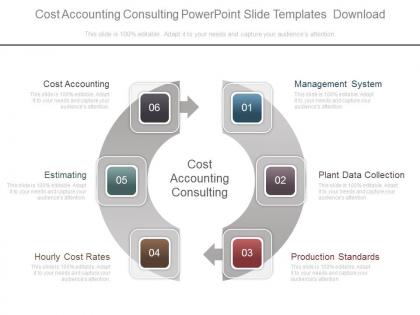
Cost accounting consulting powerpoint slide templates download




Try Before you Buy Download Free Sample Product
 Impress Your
 Audience
 100%
100% Editable
 Save Hours
 of Time


Our Cost Accounting Consulting Powerpoint Slide Templates Download are excellent game changers. Events will begin to flow in your favour.
People who downloaded this PowerPoint presentation also viewed the following :
Cost accounting consulting powerpoint slide templates download with all 7 slides:
Test our Cost Accounting Consulting Powerpoint Slide Templates Download team with the most stringent of specifications. They will match your every requirement.
FAQs for Cost accounting consulting powerpoint
Key cost accounting principles include cost classification, cost allocation, cost behavior analysis, relevant cost identification, and variance analysis. These principles enable businesses to accurately track production expenses, allocate overhead costs strategically, and identify profit drivers across departments, with many manufacturing and service organizations finding that proper cost accounting delivers enhanced pricing decisions and improved operational efficiency.
Cost accounting consulting enhances budgeting processes by implementing activity-based costing methods, establishing accurate cost allocation systems, and creating data-driven forecasting models. Through detailed cost analysis, consultants help organizations identify spending patterns, eliminate budget variances, and develop realistic financial projections, ultimately delivering improved budget accuracy and strategic resource allocation for sustainable growth.
The most common cost allocation methods include activity-based costing (ABC), direct allocation, step-down allocation, reciprocal allocation, and traditional overhead allocation methods. These approaches enable organizations to accurately distribute indirect costs across departments, products, and services, with many manufacturing firms and service companies finding that strategic cost allocation enhances pricing decisions, improves profitability analysis, and delivers clearer operational insights for competitive advantage.
Technology enhances cost accounting effectiveness through automated data collection, real-time analytics, cloud-based integration, predictive modeling, and advanced reporting tools. These solutions streamline processes by eliminating manual calculations, reducing errors, and providing instant visibility into cost structures, with many manufacturing and retail organizations finding significantly improved accuracy and faster decision-making capabilities.
Industries approach cost accounting through sector-specific methodologies, with manufacturing emphasizing activity-based costing, healthcare focusing on patient-based cost allocation, retail prioritizing inventory management systems, and financial services concentrating on regulatory compliance frameworks. Cross-sector best practices include implementing automated data collection, standardizing cost classification methods, and integrating real-time analytics, with many organizations finding that combining industry-specific techniques with universal automation delivers enhanced accuracy and competitive advantage.
Cost accounting provides critical financial data that enables management to make informed strategic decisions through detailed cost analysis, profitability assessments, budget forecasting, and resource allocation insights. By delivering precise cost-per-unit calculations and operational efficiency metrics, it helps organizations identify profitable product lines, optimize pricing strategies, and streamline operations, ultimately enhancing competitive positioning and long-term financial performance.
Businesses leverage cost accounting to identify inefficiencies by analyzing activity-based costing, tracking resource allocation patterns, and monitoring variance reports against budgets. Through detailed cost analysis, organizations streamline operations by eliminating redundant processes, optimizing labor deployment, and reducing material waste, with many manufacturing and service companies finding that systematic cost tracking delivers 15-20% operational savings.
Variable costs fluctuate with production volume, including raw materials, direct labor, and sales commissions, while fixed costs remain constant regardless of output, such as rent, insurance, and executive salaries. Understanding this distinction enables organizations to calculate break-even points, optimize pricing strategies, and make informed decisions about capacity utilization, with many companies finding that proper cost classification ultimately delivers enhanced profitability analysis and strategic resource allocation.
Cost accounting integrates with other financial management systems through automated data synchronization, unified reporting dashboards, and real-time analytics platforms that connect budgeting, forecasting, and performance management modules. This strategic combination enables organizations to streamline financial workflows, enhance decision-making accuracy, and deliver comprehensive insights across departments, with many companies finding that integrated systems significantly reduce reporting time while improving cost visibility and operational efficiency.
Common cost accounting pitfalls include inaccurate overhead allocation, neglecting activity-based costing, failing to update standard costs regularly, and poor data collection systems. These issues lead to mispriced products, flawed decision-making, and reduced profitability, with many manufacturing and service organizations finding that strategic cost accounting consulting helps streamline processes and enhance competitive advantage.
A cost accounting consultant helps implement lean manufacturing by identifying waste sources, establishing value stream costing models, and developing metrics to track efficiency improvements. Through activity-based costing and real-time cost tracking systems, consultants enable manufacturers to monitor material flows, reduce inventory carrying costs, and optimize production scheduling, ultimately delivering streamlined operations and significant cost reductions across manufacturing processes.
Businesses should focus on cost per unit, gross margin percentages, overhead allocation ratios, direct versus indirect cost breakdowns, and variance analysis metrics when analyzing cost accounting data. These metrics enable organizations to identify inefficiencies, optimize pricing strategies, and improve resource allocation, with many companies finding that regular monitoring ultimately delivers enhanced profitability and competitive positioning.
Cost accounting aids pricing strategies by providing detailed product costs, profit margins, break-even analysis, and activity-based costing data that ensures competitive yet profitable pricing. Through comprehensive cost analysis, businesses can identify pricing opportunities, benchmark against competitors, and optimize product mix decisions, while maintaining market position and profitability, ultimately delivering strategic pricing advantage in competitive markets.
Cost accounting practices should prioritize transparency in cost allocation methods, accuracy in financial reporting, confidentiality of client data, and avoiding conflicts of interest when recommending cost management strategies. These ethical foundations enable organizations to maintain stakeholder trust, ensure regulatory compliance, and support fair pricing decisions, with many companies finding that transparent cost accounting ultimately delivers competitive advantage and stronger investor confidence.
Small businesses benefit from professional cost accounting consulting through improved cost tracking, strategic pricing decisions, expense optimization, and enhanced profitability analysis. These services enable startups and growing companies to identify hidden costs, streamline operations, and make data-driven financial decisions, with many entrepreneurs finding that professional guidance ultimately delivers better cash flow management and competitive positioning in their markets.
-
Design layout is very impressive.
-
Presentation Design is very nice, good work with the content as well.