

Crm sales management powerpoint slide designs





Try Before you Buy Download Free Sample Product
 Impress Your
 Audience
 100%
100% Editable
 Save Hours
 of Time


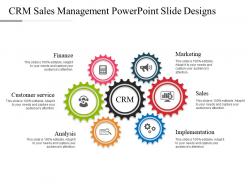
Boost your product sales by using CRM sales management PowerPoint slide designs. Make your audience aware of the advantages of customer relationship management strategies. Know what your customer needs and provide them with the products and services matching their requirement. Improve the way customer feels while dealing with your company. Target the audience of the potential customers to increase sales. Accelerate your company’s revenue and profitability. With an efficient Customer relationship management tool, keep track of all the analytical data. You can safeguard your data securely without any trouble. Project and present the easy to understand form of the complex data to your audience. Importance of customer relationship management is that it will not only enhance your team’s efficiency but also help in improving its productivity. You can keep your team motivated to work in cooperation and coordination as a single unit. Avail this readily available success with customer relationship management PPT slide to create an impressive PowerPoint hassle free. Elaborate on ideas to increase cash flow with our Crm Sales Management Powerpoint Slide Designs. Focus on generating funds.
People who downloaded this PowerPoint presentation also viewed the following :
Crm sales management powerpoint slide designs with all 5 slides:
Calculate greater profits with our Crm Sales Management Powerpoint Slide Designs. Multiply your income of accolades and earnings.


FAQs for Crm sales management
Key CRM features for effective sales management include lead tracking, pipeline visualization, automated follow-ups, contact management, sales forecasting, and integration capabilities with existing tools. These features streamline sales processes by centralizing customer data, automating routine tasks, and providing real-time insights, with many organizations finding that comprehensive CRM systems ultimately deliver faster deal closures and improved customer relationships.
CRM software enhances sales tracking by centralizing customer communications, recording interaction history, monitoring purchase patterns, and analyzing engagement metrics across multiple touchpoints. These comprehensive insights enable sales teams to personalize outreach strategies, identify high-value prospects more effectively, and optimize conversion rates, with many organizations finding that data-driven approaches significantly improve customer relationships and accelerate revenue growth.
Data analytics in CRM enhances sales performance by identifying customer behavior patterns, predicting purchase likelihood, optimizing pipeline management, and personalizing outreach strategies. Through advanced analytics, sales teams streamline lead scoring, accelerate deal closure rates, and maximize revenue opportunities, with many organizations finding that data-driven insights ultimately deliver significantly higher conversion rates and competitive advantage.
CRM integrations with tools like email platforms, marketing automation, accounting software, and communication systems streamline sales processes by eliminating data silos, automating lead handoffs, and synchronizing customer information across touchpoints. These integrations enable sales teams to access comprehensive prospect histories, automate follow-up sequences, and reduce manual data entry, ultimately delivering faster response times and improved conversion rates.
Best practices for managing leads within a CRM platform include prompt lead capture, automated lead scoring, systematic lead qualification, regular follow-up scheduling, and comprehensive lead tracking throughout the sales pipeline. These practices streamline sales processes by prioritizing high-value prospects, reducing response times, and enhancing conversion rates, with many sales organizations finding that structured lead management ultimately delivers improved revenue performance and stronger customer relationships.
Sales teams can utilize CRM systems to prioritize prospects through lead scoring algorithms, activity tracking, pipeline stage analysis, customer engagement metrics, and demographic data filtering. These CRM capabilities enable representatives to focus on high-value opportunities by identifying warm leads, tracking interaction frequency, and analyzing conversion probabilities, ultimately delivering improved closing rates and more efficient resource allocation.
**INPUT**: What metrics should sales managers focus on when using CRM to measure success? **OUTPUT**: Sales managers should focus on conversion rates, sales cycle length, pipeline velocity, customer acquisition cost, and revenue per customer when measuring CRM success. These metrics enable comprehensive performance tracking by identifying bottlenecks, optimizing resource allocation, and predicting future revenue, with many organizations finding that combining leading and lagging indicators delivers strategic insights for sustained growth. **Word count: 56 words**
CRM systems support personalized customer experiences by tracking purchase history, communication preferences, behavioral patterns, and engagement data across multiple touchpoints. Through advanced analytics and segmentation capabilities, sales teams deliver tailored product recommendations, customized messaging, and targeted offers, while automating personalized follow-ups, ultimately enhancing customer satisfaction and driving higher conversion rates.
**INPUT**: What strategies can be implemented to ensure team adoption of a new CRM system? **OUTPUT**: Successful CRM adoption strategies include comprehensive training programs, phased implementation approaches, leadership championing, user feedback integration, and performance incentive alignment. These methods streamline transition challenges by addressing resistance proactively, demonstrating immediate value through quick wins, and ensuring ongoing support, with many sales organizations finding that combining technical training with change management ultimately delivers higher adoption rates and improved sales performance. [Word count: 58 words]
Mobile CRM significantly enhances sales productivity by enabling real-time data access, instant lead updates, and seamless customer communication from any location. Field sales teams can update opportunities immediately after client meetings, access comprehensive customer histories during travel, and respond to urgent inquiries instantly, ultimately delivering faster response times and higher conversion rates.
CRM automation improves sales workflows by streamlining lead qualification, automating follow-up sequences, and eliminating manual data entry tasks across the entire sales pipeline. These technologies enhance productivity by reducing administrative burden, accelerating response times, and ensuring consistent customer touchpoints, with many organizations finding that automated workflows increase sales team efficiency by up to 30%.
Common challenges include user adoption resistance, data migration complexities, insufficient training, integration difficulties with existing tools, and customization requirements. These implementation hurdles often stem from workflow disruptions and learning curves, but organizations finding success typically address them through comprehensive training programs, phased rollouts, and strong leadership support, ultimately delivering improved sales efficiency and customer relationship management.
CRM solutions assist post-sale relationship management by automating follow-up communications, tracking customer satisfaction metrics, managing support tickets, and identifying upselling opportunities through comprehensive interaction histories. These systems enable businesses to deliver personalized service experiences, proactively address concerns, and strengthen customer loyalty, with many organizations finding that strategic post-sale engagement significantly increases retention rates and lifetime value.
Customer segmentation in CRM-driven sales management enables organizations to categorize prospects and clients based on demographics, purchasing behavior, engagement patterns, and revenue potential. This strategic approach streamlines resource allocation, personalizes outreach campaigns, and enhances conversion rates, with many sales teams finding that targeted segmentation ultimately delivers higher close rates and improved customer lifetime value.
CRM feedback directly influences product development by identifying customer pain points, feature requests, and usage patterns, while simultaneously informing sales tactics through buyer behavior analysis, objection patterns, and conversion insights. This strategic combination enables organizations to refine offerings based on real user data and optimize sales approaches, ultimately delivering more targeted products and higher conversion rates.
-
Awesome presentation, really professional and easy to edit.
-
Innovative and Colorful designs.