

CRM System Implementation Guide For Businesses Powerpoint Presentation Slides




Try Before you Buy Download Free Sample Product
 Impress Your
 Audience
 100%
100% Editable
 Save Hours
 of Time


CRM implementation is deploying CRM software so a business can manage present and future customer interactions. Successful CRM deployment may assist firms in analyzing client interactions, tracking leads effectively, and streamlining operations. Check out our efficiently designed PowerPoint presentation introducing CRM System Implementation Guide for Businesses. It covers CRM system planning, including business goals and implementation. It also includes strategies organizations can use while implementing new CRM software. This PPT covers the detailed CRM implementation process, including analyzing business processes, mapping sales and marketing processes with the CRM system, and identifying key players. It also covers a detailed section of CRM and system deployment with significant steps such as setting up organization details, customizing the account and setting up basic modules, CRM access, etc. This complete deck also covers a section for analyzing system implementation training, cost, and time followed by a post-implementation impact analysis. Download our 100 percent editable and customizable template, which is also compatible with Google slides.
People who downloaded this PowerPoint presentation also viewed the following :
Content of this Powerpoint Presentation
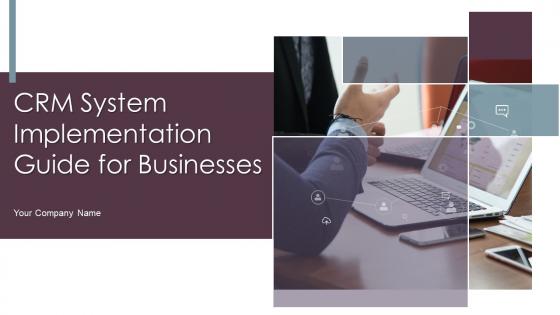
Slide 1: This slide introduces CRM System Implementation Guide for Businesses. State Your Company Name and begin.
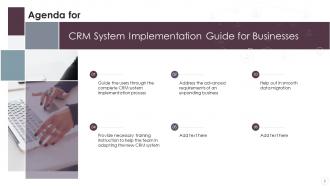
Slide 2: This slide states Agenda of the presentation.
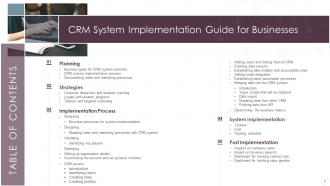
Slide 3: This slide presents Table of Content for the presentation.
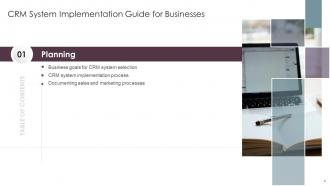
Slide 4: This slide highlights title for topics that are to be covered next in the template.
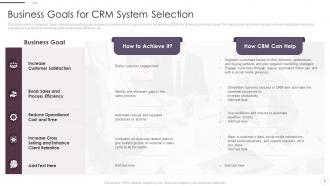
Slide 5: This slide shows Business Goals for CRM System Selection.
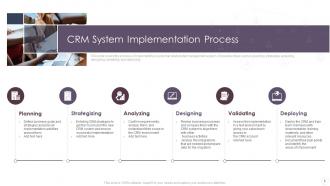
Slide 6: This slide presents CRM System Implementation Process.
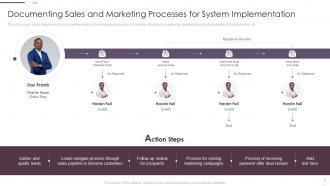
Slide 7: This slide displays Documenting Sales and Marketing Processes for System Implementation.
Slide 8: This slide highlights title for topics that are to be covered next in the template.
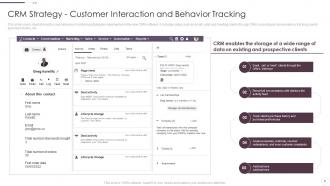
Slide 9: This slide covers client interaction and behaviour monitoring strategies.
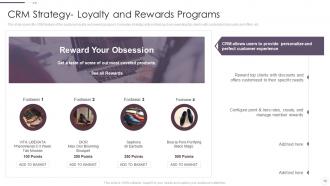
Slide 10: This slide represents CRM feature of the customer loyalty and reward program.
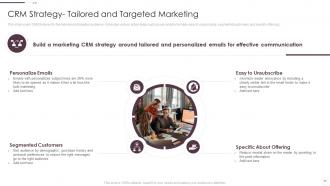
Slide 11: This slide showcases CRM features for the tailored and targeted audience.
Slide 12: This slide highlights title for topics that are to be covered next in the template.
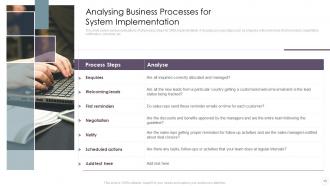
Slide 13: This slide shows various evaluations of all process steps for CRM implementation.
Slide 14: This slide highlights title for topics that are to be covered next in the template.
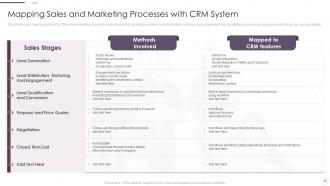
Slide 15: This slide presents Mapping Sales and Marketing Processes with CRM System.
Slide 16: This slide highlights title for topics that are to be covered next in the template.
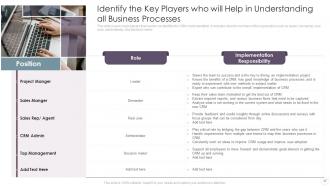
Slide 17: This slide covers major players that need to be identified for CRM implementation.
Slide 18: This slide highlights title for topics that are to be covered next in the template.
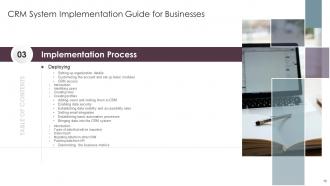
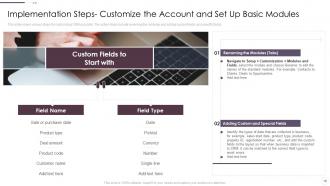
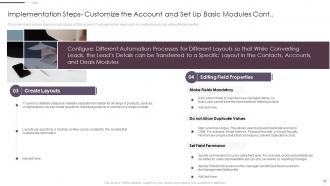
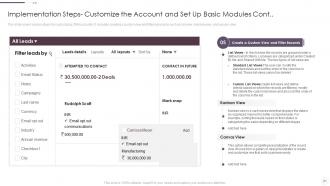
Slide 19: This slide displays various steps for customizing CRM accounts.
Slide 20: This is another slide continuing steps for customizing a CRM account.
Slide 21: This is another slide continuing steps for customizing a CRM account.
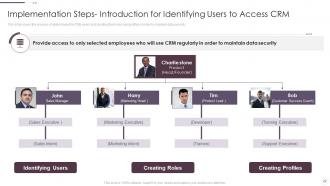
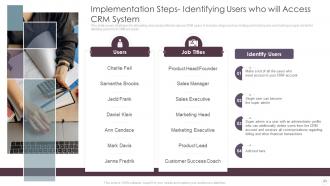
Slide 22: This slide covers the process of determining the CRM users and creating their roles and profiles.
Slide 23: This slide represents strategies for allocating roles and profiles to various CRM users.
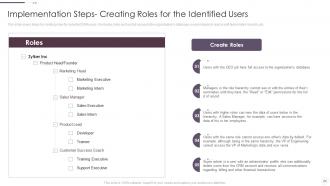
Slide 24: This slide showcases steps for creating roles for selected CRM users.
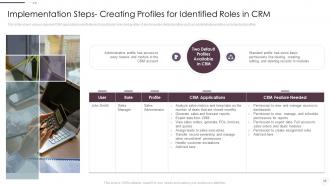
Slide 25: This slide covers various required CRM applications and features for particular roles and profiles.
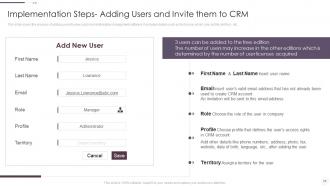
Slide 26: This slide shows process of adding users to new customer relationship management software.
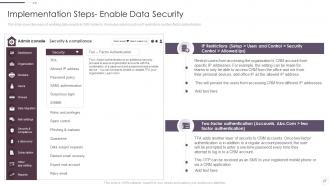
Slide 27: This slide presents two ways of enabling data security in CRM systems.
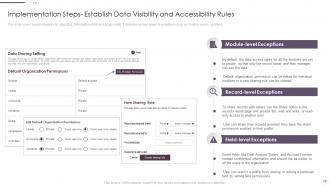
Slide 28: This slide displays various features for adjusting CRM data visibility and accessibility.
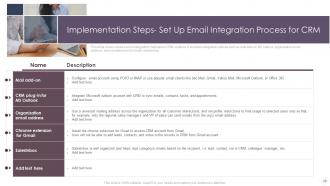
Slide 29: This slide represents various email integration methods for CRM systems.
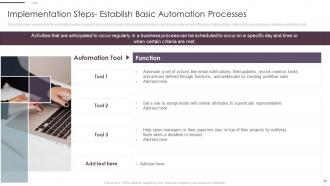
Slide 30: This slide showcases various tools for automating regular business tasks and processes.
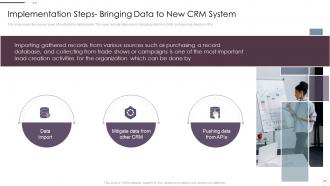
Slide 31: This slide covers the various types of methods for data transfer.
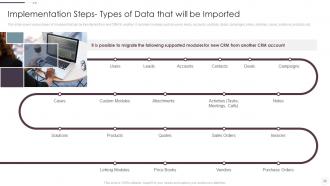
Slide 32: This slide shows types of modules that can be transferred from one CRM to another.
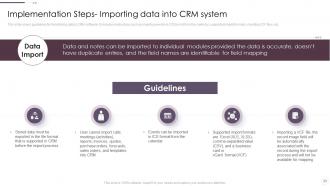
Slide 33: This slide presents guidelines for transferring data to CRM software.
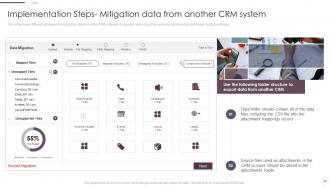
Slide 34: This slide displays different strategies for mitigating data from other CRM software.
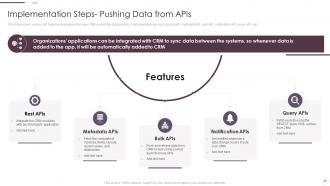
Slide 35: This slide represents various API features available in the new CRM system for data transfer.
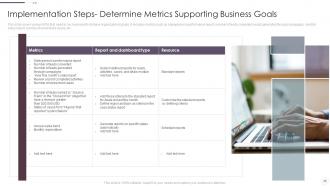
Slide 36: This slide showcases various KPIs that need to be measured to achieve organizational goals.
Slide 37: This slide highlights title for topics that are to be covered next in the template.
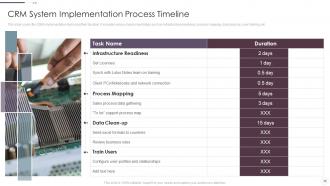
Slide 38: This slide shows CRM System Implementation Process Timeline.
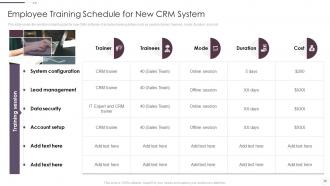
Slide 39: This slide presents Employee Training Schedule for New CRM System.
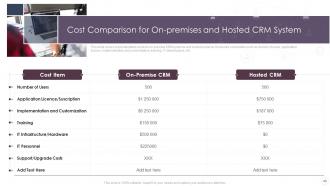
Slide 40: This slide displays Cost Comparison for On-premises and Hosted CRM System.
Slide 41: This slide highlights title for topics that are to be covered next in the template.
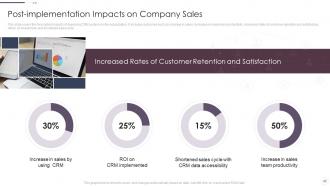
Slide 42: This slide represents Post-implementation Impacts on Company Sales.
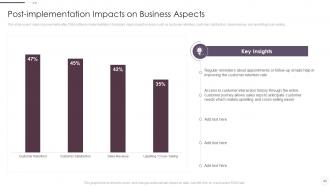
Slide 43: This slide showcases Post-implementation Impacts on Business Aspects.
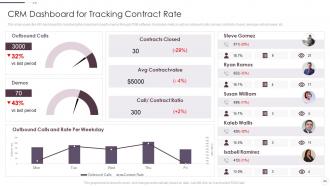
Slide 44: This slide shows CRM Dashboard for Tracking Contract Rate.
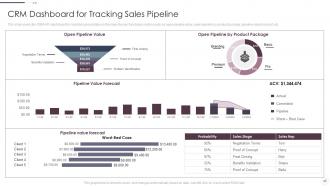
Slide 45: This slide presents CRM Dashboard for Tracking Sales Pipeline.
Slide 46: This slide displays Icons for CRM System Implementation Guide for Businesses.
Slide 47: This slide is titled as Additional Slides for moving forward.
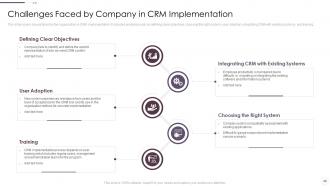
Slide 48: This slide represents Challenges Faced by Company in CRM Implementation.
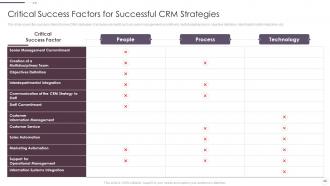
Slide 49: This slide showcases Critical Success Factors for Successful CRM Strategies.
Slide 50: This slide presents Roadmap with additional textboxes.
Slide 51: This slide shows SWOT describing- Strength, Weakness, Opportunity, and Threat.
Slide 52: This slide depicts Venn diagram with text boxes.
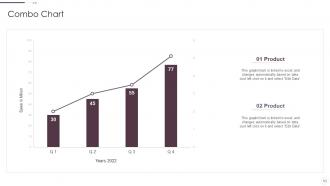
Slide 53: This slide depicts Combo chart with two products comparison.
Slide 54: This slide shows Post It Notes. Post your important notes here.
Slide 55: This is Our Goal slide. State your firm's goals here.
Slide 56: This is an Idea Generation slide to state a new idea or highlight information, specifications etc.
Slide 57: This slide displays Mind Map with related imagery.
Slide 58: This is a Thank You slide with address, contact numbers and email address.
CRM System Implementation Guide For Businesses Powerpoint Presentation Slides with all 63 slides:
Use our CRM System Implementation Guide For Businesses Powerpoint Presentation Slides to effectively help you save your valuable time. They are readymade to fit into any presentation structure.







FAQs for CRM System Implementation Guide For Businesses
Key elements include budget planning, stakeholder alignment, data quality assessment, system integration requirements, and user training strategies. These foundational components streamline implementation by ensuring organizational readiness, minimizing technical disruptions, and maximizing user adoption, with many companies finding that thorough pre-planning ultimately delivers faster deployment and higher ROI.
Organizations can assess their current CRM needs by evaluating customer data management capabilities, analyzing sales process efficiency, reviewing communication touchpoints, and identifying integration requirements with existing systems. Through comprehensive audits of customer interactions, lead tracking, and reporting gaps, companies across retail, healthcare, and financial services streamline operations while enhancing customer experiences and competitive positioning.
Common CRM implementation challenges include data migration complexities, user adoption resistance, inadequate training programs, integration difficulties with existing systems, and insufficient customization planning. These obstacles often stem from poor change management and unrealistic timeline expectations, with many organizations finding that thorough stakeholder engagement and phased rollout strategies significantly enhance adoption rates and minimize operational disruptions.
Selecting the right CRM software requires evaluating your specific business needs, budget constraints, scalability requirements, integration capabilities, and user adoption potential. Organizations should assess features like contact management, sales automation, and reporting tools, while considering implementation complexity and vendor support, with many companies finding that cloud-based solutions offer greater flexibility and faster deployment than on-premise alternatives.
Data migration serves as the foundation of successful CRM implementation, involving data cleansing, mapping, validation, and integration from multiple legacy systems. This critical process ensures operational continuity and user adoption, with many organizations finding that poor data quality can undermine even the most sophisticated CRM platforms, ultimately determining long-term system effectiveness.
Stakeholder engagement can be maximized through regular communication updates, collaborative requirement gathering sessions, comprehensive training programs, and establishing clear feedback channels throughout implementation phases. By involving department heads in system design decisions, conducting hands-on workshops, and creating implementation champions within each team, organizations ultimately ensure higher user adoption rates and smoother transitions.
Effective CRM training strategies include hands-on workshops, role-specific modules, phased rollouts, peer mentoring programs, and ongoing support resources. These approaches enhance adoption by addressing individual learning styles, departmental workflows, and skill levels, with many organizations finding that combining interactive sessions with real-world practice scenarios ultimately delivers faster proficiency and higher user engagement rates.
CRM implementation success is measured through customer satisfaction scores, sales conversion rates, lead response times, data accuracy levels, and user adoption percentages. These metrics enable organizations to track operational efficiency improvements, revenue growth acceleration, and enhanced customer experiences, with many companies finding that comprehensive measurement frameworks ultimately deliver competitive advantage and strategic insights for continuous optimization.
CRM integration best practices include conducting thorough data audits, mapping existing workflows, establishing clear data governance protocols, selecting compatible APIs, and implementing phased rollouts. These approaches streamline operations by eliminating data silos, automating customer touchpoints, and centralizing information flow, with many organizations finding that strategic integration ultimately delivers enhanced productivity and improved customer experiences.
Customer feedback can be incorporated through pre-implementation surveys, user acceptance testing, pilot program evaluations, and post-launch feedback loops. These approaches enable organizations to identify pain points, refine workflows, and enhance user adoption, with many companies finding that continuous feedback integration ultimately delivers more intuitive systems and improved customer experiences.
Essential post-implementation support includes ongoing user training, technical maintenance, data quality management, performance monitoring, and dedicated help desk services. These support mechanisms streamline adoption by addressing user challenges, ensuring system reliability, and maintaining data integrity, with many organizations finding that continuous support ultimately delivers higher user engagement, improved data accuracy, and sustained competitive advantage.
Businesses ensure CRM data privacy and security through comprehensive encryption protocols, role-based access controls, regular security audits, compliance with regulations like GDPR, and secure data migration processes. Financial institutions and healthcare organizations particularly benefit from multi-factor authentication and endpoint protection, ultimately delivering enhanced customer trust and regulatory compliance while minimizing breach risks.
Cloud-based CRM solutions deliver greater scalability, lower upfront costs, automatic updates, remote accessibility, and faster deployment compared to on-premises systems. While on-premises offers more customization control, cloud solutions enable organizations to reduce IT overhead, access real-time data anywhere, and scale operations seamlessly, with many businesses finding enhanced collaboration and operational efficiency.
Manufacturing focuses on supply chain integration and customer service automation, while healthcare prioritizes patient data security and compliance with regulations like HIPAA. Retail sectors emphasize omnichannel customer experiences and inventory management integration, whereas financial services concentrate on regulatory compliance and risk management, with many organizations finding that sector-specific customization ultimately delivers better customer engagement and operational efficiency.
Customer satisfaction scores, lead conversion rates, sales cycle length, user adoption rates, and revenue per customer are essential CRM performance metrics. These indicators enable organizations to assess system effectiveness by tracking improved customer experiences, streamlined sales processes, and enhanced team productivity, with many companies finding that consistent monitoring ultimately delivers better forecasting accuracy and competitive advantage.
-
Understandable and informative presentation.
-
I took a chance with SlideTeam. I never looked back. Great products and great service.