

Cross Cultural Competence For Effective Communication And Team Productivity Powerpoint Presentation Slides




Try Before you Buy Download Free Sample Product
 Impress Your
 Audience
 100%
100% Editable
 Save Hours
 of Time


Our Cross Cultural Competence For Effective Communication And Team Productivity Powerpoint Presentation Slides are topically designed to provide an attractive backdrop to any subject. Use them to look like a presentation pro.
People who downloaded this PowerPoint presentation also viewed the following :
Content of this Powerpoint Presentation
Slide 1: This slide introduces Cross-Cultural Competence for Effective Communication and Team Productivity. Mention your Company name and begin.
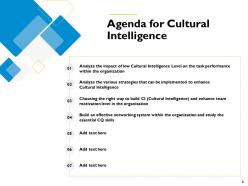
Slide 2: This slide displays Agenda for Cultural Intelligence.
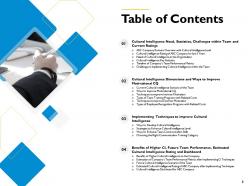
Slide 3: This slide depicts Table of Contents.
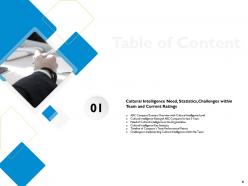
Slide 4: This slide shows Table of Content.
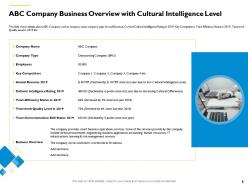
Slide 5: This slide shows details about ABC Company such as company name, company type, Annual Revenue, Current Cultural Intelligence Rating in 2019 , Key Competitors, Team Efficiency Status in 2019 , Teamwork Quality Level in 2019 etc.
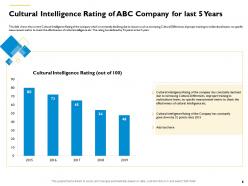
Slide 6: This slide shows the current Cultural Intelligence Rating of the company which is constantly declining due to reasons such as increasing Cultural Differences, improper training to multicultural teams, no specific measurement metric to check the effectiveness of cultural intelligence etc. The rating has declined by 32 points in last 5 years
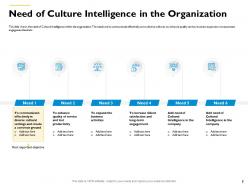
Slide 7: This slide shows the need of Cultural Intelligence within the organization. The needs are to communicate effectively across diverse cultures, to enhance quality service, business expansion, increase team engagement level etc.
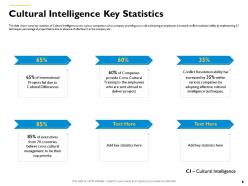
Slide 8: This slide shows some key statistics of Cultural Intelligence across various companies such as company providing cross cultural training to employees, increased conflict resolution ability by implementing CI techniques, percentage of project failure due to absence of effective CI in the company etc.
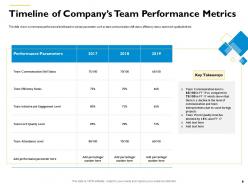
Slide 9: This slide shows current team performance level based on certain parameters such as team communication skill status, efficiency status, teamwork quality level etc.
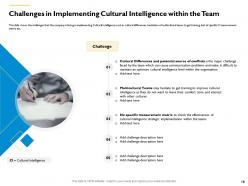
Slide 10: This slide shows the challenges that the company is facing in implementing Cultural Intelligence such as cultural differences, hesitation of multicultural teams to get training, lack of specific CI measurement metric etc.
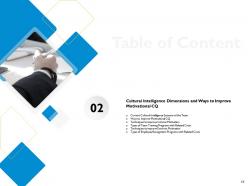
Slide 11: This slide displays Table of Content.
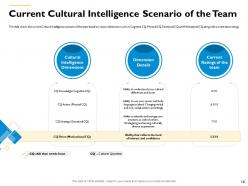
Slide 12: This slide shows the current Cultural Intelligence scenario of the team based on various dimensions such as Cognitive CQ, Physical CQ, Emotional CQ and Motivational CQ along with current team ratings
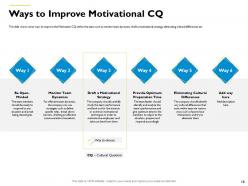
Slide 13: This slide shows some ways to improve the Motivation CQ within the team such as monitor team dynamics, draft a motivational strategy, eliminating cultural differences etc.
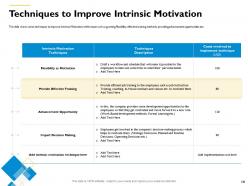
Slide 14: This slide shows some techniques to improve Intrinsic Motivation within team such as granting Flexibility, effective training methods, providing advancement opportunities etc.
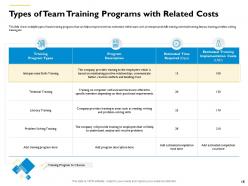
Slide 15: This slide shows multiple types of team training programs that can help to improve intrinsic motivation within team such as interpersonal skills training, technical training, literacy training, problem-solving training etc.
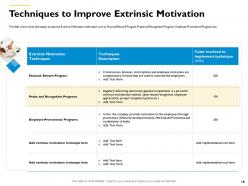
Slide 16: This slide shows some techniques to improve Extrinsic Motivation within team such as Financial Reward Program, Praise and Recognition Programs, Employee Promotional Programs etc.
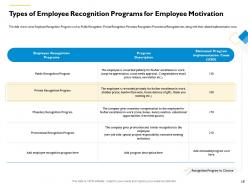
Slide 17: This slide shows some Employee Recognition Programs such as Public Recognition, Private Recognition, Monetary Recognition, Promotional Recognition etc. along with their related implementation costs.
Slide 18: This slide displays Table of Content of the presentation.
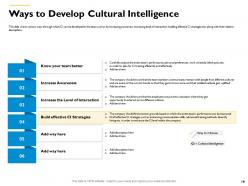
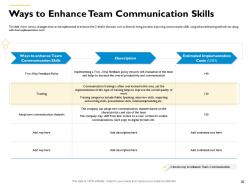
Slide 19: This slide shows various ways through which CI can be developed in the team such as by increasing awareness, increasing level of interaction, building effective CI strategies etc. along with their relative description.
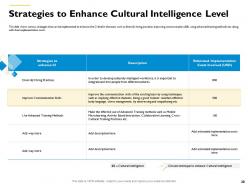
Slide 20: This slide shows various strategies that can be implemented to enhance the CI level in the team such as diversify hiring practices, improving communication skills, using advanced training methods etc. along with their implementation costs .
Slide 21: This slide shows various strategies that can be implemented to enhance the CI level in the team such as diversify hiring practices, improving communication skills, using advanced training methods etc. along with their implementation costs
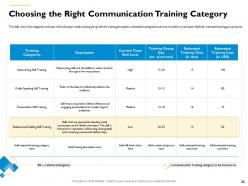
Slide 22: This slide shows the categories and areas where the team needs training along with the training description, estimated training time and costs involved, current team skill level, estimated training group size etc.
Slide 23: This slide displays Table of Content of the presentation.
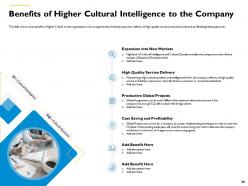
Slide 24: This slide shows some benefits of higher CI level to the organization such as opportunity of market expansion, delivery of high-quality service, productive and more profitable global projects etc.
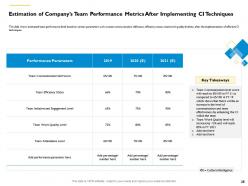
Slide 25: This slide shows estimated team performance level based on certain parameters such as team communication skill status, efficiency status, teamwork quality level etc. after the implementation of effective CI techniques.
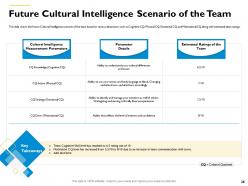
Slide 26: This slide shows the future Cultural Intelligence scenario of the team based on various dimensions such as Cognitive CQ, Physical CQ, Emotional CQ and Motivational CQ along with estimated team ratings.
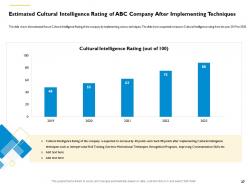
Slide 27: This slide shows the estimated future Cultural Intelligence Rating of the company by implementing various techniques. The slide shows expected increase in Cultural Intelligence rating from the year 2019 to 2023
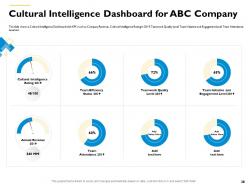
Slide 28: This slide shows a Cultural Intelligence Dashboard with KPI’s such as Company Revenue , Cultural Intelligence Rating in 2019, Teamwork Quality Level, Team Initiative and Engagement Level, Team Attendance Level etc.
Slide 29: This is Cross-Cultural Competence for Effective Communication and Team Productivity Icons Slide
Slide 30: This slide is titled as Additional Slides for moving forward.
Slide 31: This is About Us slide to showcase Company specifications.
Slide 32: This is Our Team slide with Names and Designations.
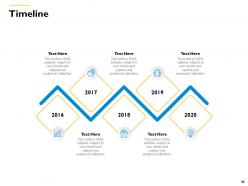
Slide 33: This slide shows Timeline process.
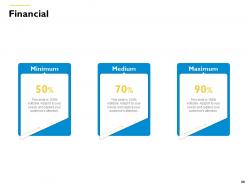
Slide 34: This is Financial slide. Showcase Finance related stuff.
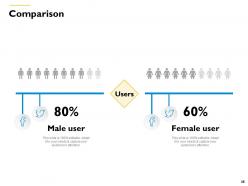
Slide 35: This is Comparison slide.
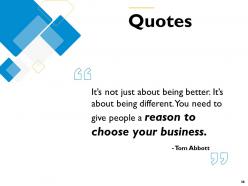
Slide 36: This slide displays motivational Quotes
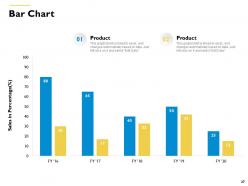
Slide 37: This slide depicts Bar Chart for Comparison of products.
Slide 38: This is Thank You slide with Contact details.
Cross Cultural Competence For Effective Communication And Team Productivity Powerpoint Presentation Slides with all 38 slides:
Use our Cross Cultural Competence For Effective Communication And Team Productivity Powerpoint Presentation Slides to effectively help you save your valuable time. They are readymade to fit into any presentation structure.

FAQs for Cross Cultural Competence For Effective Communication And Team Productivity
Honestly, it's mostly about reading the room and adapting on the fly. Cultural awareness is huge - you gotta understand how different places handle business meetings and make decisions. Listen to what people aren't saying too, not just the obvious stuff. What works great with your US team might be completely wrong for colleagues in Japan or Germany. I'd actually start by doing some quick research on their backgrounds before your next call. Ask questions when you're unsure, but do it respectfully. Oh and don't judge right away if something seems weird - there's probably a good reason behind it.
So there's a few ways to tackle this. The formal route uses tools like the Intercultural Development Inventory or Cultural Intelligence Scale - gives you solid baseline data. But honestly? The real gold comes from just watching how people actually handle multicultural situations. Do they adapt their communication style? How do they deal with cross-cultural conflicts? 360-degree feedback works great here, plus scenario-based tests and self-reflection surveys. I'd mix the formal assessments with real-world observation though - you need both to really get what's happening.
Honestly, empathy is huge when it comes to understanding different cultures. You know how you sometimes react a certain way because of your own experiences? Same thing applies to everyone else. Instead of jumping to conclusions about why someone does something, try asking questions first. Like actually wondering about their perspective instead of assuming you get it. It builds way more trust that way. I've noticed people open up more when they feel like you're genuinely curious about their background rather than just being polite. Short version - put yourself in their shoes before you judge.
Honestly, just listen more than you talk - like really listen, not just planning what to say next. When you're confused, ask questions instead of nodding along. Skip the idioms too since they don't translate well (learned that one the hard way lol). Body language is tricky because it means different things everywhere. Oh and double-check that you both understood the same thing before wrapping up. I know it sounds obvious, but being patient with the awkward moments makes a huge difference. Stay curious about their perspective - it's way more interesting than you'd think.
Honestly, it's mostly about language barriers and people making weird assumptions about each other's work styles. Like when someone says "maybe we can consider that" and you think they're open to it, but they're actually politely shutting you down. Different cultures handle feedback and hierarchy in totally opposite ways too. Time zones suck but that's just scheduling drama. What really trips people up is missing nonverbal cues or not realizing that your "direct communication" might come off as rude to someone else. My advice? Just ask people upfront how they prefer to work instead of guessing.
Start with workshops covering communication styles and business practices across regions. Role-playing awkward situations beats boring theory every time - seriously, it's weirdly effective. Cover obvious stuff like hierarchy expectations but also subtle things like how silence gets interpreted. Don't make it a one-off thing though. Monthly lunch sessions or pairing people up as cultural mentors works better. Oh, and definitely get employees from different backgrounds involved when you're planning this stuff. Their perspective is way more valuable than whatever some consultant might tell you.
Honestly, cross-cultural skills are a game-changer for global teams. Better collaboration, faster problem-solving, way fewer misunderstandings that tank projects. Your team members actually get each other's communication styles and cultural quirks? They'll build trust faster and work so much better together. I've watched teams flip from constant drama to absolutely killing it just by focusing on this stuff. Plus it cuts out all that weird awkward dancing around differences - you know what I mean? Try having everyone share how they prefer to communicate and make decisions. You'd be shocked how much smoother everything runs after that.
So Hofstede's cultural dimensions are basically a cheat sheet for understanding why your coworkers from different countries act the way they do. They break everything down into categories - hierarchy levels, individual vs. team mindset, how people deal with uncertainty, that kind of thing. Super helpful when you're trying to figure out communication styles or leadership approaches. Though honestly, I learned this stuff in a cross-cultural management class and thought it was kinda dry at first. But it actually works! Just don't box people in - these are patterns, not personality tests. Worth looking up the dimensions for whoever you're working with.
Start with listening - like really listening to what your team brings from their different backgrounds. Ask questions because you're genuinely curious, not just checking a box. Mixed project teams work great too. Oh and definitely create that safe space where people can share without worrying about being judged. Check your own blind spots regularly (we all have them). Celebrate different holidays, mess up sometimes and admit it fast. Honestly, the leaders I respect most are the ones who say "I'm still learning this stuff." Pick something small to try this week and go from there.
Having cross-cultural awareness totally changes how you handle team drama. People express disagreement differently based on their background - what seems "rude" might just be someone being direct in their culture. I've seen this mess up so many projects honestly. Instead of getting stuck on surface stuff, you can dig into what's really bothering everyone. Ask questions about their communication preferences rather than assuming they're being difficult. Once you get why each person approaches conflict differently, finding solutions becomes way easier. Different doesn't mean wrong, it just means you need to adjust your approach.
Don't exploit differences in negotiation styles or power dynamics - that's just shady. Your ethics aren't universal, so what feels "right" might clash with their cultural norms. This stuff gets messy! Be upfront about your own constraints while staying genuinely curious about theirs. Honestly, I think most problems come from assumptions we don't even realize we're making. Before you negotiate, do some homework on their cultural context. Then actually talk through what "fair" means to both of you - don't just wing it and hope for the best.
Honestly, translation apps have gotten insanely good lately - Google Translate can handle way more complex stuff now than it used to. Video calls are clutch too since you catch body language and facial expressions that totally disappear over email. There are also these cultural context apps that'll tell you the business norms for different countries, which is super helpful when you don't want to accidentally offend someone. Oh, and virtual collaboration tools help everyone work on the same level regardless of location. I'd definitely test out a translation app before your next international call though - better safe than sorry!
McDonald's is your best example here - they're smart about adapting menus locally while keeping the brand consistent. Rice burgers in Taiwan, tons of veggie options in India, that kind of thing. Unilever does this really well too, actually letting regional teams call the shots on products and marketing instead of micromanaging from corporate. Oh, and Netflix absolutely crushed it with their local content strategy. Korean shows, Brazilian originals - they clearly figured out that one-size-fits-all doesn't work anymore. What these companies share is they hire locally, train people on cultural differences, and don't just force headquarters' vision everywhere.
Honestly, you can't mess around with cultural competence when dealing with international customers. Trust builds so much faster when you actually understand their communication style and business norms. Customers notice when you "get" their context - it shows respect. Plus you'll avoid those embarrassing mistakes that kill deals (learned that one the hard way in Tokyo, oof). Teams who nail this stuff see way better satisfaction scores and retention. Short version? Research the basics for each market first. How direct are they? Big on hierarchy? Do they need relationship-building before business talk?
Honestly, just start consuming stuff from other cultures - books, movies with subtitles, international news. Language apps help too, even if you only learn basic phrases. People appreciate the effort. I always hit up authentic restaurants and chat with the staff about their background (yeah it's kinda dorky but whatever, it works). Travel if you can swing it, but there's probably cultural events happening right in your town. The biggest thing though? Actually listen when you meet people from different places instead of just waiting for your turn to talk. Don't overthink it - just stay curious and you'll pick things up naturally.
-
Content of slide is easy to understand and edit.
-
Enough space for editing and adding your own content.
-
Unique design & color.