

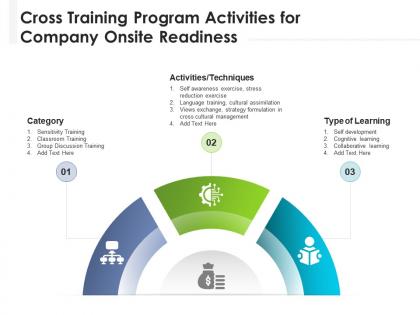
Cross training program activities for company onsite readiness




Try Before you Buy Download Free Sample Product
 Impress Your
Audience
 100%
Editable
 Save Hours
of Time


Our Cross Training Program Activities For Company Onsite Readiness are topically designed to provide an attractive backdrop to any subject. Use them to look like a presentation pro.
People who downloaded this PowerPoint presentation also viewed the following :
Cross training program activities for company onsite readiness with all 2 slides:
Use our Cross Training Program Activities For Company Onsite Readiness to effectively help you save your valuable time. They are readymade to fit into any presentation structure.


FAQs for Cross training program activities for
Cross-training programs enhance communication skills, technical competencies, problem-solving abilities, leadership capabilities, and adaptability across different departments and functions. These programs streamline knowledge transfer by exposing employees to diverse processes, systems, and workflows, with many organizations finding that cross-trained staff deliver improved collaboration, operational flexibility, and ultimately stronger business continuity during transitions.
Cross-training improves team collaboration and communication by fostering mutual understanding of different roles, breaking down departmental silos, and encouraging knowledge sharing across functions. Through structured rotation programs, teams develop empathy for colleagues' challenges, enhance problem-solving capabilities, and create stronger interpersonal networks, ultimately delivering more cohesive workflows and streamlined project execution.
Effective methods for assessing employee readiness include skills gap analyses, performance evaluations, learning style assessments, competency mapping, and motivation interviews. These approaches enable organizations to identify candidates with strong foundational skills, adaptability, and growth mindset, while ensuring strategic alignment between employee capabilities and cross-training objectives, ultimately delivering enhanced workforce flexibility and operational efficiency.
Cross-training contributes to employee retention and job satisfaction by expanding skill sets, reducing workplace monotony, and creating clearer advancement pathways within organizations. Through strategic cross-functional exposure, employees develop greater job security, enhanced problem-solving capabilities, and deeper understanding of business operations, while companies benefit from increased workforce flexibility and reduced turnover costs, ultimately delivering stronger employee engagement.
Organizations should track completion rates, skill assessment scores, employee retention, internal mobility rates, and productivity improvements across cross-trained teams. These metrics enable measurement of program effectiveness, identify knowledge gaps, and demonstrate ROI, with many companies finding that comprehensive tracking ultimately delivers enhanced operational flexibility, reduced training costs, and stronger competitive advantage.
Technology can support cross-training programs through learning management systems, virtual reality simulations, mobile learning platforms, AI-powered skill assessments, and collaborative digital workspaces. These technologies streamline training delivery, enable personalized learning paths, and provide real-time progress tracking, with many organizations finding that digital solutions reduce training costs while accelerating employee development across multiple departments.
Management plays a crucial role by establishing clear program objectives, allocating necessary resources, and creating supportive policies that encourage participation across departments. They facilitate success by identifying skill gaps, matching employees with appropriate training opportunities, and maintaining consistent communication about program benefits, ultimately delivering enhanced workforce flexibility and improved operational efficiency throughout the organization.
Organizations face challenges including employee resistance to learning new skills, time constraints during busy periods, initial productivity drops, and resource allocation for training materials. However, these obstacles can be overcome by starting with voluntary participants, scheduling training during slower periods, setting realistic expectations for temporary efficiency decreases, and leveraging experienced employees as mentors, ultimately delivering enhanced workforce flexibility and operational resilience.
Cross-training programs can be tailored through diverse delivery methods including hands-on workshops, visual presentations, mentoring partnerships, online modules, and collaborative group projects. These approaches accommodate different learning preferences by combining kinesthetic experiences with visual demonstrations and peer interactions, with many organizations finding that flexible, multi-modal training significantly enhances skill retention and employee engagement.
Cross-training enhances operational efficiency by reducing bottlenecks, minimizing downtime during absences, and enabling flexible resource allocation across departments. When employees master multiple roles, organizations streamline workflows, accelerate project completion, and maintain consistent service levels, with many companies finding that cross-trained teams deliver faster customer responses and significantly lower operational costs.
Best practices for developing cross-training content include conducting skills gap analyses, creating modular learning materials, incorporating hands-on simulations, establishing mentorship pairings, and designing competency-based assessments. These approaches enhance knowledge retention by combining theoretical understanding with practical application, while enabling organizations to customize training paths for different roles, ultimately delivering improved workforce flexibility and operational efficiency.
Organizations ensure cross-training aligns with business goals by mapping skill development to strategic priorities, identifying critical knowledge gaps, and focusing on competencies that drive competitive advantage. Through targeted programs in key areas like customer service, technical expertise, and operational efficiency, companies enhance workforce flexibility while reducing dependency risks, ultimately delivering improved productivity and sustainable growth across departments.
Cross-training delivers enhanced career mobility, increased job security, expanded skill sets, improved problem-solving capabilities, and greater organizational value over time. These competencies enable professionals to adapt to market changes, pursue diverse career paths, and command higher compensation, while organizations benefit from more versatile teams, reduced knowledge silos, and improved succession planning across departments.
Employee feedback enhances cross-training program design by identifying skill gaps, revealing preferred learning methods, and highlighting practical workplace challenges that theoretical frameworks might miss. Through surveys, focus groups, and performance reviews, organizations can tailor programs to actual job requirements and learning preferences, ultimately delivering more effective skill development and higher employee engagement across departments.
Healthcare, financial services, manufacturing, retail, and technology sectors benefit most from cross-training because they require operational continuity, regulatory compliance, and rapid adaptation to market changes. These industries leverage cross-training to minimize disruptions during peak periods, enhance service delivery through versatile teams, and build strategic workforce resilience, ultimately delivering improved customer experiences and competitive advantage.
-
Unique and attractive product design.
-
Editable templates with innovative design and color combination.
-
Use of different colors is good. It's simple and attractive.
-
Much better than the original! Thanks for the quick turnaround.
-
Easily Editable.