

Cryptocurrency Extraction Plan Proposal Powerpoint Presentation Slides





Try Before you Buy Download Free Sample Product
 Impress Your
 Audience
 100%
100% Editable
 Save Hours
 of Time


Our Cryptocurrency Extraction Plan Proposal template is designed to help you understand the importance of cryptocurrency mining in the blockchain technology. The mining process involves solving complex mathematical problems to discover new blocks that are added to the blockchain. This process ensures the security and reliability of the blockchain, making it a crucial aspect of the technology. Our proposal includes a detailed overview of the mining process and the services offered by our Crypto Exchange deck. We guarantee the highest standards of safety, reliability, and efficiency for our customers. Our team is equipped with the latest technology and the most experienced staff, providing the best support and advice on the most profitable mining strategies. The administrative services we offer include cloud mining, hardware setup, pool management, and technical support. With our proposal, you can maximize your returns while minimizing risks. Download our customizable template now and take advantage of our expertise in the cryptocurrency mining industry.
People who downloaded this PowerPoint presentation also viewed the following :
Content of this Powerpoint Presentation
Slide 1: This slide introduces Cryptocurrency Mining Proposal. Commence by stating Your Company Name.
Slide 2: The following slide shows the cover letter for the engineering maintenance service proposal.
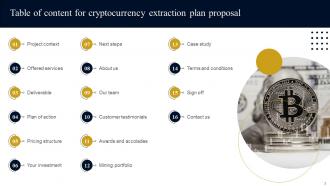
Slide 3: This slide incorporates the Table of Contents.
Slide 4: The following slide highlights the context of the proposal, it covers the client’s needs to develop cryptocurrency mining infrastructure, maintenance and portfolio management.
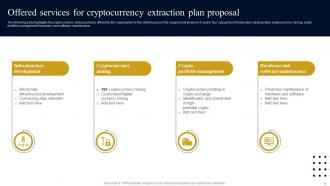
Slide 5: The following slide states the cryptocurrency mining services offered by the organization to the client based on the requirement analysis.
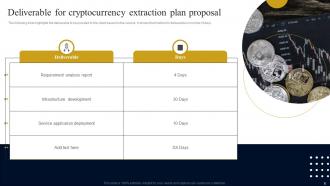
Slide 6: The following slide highlights the deliverable to be provided to the client based on the service.
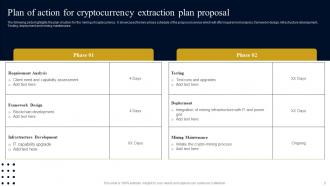
Slide 7: The following slide elucidates the plan of action for the mining of cryptocurrency.
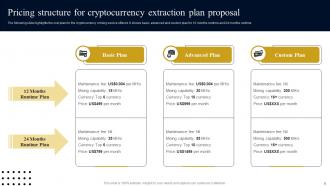
Slide 8: The following slide displays the cost plan for the cryptocurrency mining service offered.
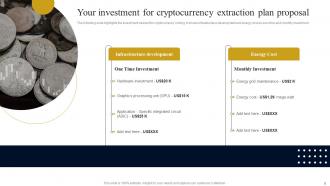
Slide 9: The following slide portrays the investment needed for cryptocurrency mining.
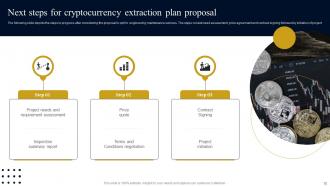
Slide 10: This slide lists the steps to progress after considering the proposal to opt for engineering maintenance services.
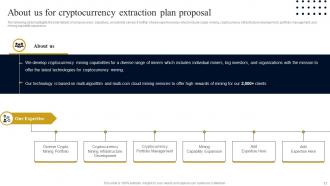
Slide 11: The following slide contains the brief details of company work, objectives, and clients served.
Slide 12: This slide shows the management team of the company.
Slide 13: This slide continues the information on the management team of the company.
Slide 14: The following slide illustrates the customer testimonials provided by multiple clienteles to the organization for the rendered services.
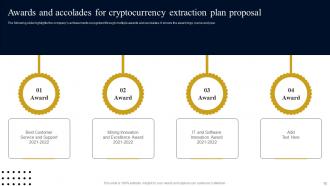
Slide 15: The following slide highlights the company’s achievements recognized through multiple awards and accolades.
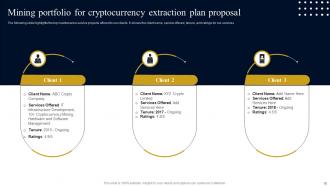
Slide 16: This slide deals with the top maintenance service projects offered to clients.
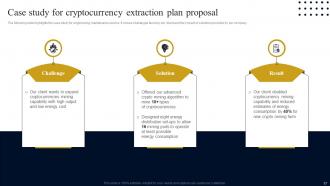
Slide 17: This slide presents the case study for engineering maintenance service.
Slide 18: This slide mentions the terms and conditions of the agreement between client and company.
Slide 19: The following slide illustrates the service agreement signing off the document for acceptance of the proposal.
Slide 20: This slide incorporates the Company related information.
Slide 21: This is the Icons slide containing all the Icons used in the plan.
Slide 22: This slide is used for depicting Additional information.
Slide 23: This is Our mission slide. State your organization's mission, vision, and goals here.
Slide 24: This is the About us slide for stating the Organization related information.
Slide 25: This slide elucidates the Timeline of the organization.
Slide 26: This slide presents the Company Roadmap.
Cryptocurrency Extraction Plan Proposal Powerpoint Presentation Slides with all 31 slides:
Use our Cryptocurrency Extraction Plan Proposal Powerpoint Presentation Slides to effectively help you save your valuable time. They are readymade to fit into any presentation structure.



















FAQs for Cryptocurrency Extraction Plan Proposal
Key technological requirements for effective cryptocurrency mining include specialized ASIC hardware, robust cooling systems, reliable high-speed internet connectivity, efficient power supply units, and comprehensive monitoring software. These technologies work together by maximizing computational power, minimizing operational costs, and ensuring consistent uptime, with many mining operations finding that strategic infrastructure investments ultimately deliver higher hash rates and improved profitability margins.
Mining profitability varies significantly across cryptocurrencies based on factors like electricity costs, hardware requirements, network difficulty, and market value fluctuations. Bitcoin requires expensive ASIC miners with high energy consumption, while altcoins like Ethereum Classic or Monero offer accessibility through GPU mining, with many miners finding that diversifying across multiple currencies helps optimize returns and minimize risks.
Large-scale cryptocurrency mining operations significantly impact the environment through massive energy consumption, carbon emissions from fossil fuel-powered grids, electronic waste from obsolete hardware, and heat generation requiring additional cooling systems. While many mining facilities increasingly adopt renewable energy sources and efficient technologies, the industry presents both sustainability challenges and opportunities, with forward-thinking operations ultimately delivering cleaner mining practices and reduced environmental footprints.
Miners can optimize energy consumption through renewable energy sources, advanced cooling systems, efficient mining hardware, strategic facility locations, and energy management software. These approaches streamline operations by reducing electricity costs, minimizing environmental impact, and enhancing operational efficiency, with many mining operations finding that sustainable practices ultimately deliver competitive advantages and regulatory compliance in an increasingly environmentally-conscious market.
Mining hardware directly determines cryptocurrency mining efficiency through processing power, energy consumption, heat management, and computational speed capabilities. Specialized ASIC miners and high-performance GPUs enable faster hash rates and lower electricity costs compared to traditional processors, with many mining operations finding that strategic hardware investments significantly enhance profitability and competitive positioning in increasingly demanding blockchain networks.
Legal considerations for cryptocurrency mining include business licensing requirements, tax compliance obligations, environmental regulations, zoning permits for industrial operations, and adherence to securities laws. These regulatory frameworks vary significantly by jurisdiction, with countries like El Salvador embracing mining while others impose restrictions, ultimately requiring businesses to navigate complex compliance landscapes while securing proper permits and maintaining transparent reporting to ensure sustainable operations.
The difficulty adjustment mechanism directly impacts mining operations by regulating computational requirements, energy consumption, and profitability margins based on network hash rate fluctuations. When difficulty increases, mining operations require more powerful hardware and higher energy costs, while decreases enhance profitability, with many commercial miners finding that strategic timing and efficient infrastructure ultimately deliver competitive advantages in an increasingly volatile market.
Proof of Work requires energy-intensive computational competition for block rewards, favoring miners with specialized hardware and low electricity costs, while Proof of Stake eliminates traditional mining through validator selection based on token holdings. These contrasting mechanisms fundamentally reshape mining strategies, with PoW emphasizing hardware investment and operational efficiency, and PoS transitioning toward staking services and network governance participation.
Mining pools benefit individual miners by providing consistent payouts, reducing variance, and enabling access to advanced infrastructure and technical support. Through pooled resources, individual miners can compete effectively against large operations while receiving steady income streams rather than sporadic rewards, with many smaller miners finding that collaborative approaches deliver enhanced profitability and operational stability.
Essential security measures include hardware wallets for storage, multi-factor authentication, regular software updates, network firewalls, and physical security systems for mining facilities. These protocols enhance operational security by preventing unauthorized access, minimizing cyber threats, and protecting valuable digital assets, with many mining operations finding that comprehensive security frameworks ultimately deliver greater investor confidence and operational resilience.
Market trends significantly influence cryptocurrency mining viability through price volatility, regulatory changes, technological advancements, and energy cost fluctuations. These factors determine profitability by affecting mining rewards, operational expenses, and equipment investments, with many mining operations finding that diversifying across multiple cryptocurrencies and implementing energy-efficient technologies ultimately delivers competitive advantage in volatile markets.
Cryptocurrency mining investments present both significant opportunities and considerable risks, including volatile market prices, high energy costs, regulatory uncertainty, equipment depreciation, and substantial initial capital requirements. While successful mining operations can deliver steady passive income streams and long-term asset appreciation, many investors find that profitability depends heavily on electricity costs, hardware efficiency, and market timing, ultimately requiring careful risk assessment.
Increasing mining difficulty has significantly elevated hardware requirements, operational costs, and technical expertise needed for entry-level miners, making profitable solo mining increasingly challenging. While this presents barriers, many newcomers are finding success through mining pools, cloud mining services, and focusing on newer, less competitive cryptocurrencies, ultimately enabling participation despite higher complexity.
Emerging cryptocurrency mining innovations include quantum-resistant algorithms, liquid immersion cooling systems, renewable energy integration, ASIC chip optimization, and AI-powered mining pool management. These technologies enhance mining efficiency by reducing energy consumption, improving hash rates, and minimizing operational costs, with many mining operations finding that strategic adoption delivers significant competitive advantages in an increasingly regulated environment.
Miners stay informed through cryptocurrency developer forums, protocol update announcements, mining pool communications, blockchain news platforms, and technical documentation repositories. By actively monitoring these channels, miners can anticipate protocol changes, adjust hardware configurations, update mining software, and modify operational strategies, ultimately maintaining competitive advantage in an increasingly dynamic mining landscape.
-
“One of the best experiences with SlideTeam for my presentation.Everything on time, communication is efficient and price is reasonable. All good in one place.”
-
Every time I ask for something out-of-the-box from them and they never fail in delivering that. No words for their excellence!