

Cultural Shift Toward A Technology In A Banking Company Powerpoint Presentation Slides





Try Before you Buy Download Free Sample Product
 Impress Your
Audience
 100%
Editable
 Save Hours
of Time


Creating a modern banking organization requires an emphasis that goes beyond modern technologies. Although several banks are focused on the technological improvements needed for technological transformation, cultural change needs to precede investment in and implementation of new technologies. There is a need to change the current or old technology with the latest one for long term sustainability. This presentation identifies the importance of digital technology in the banking industry. This presentation is helpful for the banking institutions who want to increase their operational efficiency, who wants to create banking advantages for their customers, who want to deliver better innovative products and services, etc. Technology helps the banking company to protect its customers from various types of fraud. The main objective behind this presentation is to analyze the current technical problems in the banking companies i.e. Security breaches, Huge volume of data, etc. and providing the best solutions to the companies. This presentation includes various slides i.e. company introduction, company financials, global banking industry, the importance of technology in the banking company, SWOT Analysis, competitive analysis, strategies to overcome the challenges, profitability analysis, major risks, and their mitigation strategies, etc. In the end, it comprises slides that show an increase in company financials due to the successful implementation of the strategies with dashboards.
People who downloaded this PowerPoint presentation also viewed the following :
Content of this Powerpoint Presentation
Slide 1: This is the cover slide of the deck Technology in a Banking Company
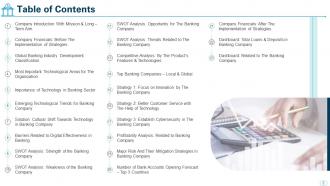
Slide 2: This is a Table of Contents slide.
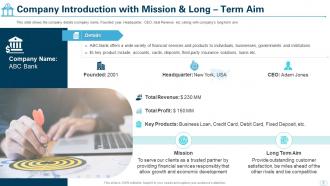
Slide 3: This slide shows the company details (company name, Founded year, Headquarter, CEO, total Revenue etc.) along with company’s long-term aim.
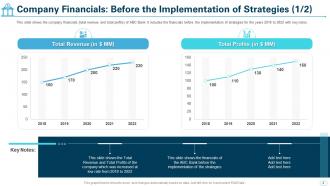
Slide 4: This slide shows the company financials (total revenue and total profits) of ABC Bank. It includes the financials before the implementation of strategies for the years 2018 to 2022 with key notes.
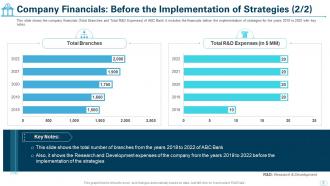
Slide 5: This slide shows the company financials (Total Branches and Total R&D Expenses) of ABC Bank. It includes the financials before the implementation of strategies for the years 2018 to 2022 with key notes.
Slide 6: This slide shows the worldwide growth of banking industry in classification of Total assets, Return on assets and better capitalization.
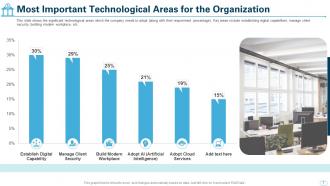
Slide 7: This slide shows the significant technological areas which the company needs to adopt (along with their requirement percentage). Key areas include establishing digital capabilities, manage client security, building modern workplace, etc.
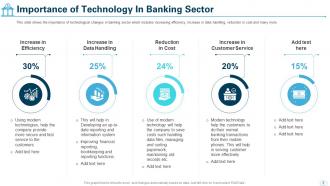
Slide 8: This slide shows the importance of technological changes in banking sector which includes increasing efficiency, increase in data handling, reduction in cost and many more.
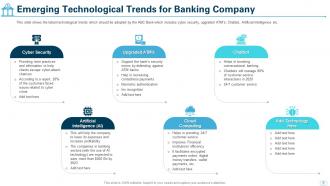
Slide 9: This slide shows the latest technological trends which should be adopted by the ABC Bank which includes cyber security, upgraded ATM’s, Chatbot, Artificial Intelligence etc.
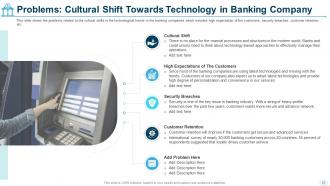
Slide 10: This slide shows the problems related to the cultural shifts in the technological trends in the banking companies which includes high expectation of the customers, security breaches, customer retention, etc.
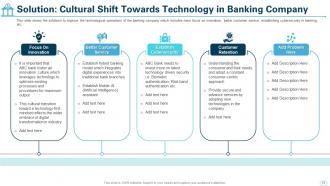
Slide 11: This slide shows the solutions to improve the technological operations of the banking company which includes more focus on innovation, better customer service, establishing cybersecurity in banking, etc.
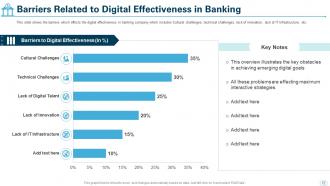
Slide 12: This slide shows the barriers which effects the digital effectiveness in banking company which includes Cultural challenges, technical challenges, lack of innovation, lack of IT Infrastructure, etc.
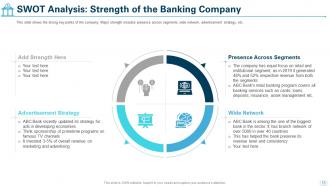
Slide 13: This slide shows the strong key points of the company. Major strength includes presence across segments, wide network, advertisement strategy, etc.
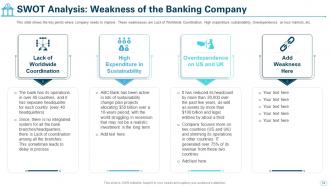
Slide 14: This slide shows the key points where company needs to improve. These weaknesses are Lack of Worldwide Coordination, High expenditure sustainability, Overdependence on less markets, etc.
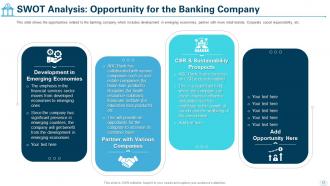
Slide 15: This slide shows the opportunities related to the banking company which includes development in emerging economies, partner with more retail brands, Corporate social responsibility, etc.
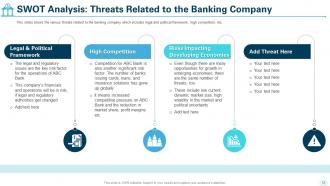
Slide 16: This slides shows the various threats related to the banking company which includes legal and political framework, high competition, etc.
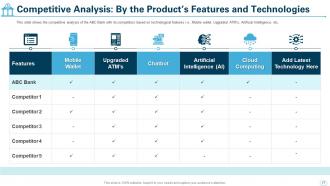
Slide 17: This slide shows the competitive analysis of the ABC Bank with its competitors based on technological features i.e., Mobile wallet, Upgraded ATM’s, Artificial Intelligence, etc.
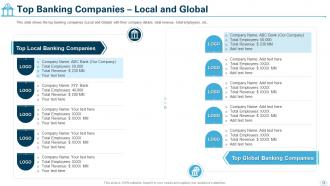
Slide 18: This slide shows the top banking companies (Local and Global) with their company details, total revenue, total employees, etc.
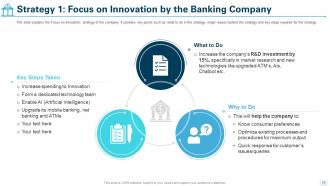
Slide 19: The slide explains the Focus on Innovation strategy of the company. It provides key points such as ‘what to do in the strategy, major reason behind the strategy and key steps required for the strategy
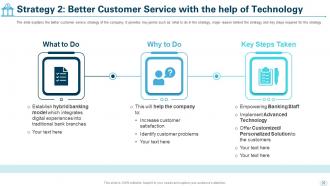
Slide 20: The slide explains the better customer service strategy of the company. It provides key points such as ‘what to do in the strategy, major reason behind the strategy and key steps required for the strategy
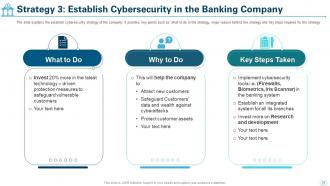
Slide 21: The slide explains the establish cybersecurity strategy of the company. It provides key points such as ‘what to do in the strategy, major reason behind the strategy and key steps required for the strategy
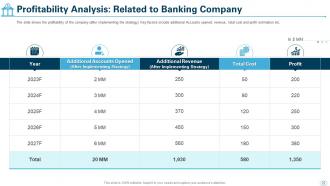
Slide 22: The slide shows the profitability of the company (after implementing the strategy). Key factors include additional Accounts opened, revenue, total cost and profit estimation etc.
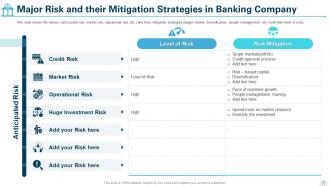
Slide 23: This slide shows the various risks (credit risk, market risk, operational risk, etc.) and their mitigation strategies (target market, diversification, people management, etc.) with their level of risks.
Slide 24: The slide shows the forecasted accounts opening of ABC Bank in top three countries (United States, United Kingdom, India). For each country, it provides number of customers and total accounts opened in next five years (2023-2027)
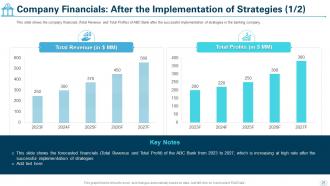
Slide 25: This slide shows the company financials (Total Revenue and Total Profits) of ABC Bank after the successful implementation of strategies in the banking company.
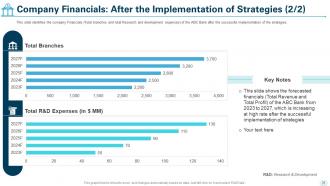
Slide 26: This slide identifies the company Financials (Total branches and total Research and development expenses) of the ABC Bank after the successful implementation of the strategies.
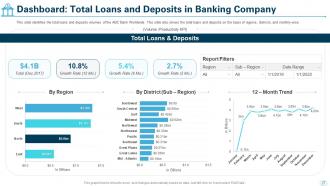
Slide 27: This slide identifies the total loans and deposits volumes of the ABC Bank Worldwide. This slide also shows the total loans and deposits on the basis of regions, districts, and monthly-wise.
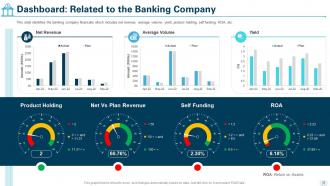
Slide 28: This slide identifies the banking company financials which includes net revenue, average volume, yield, product holding, self funding, ROA, etc.
Slide 29: This is an Icon Slide.
Slide 30: This is an Additional Slides
Slide 31: This slide presents Puzzle for creative thinking.
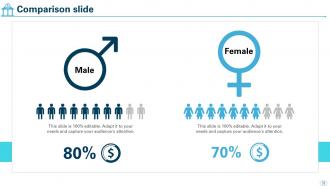
Slide 32: This is a Comparison slide to compare two different products.
Slide 33: This is Funnel Filter Icon with Arrow slide that can be used to present lead generation.
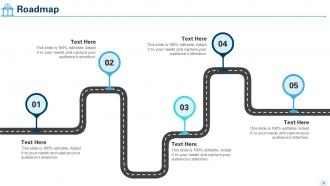
Slide 34: This is a Roadmap slide that can be used to present series of events.
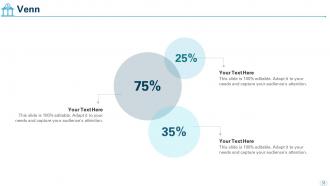
Slide 35: This is a Venn diagram slide that can be used to compare three different items.
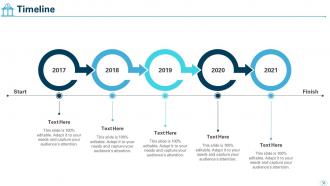
Slide 36: This is a Timeline slide that can be used to present chronological sequence of events.
Slide 37: This is a 30 60 90 Days Plan slide that can be used to prepare robust organizational plans.
Slide 38: This is a Thank You slide for acknowledgment.
Cultural Shift Toward A Technology In A Banking Company Powerpoint Presentation Slides with all 43 slides:
Use our Cultural Shift Toward A Technology In A Banking Company Powerpoint Presentation Slides to effectively help you save your valuable time. They are readymade to fit into any presentation structure.














FAQs for Cultural Shift Toward A Technology In A Banking Company
Key cultural shifts driving digital banking adoption include demand for instant services, mobile-first expectations, personalized experiences, transparent operations, and seamless omnichannel interactions. These evolving customer behaviors enhance banking operations by reducing wait times, streamlining account management, and delivering 24/7 accessibility, with many financial institutions finding that embracing these shifts creates significant competitive advantage.
Customer behavior influences banking transformation by driving demand for instant, personalized, and omnichannel experiences that mirror their digital lifestyles across retail and social platforms. Banks are responding with mobile-first strategies, AI-powered chatbots, and seamless digital onboarding processes, while integrating real-time payment systems and predictive analytics to deliver faster services and enhanced customer experiences.
Fintech companies are reshaping traditional banking cultures by introducing agile development practices, customer-centric design thinking, data-driven decision making, and collaborative work environments that prioritize innovation over rigid hierarchies. Through digital-first approaches and rapid iteration cycles, these cultural shifts enable banks to deliver faster product launches, enhanced customer experiences, and streamlined operations, with many financial institutions finding that adopting fintech methodologies significantly improves their competitive positioning.
AI and machine learning revolutionize banking customer interactions by enabling personalized recommendations, instant query resolution through chatbots, and proactive fraud detection. Through these technologies, banks deliver faster loan approvals, 24/7 customer support, and tailored financial advice, while reducing operational costs, ultimately enhancing customer satisfaction and competitive positioning.
Social media significantly influences banking customer expectations by showcasing instant, personalized experiences from other industries, creating demand for seamless digital interactions, real-time support, and transparent communication. Banks increasingly leverage social platforms for customer service, financial education, and personalized marketing, with many institutions finding that active social engagement enhances customer loyalty and competitive positioning.
Banks address data privacy and security through multi-layered encryption, zero-trust architecture, biometric authentication, regulatory compliance frameworks, and continuous monitoring systems. These technologies enhance customer protection by minimizing data breaches, streamlining secure transactions, and ensuring regulatory adherence, with many financial institutions finding that proactive security measures ultimately deliver competitive advantage and stronger customer trust.
Banks face cultural challenges including employee resistance to change, fear of job displacement, generational technology gaps, risk-averse mindsets, and siloed departmental structures. These barriers can significantly impact digital transformation initiatives, with many financial institutions finding that comprehensive change management, retraining programs, and leadership commitment ultimately deliver smoother technology adoption and competitive advantage.
Mobile banking has strengthened customer loyalty by delivering enhanced convenience, 24/7 accessibility, and personalized financial management tools, while building trust through advanced security features and transparent transaction tracking. Financial institutions implementing robust mobile platforms find that customers demonstrate increased engagement and retention rates, with many banks reporting that seamless mobile experiences ultimately drive competitive advantage in an increasingly digital marketplace.
A cashless society fundamentally transforms traditional banking by accelerating digital service delivery, reducing physical branch dependency, and requiring enhanced cybersecurity infrastructure and real-time transaction processing capabilities. Banks increasingly streamline operations through mobile platforms, contactless payments, and automated services, while investing heavily in fraud detection and customer digital experiences, ultimately delivering faster transactions and lower operational costs in an increasingly competitive financial landscape.
**INPUT**: How do different demographics perceive and adopt banking technologies? **OUTPUT**: Different demographics approach banking technologies with varying levels of enthusiasm and adoption patterns, with younger generations embracing mobile-first solutions while older customers prefer gradual integration alongside traditional services. Financial institutions increasingly recognize that strategic demographic targeting, personalized onboarding experiences, and multi-channel approaches enable broader technology acceptance, ultimately delivering enhanced customer satisfaction and competitive advantage across all age groups. **Word count: 60 words**
Banks can foster innovation culture through cross-functional collaboration teams, dedicated innovation labs, employee idea competitions, partnerships with fintech startups, and continuous learning programs. These strategies streamline traditional processes while encouraging experimentation, with many financial institutions finding that empowering employees to test new technologies and approaches ultimately delivers enhanced customer experiences and competitive advantage in an increasingly digital banking landscape.
Regulatory changes are accelerating cultural acceptance by establishing clear frameworks for digital banking, fintech partnerships, and data protection, which reduces consumer uncertainty about new technologies. Through standardized compliance requirements, banks can confidently implement innovations like mobile payments and AI-driven services, while customers increasingly trust these solutions, ultimately delivering faster adoption rates and enhanced digital banking experiences.
Cultural differences significantly affect banking technology adoption through varying trust levels in digital systems, regulatory frameworks, customer preferences for personal versus automated interactions, and infrastructure readiness. While Nordic countries embrace cashless solutions and Asian markets drive mobile payment innovation, regions with strong relationship-banking traditions often require hybrid approaches that blend digital efficiency with human touchpoints, ultimately requiring banks to customize their technological strategies for each market's cultural expectations.
Banks leverage customer feedback through advanced analytics platforms, real-time surveys, social media monitoring, mobile app reviews, and user behavior tracking to enhance digital experiences. These insights enable institutions to streamline mobile interfaces, personalize services, and reduce transaction friction, with many financial organizations finding that responsive feedback integration significantly improves customer satisfaction and competitive positioning.
Inclusivity drives banking technology development by ensuring accessibility across diverse populations, languages, and economic backgrounds, while addressing unbanked communities through mobile solutions and simplified interfaces. Banks increasingly recognize that inclusive design expands market reach, reduces regulatory risks, and enhances customer loyalty, with institutions like microfinance providers finding that culturally-adapted technologies deliver sustainable growth and competitive advantage.
-
Crisp and neat slides. Makes it fun and easier to curate presentations.
-
Nothing beats the well-formatted and professionally designed templates offered. Kudos to SlideTeam for their amazing collection of PPT slides.