

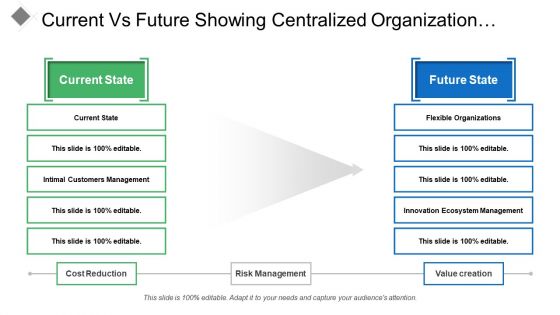
Current vs future showing centralized organization flexible organization





Try Before you Buy Download Free Sample Product
 Impress Your
 Audience
 100%
100% Editable
 Save Hours
 of Time


Make this current vs future showing centralized organization flexible organization PowerPoint presentation slide be a part of your next presentation. Our designing team has created this current vs future state professional PPT design to meet the industry requirements. By incorporating our current vs future state organization presentation graphic, you can compare your business performance in a clear and reasonable way. Elegant and professional colors have been used to design this current vs future state PPT visual which can also be changed to match your company’s look and feel if required as the slide is completely amendable. Any business firm needs to have a direction and a goal in mind before starting its operations. With our current vs future state comparison PPT template, you can represent a clear picture of where you want your business to be in the future with the available resources, efforts and time given to your team members. Figure out each and every detail with our Current Vs Future Showing Centralized Organization Flexible Organization. Be able to analyze any challenge.
People who downloaded this PowerPoint presentation also viewed the following :
Current vs future showing centralized organization flexible organization with all 5 slides:
Do not let the excitement abate. Our Current Vs Future Showing Centralized Organization Flexible Organization will keep the mood up.
FAQs for Current vs future showing centralized
Centralized organizations feature concentrated decision-making authority at the top levels, standardized processes across departments, clear hierarchical reporting structures, limited autonomy for lower-level employees, and uniform policies throughout the organization. This approach streamlines operations by ensuring consistent standards, reducing redundancies, and maintaining tight quality control, with many large institutions finding that centralized structures enhance coordination and strategic alignment across multiple locations.
Centralized structures concentrate decision-making at senior leadership levels, ensuring consistency and control but potentially slowing response times, while flexible organizations distribute authority across teams and departments for faster adaptation. Many companies find that flexible structures enable quicker market responses, enhanced innovation, and improved employee engagement, ultimately delivering competitive advantage in increasingly dynamic business environments.
Centralized organizations offer multinational companies enhanced strategic control, standardized operational procedures, streamlined decision-making processes, unified brand messaging, and consolidated resource allocation across global markets. Through centralized governance, companies achieve greater cost efficiencies, consistent quality standards, and coordinated market strategies, while minimizing operational redundancies and ensuring aligned corporate objectives, ultimately delivering competitive advantage in increasingly complex international environments.
Flexible organizations outperform centralized ones in rapidly changing markets, innovation-driven industries, customer-centric environments, and diverse geographical operations where local adaptation is crucial. These structures enable faster decision-making, enhanced responsiveness to market shifts, and greater employee autonomy, with many technology companies and startups finding that decentralized approaches deliver competitive advantage and accelerated growth.
Employee autonomy differs significantly between these frameworks, with centralized structures typically limiting decision-making authority to senior leadership while flexible organizations distribute autonomy across multiple levels. In centralized systems, employees follow established protocols and seek approval for decisions, whereas flexible frameworks enable staff to make independent choices, adapt to local conditions, and respond quickly to customer needs, ultimately enhancing innovation and organizational responsiveness.
Organizational structure significantly impacts innovation by influencing communication flow, decision-making speed, and creative collaboration, with centralized structures providing clear direction but potentially stifling rapid experimentation, while flexible structures enhance cross-functional innovation and agile responses. Many technology companies and startups find that hybrid approaches deliver both strategic alignment and creative freedom, ultimately enabling faster product development and competitive advantage.
Companies transition from centralized to flexible structures by gradually delegating decision-making authority, implementing cross-functional teams, establishing clear accountability frameworks, and investing in employee training and development programs. This strategic transformation enables faster responses to market changes, enhanced innovation capabilities, and improved employee engagement, with many organizations finding that phased implementation across departments minimizes disruption while delivering competitive advantages.
Technology enables flexible organizational structures by providing cloud-based collaboration platforms, project management systems, remote communication tools, and real-time data analytics that support distributed teams. These digital solutions streamline coordination across departments, enhance transparency in workflows, and automate routine processes, with many organizations finding that technology ultimately delivers faster decision-making and improved operational agility.
Centralized organizations manage risk through standardized policies, formal approval hierarchies, and centralized oversight committees, while flexible organizations emphasize distributed decision-making, adaptive responses, and localized risk assessment. Through these contrasting approaches, banks typically use centralized frameworks for regulatory compliance, whereas tech companies leverage flexible models for rapid market adaptation, with many finding that hybrid approaches deliver both consistency and agility.
Centralized structures foster consistent culture through uniform policies, standardized communication, and shared values across all levels, while flexible structures encourage diverse, adaptive cultures with localized decision-making and varied practices. While centralized organizations deliver cultural cohesion and brand consistency, flexible structures enable innovation and responsiveness, with many companies finding that hybrid approaches balance cultural unity with departmental autonomy for competitive advantage.
In centralized organizations, communication flows vertically through hierarchical channels, with decisions and information moving up and down formal reporting structures. Flexible organizations enable horizontal communication across teams and departments, with many companies finding that cross-functional collaboration, direct peer-to-peer messaging, and decentralized decision-making ultimately streamline operations and accelerate response times.
Technology companies, startups, consulting firms, creative agencies, and healthcare organizations benefit most from decentralized organizational flexibility due to their need for rapid innovation and client responsiveness. These sectors leverage distributed decision-making to accelerate product development, enhance customer service delivery, and adapt quickly to market changes, ultimately delivering competitive advantages through increased agility and faster time-to-market solutions.
Leadership styles significantly influence centralized organizations through decision-making speed, communication clarity, and employee engagement levels. Authoritative leaders can leverage centralized structures for rapid strategic execution, while collaborative leaders may need to adapt by creating feedback channels and empowerment opportunities, with many organizations finding that transformational leadership approaches ultimately deliver both operational efficiency and workforce satisfaction in centralized environments.
Key performance metrics include operational efficiency ratios, decision-making speed measurements, employee engagement scores, innovation indices, and customer satisfaction ratings. Organizations typically find that centralized structures excel in cost control and standardization metrics, while flexible organizations outperform in agility measures, employee retention, and market responsiveness, ultimately delivering competitive advantages tailored to their strategic priorities.
Flexible organizational structures are generally more effective for customer responsiveness because they enable faster decision-making, reduce bureaucratic delays, and allow front-line employees to address customer needs directly without multiple approval layers. While centralized structures provide consistency, flexible organizations in sectors like retail and financial services can adapt quickly to customer feedback, implement solutions rapidly, and deliver personalized experiences that enhance satisfaction and competitive advantage.
-
Qualitative and comprehensive slides.
-
Graphics are very appealing to eyes.