

Cyber Security Attacks Response Plan Cyber Security Event And Incident Flow Diagram




Try Before you Buy Download Free Sample Product
 Impress Your
Audience
 100%
Editable
 Save Hours
of Time


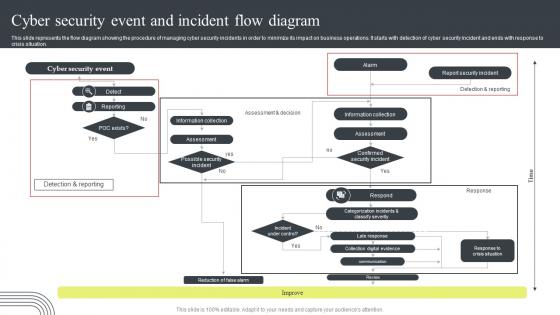
This slide represents the flow diagram showing the procedure of managing cyber security incidents in order to minimize its impact on business operations. It starts with detection of cyber security incident and ends with response to crisis situation.
People who downloaded this PowerPoint presentation also viewed the following :
Cyber Security Attacks Response Plan Cyber Security Event And Incident Flow Diagram with all 6 slides:
Use our Cyber Security Attacks Response Plan Cyber Security Event And Incident Flow Diagram to effectively help you save your valuable time. They are readymade to fit into any presentation structure.






FAQs for Cyber Security Attacks Response Plan Cyber Security Event And
Every Cyber Security Incident Response Plan should include incident identification and classification procedures, communication protocols, containment strategies, evidence preservation methods, recovery processes, and post-incident analysis frameworks. These components work together by enabling rapid threat detection, coordinating cross-functional response teams, and minimizing business disruption, with many organizations finding that comprehensive planning significantly reduces recovery time and operational costs.
Organizations can ensure their incident response teams are properly trained through regular tabletop exercises, hands-on simulations, threat intelligence briefings, and certification programs in cybersecurity frameworks like NIST or ISO 27035. These comprehensive training approaches, combined with access to cutting-edge security tools and real-time threat feeds, enable teams to respond swiftly and effectively to emerging cyber threats, ultimately minimizing downtime and protecting critical business operations.
Threat intelligence enhances incident response plans by providing contextual threat data, identifying attack patterns, enabling proactive threat hunting, and informing priority-based response protocols. Through real-time intelligence feeds, organizations streamline detection capabilities, accelerate containment decisions, and strengthen defensive strategies, with many financial services and healthcare institutions finding that intelligence-driven approaches significantly reduce response times and improve security outcomes.
Cyber Security Incident Response Plans should be tested quarterly through tabletop exercises and updated annually, with immediate revisions following actual incidents or significant infrastructure changes. Many organizations find that regular testing reveals communication gaps and process inefficiencies, while frequent updates ensure alignment with evolving threats, ultimately delivering faster containment and reduced business impact.
Best practices for communication during cybersecurity incidents include establishing clear escalation protocols, designating authorized spokespersons, maintaining regular stakeholder updates, using secure communication channels, and preparing pre-approved messaging templates. These approaches streamline crisis management by ensuring accurate information flow, minimizing confusion, and maintaining stakeholder confidence, with many organizations finding that structured communication protocols significantly reduce response times and reputational damage.
Organizations should prioritize incidents using severity classifications that consider business impact, affected systems, data sensitivity, operational disruption, and regulatory implications. Banking institutions typically prioritize customer data breaches over system slowdowns, while healthcare organizations focus on patient safety systems, with many finding that clear escalation matrices enable faster response times, minimize damage, and ensure critical assets receive immediate attention.
Common pitfalls include inadequate stakeholder involvement, insufficient testing and training, unclear roles and responsibilities, poor communication protocols, and lack of regular updates. Many organizations create overly complex plans without considering real-world constraints, while others underestimate recovery timeframes and external dependencies, ultimately finding that untested plans fail during actual incidents when swift, coordinated responses are critical.
Small businesses typically implement streamlined incident response plans with fewer team members, simpler communication channels, and basic containment procedures, while large enterprises require complex multi-tiered frameworks involving specialized security teams, detailed escalation protocols, and comprehensive recovery systems. Through scalable response strategies, organizations can enhance their security posture proportionally, with many finding that tailored approaches deliver faster threat mitigation and improved operational resilience.
Legal and regulatory considerations include data breach notification laws, privacy regulations like GDPR and CCPA, industry-specific compliance requirements, evidence preservation protocols, and regulatory reporting obligations. These frameworks ensure organizations maintain compliance while managing incidents, with many financial services and healthcare institutions finding that proactive legal alignment streamlines response efforts and minimizes regulatory penalties.
Tools enhancing incident response capabilities include SIEM platforms, endpoint detection systems, threat intelligence feeds, automated orchestration tools, and forensic analysis software. These technologies streamline incident detection, accelerate threat containment, and enable coordinated response workflows, with many organizations finding that integrated platforms deliver faster resolution times and significantly improved security postures.
Post-incident reviews should include documenting the timeline and impact, analyzing response effectiveness, identifying security gaps, evaluating communication protocols, and assessing recovery procedures. These comprehensive assessments enable organizations to strengthen their defenses, streamline future responses, and enhance team coordination, with many companies finding that structured reviews significantly reduce response times and improve overall cybersecurity resilience.
Organizations can enhance collaboration by establishing clear communication protocols, creating cross-functional incident response teams with defined roles, and conducting regular joint training exercises that simulate real-world scenarios. Through integrated communication platforms and pre-defined escalation procedures, departments like HR, legal, and operations work seamlessly with IT security, ultimately delivering faster incident resolution and minimized business disruption.
Key metrics include mean time to detection, containment time, recovery duration, incident classification accuracy, and stakeholder communication effectiveness. These measurements enable organizations to identify response bottlenecks, optimize resource allocation, and enhance security protocols, with many financial institutions and healthcare providers finding that consistent metric tracking ultimately delivers faster threat mitigation and improved operational resilience.
Third-party vendors should be integrated through clearly defined communication protocols, shared incident classification systems, and coordinated response procedures that align with your organization's security framework. Many financial services and healthcare organizations establish dedicated vendor liaison roles, require real-time threat intelligence sharing, and conduct joint tabletop exercises, ultimately ensuring seamless collaboration while maintaining strict data protection standards across the entire business ecosystem.
Ransomware incident considerations include immediate network isolation, backup verification, ransom payment policies, legal notification requirements, and communication protocols with law enforcement agencies. These specialized procedures enable organizations to contain threats rapidly, assess data recovery options, and maintain compliance obligations, while many financial institutions and healthcare systems find that pre-established vendor relationships and alternative operational processes minimize downtime and restore critical services efficiently.
-
It is my first time working with them and that too on a friend's recommendation. I would say, I am not expecting such a worldly service at this low price.
-
Great product, helpful indeed!