

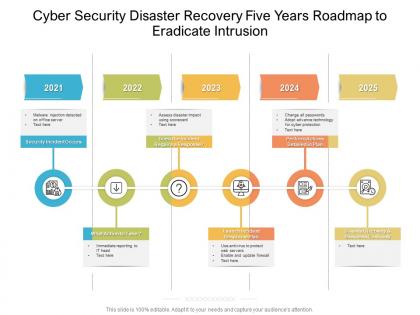
Cyber security disaster recovery five years roadmap to eradicate intrusion




Try Before you Buy Download Free Sample Product
 Impress Your
Audience
 100%
Editable
 Save Hours
of Time


Our Cyber Security Disaster Recovery Five Years Roadmap To Eradicate Intrusion are topically designed to provide an attractive backdrop to any subject. Use them to look like a presentation pro.
People who downloaded this PowerPoint presentation also viewed the following :
Cyber security disaster recovery five years roadmap to eradicate intrusion with all 2 slides:
Use our Cyber Security Disaster Recovery Five Years Roadmap To Eradicate Intrusion to effectively help you save your valuable time. They are readymade to fit into any presentation structure.


FAQs for Cyber security disaster recovery five years roadmap
An effective cybersecurity roadmap includes threat assessment, risk management, security architecture design, incident response planning, and ongoing training and awareness programs. These components work together to proactively identify vulnerabilities, minimize risks, establish robust security measures, effectively respond to incidents, and cultivate a security-conscious culture across organizations, ultimately delivering enhanced data protection and business continuity.
Assessing your cybersecurity posture involves identifying vulnerabilities and strengths across your IT infrastructure, data security practices, and employee awareness. Organizations can leverage vulnerability scans, penetration testing, and risk assessments to pinpoint weaknesses, while reviewing security policies, incident response plans, and employee training programs reveals strengths. These insights, coupled with industry best practices and threat intelligence, inform a tailored cybersecurity roadmap that prioritizes mitigation strategies and resource allocation, ultimately enhancing organizational resilience and protecting valuable assets.
Risk assessment plays a crucial role in developing a cybersecurity roadmap by identifying vulnerabilities, potential threats, and their potential impact on an organization. It allows businesses to prioritize security measures based on the likelihood and severity of risks, enabling them to allocate resources effectively and develop targeted strategies. By understanding their unique risk profile, organizations can create a roadmap that addresses their most critical security needs, ultimately enhancing their resilience against cyber threats.
Organizations should update their cybersecurity roadmap at least annually, and more frequently in rapidly evolving threat landscapes. This ensures alignment with emerging threats, evolving technologies, and changing business needs. Regular updates allow organizations to proactively address vulnerabilities, integrate new security controls, and adapt to shifting regulatory requirements, ultimately enhancing their overall security posture and minimizing risk.
Integrating a cybersecurity roadmap with overall business strategy involves aligning security measures with organizational goals, risk tolerance, and future plans. This ensures that cybersecurity initiatives support business growth by proactively mitigating threats, safeguarding sensitive data, and enhancing operational efficiency, ultimately contributing to a competitive advantage while minimizing disruptions and financial losses.
Developing a cybersecurity roadmap involves prioritizing initiatives based on risk assessment and business impact. Organizations can prioritize by identifying critical assets, vulnerabilities, and potential threats, then mapping out mitigation strategies aligned with business objectives. For example, financial institutions might prioritize fraud detection and data encryption, while healthcare providers focus on patient data protection and HIPAA compliance, ultimately strengthening their defenses and ensuring business continuity.
Creating a cybersecurity roadmap presents both challenges and opportunities; common pitfalls include neglecting stakeholder buy-in, failing to prioritize risks based on impact and likelihood, and underestimating the need for ongoing monitoring and adaptation. With many organizations finding that a static roadmap becomes outdated quickly, it's crucial to incorporate flexibility and iterative updates, ensuring alignment with evolving threats and business needs.
Integrating emerging technologies like AI and machine learning into a cybersecurity roadmap can significantly enhance an organization's defenses. AI-powered systems can automate threat detection and response by analyzing vast amounts of data for suspicious patterns, enabling faster identification and mitigation of potential breaches. Machine learning algorithms can also continuously adapt and improve their accuracy over time by learning from new threats and vulnerabilities, ultimately delivering proactive security measures and minimizing the risk of successful attacks.
A comprehensive cybersecurity roadmap should track metrics such as incident response time, mean time to remediation (MTTR), vulnerability discovery rate, and security awareness training completion rates. These metrics provide insights into the effectiveness of security controls, incident handling processes, and employee training programs, ultimately demonstrating the roadmap's success in mitigating risks and enhancing the organization's overall security posture.
A cybersecurity roadmap addresses compliance requirements across different industries by outlining specific security controls tailored to each sector's regulations. For example, a healthcare organization's roadmap will prioritize HIPAA compliance through data encryption and access controls, while a financial institution's roadmap focuses on PCI DSS adherence through secure payment processing and vulnerability assessments. By aligning security measures with industry-specific standards, organizations can demonstrate compliance, mitigate risks, and protect sensitive data across diverse sectors.
Developing a robust cybersecurity roadmap necessitates crucial stakeholder involvement from various departments within an organization. This includes IT security teams, legal and compliance experts, senior management, and representatives from each department whose data and operations are critical to the business. These diverse perspectives ensure the roadmap addresses technical vulnerabilities, legal requirements, business continuity needs, and user awareness training, ultimately delivering a comprehensive and effective cybersecurity strategy.
Organizations can ensure their cybersecurity roadmap is adaptable by prioritizing continuous monitoring and assessment, integrating threat intelligence feeds, and establishing flexible response protocols. By regularly evaluating their existing security posture against emerging threats and vulnerabilities, organizations can proactively update their roadmap, implementing new controls and adjusting strategies to effectively mitigate evolving risks. This iterative approach, often adopted by financial services and healthcare institutions, ensures their defenses remain robust in the face of constantly changing cyber landscapes.
A robust cybersecurity roadmap for today's organizations must address the expanded attack surface presented by remote workforces, encompassing endpoint security, data encryption, and robust access controls. With many organizations finding that traditional perimeter-based security is insufficient, a comprehensive strategy must include multi-factor authentication, regular security awareness training, and vulnerability assessments tailored to remote environments, ultimately delivering enhanced data protection and operational continuity.
Organizations can leverage third-party partnerships in their cybersecurity roadmap by integrating specialized expertise and resources. This can involve collaborating with managed security service providers (MSSPs) for 24/7 threat monitoring and incident response, partnering with cybersecurity consulting firms for vulnerability assessments and penetration testing, and engaging with technology vendors for advanced security solutions tailored to their specific needs. These strategic alliances enable organizations to enhance their security posture, mitigate risks, and focus on core business operations while benefiting from the latest industry best practices and cutting-edge technologies.
A comprehensive cybersecurity roadmap for employees should include training on recognizing phishing attempts, handling sensitive data securely, and understanding password best practices. These initiatives empower employees to act as the first line of defense, minimizing the risk of data breaches and cyberattacks. With many organizations facing increasingly sophisticated threats, well-trained employees are essential for maintaining a robust cybersecurity posture.
-
Very unique, user-friendly presentation interface.
-
Excellent template with unique design.
-
Informative design.