

Cyber Security Gap Analysis Process




Try Before you Buy Download Free Sample Product
 Impress Your
Audience
 100%
Editable
 Save Hours
of Time


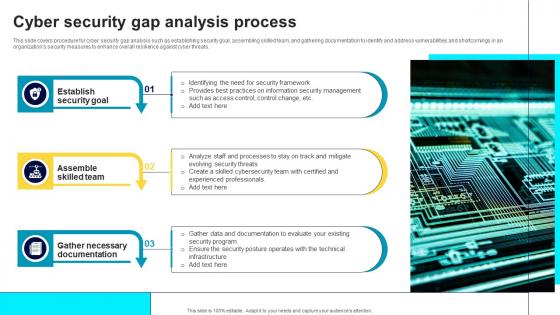
This slide covers procedure for cyber security gap analysis such as establishing security goal, assembling skilled team, and gathering documentation to identify and address vulnerabilities and shortcomings in an organizations security measures to enhance overall resilience against cyber threats.
People who downloaded this PowerPoint presentation also viewed the following :
Cyber Security Gap Analysis Process with all 9 slides:
Use our Cyber Security Gap Analysis Process to effectively help you save your valuable time. They are readymade to fit into any presentation structure.









FAQs for Cyber Security
Key components of a cybersecurity gap analysis include current security posture assessment, threat landscape evaluation, compliance requirements review, vulnerability identification, and risk prioritization matrices. These elements work together by establishing baseline security measures, identifying critical vulnerabilities, and creating actionable remediation roadmaps, with many organizations finding that comprehensive gap analyses ultimately deliver enhanced protection and regulatory compliance.
Organizations identify their cybersecurity posture through comprehensive risk assessments, vulnerability scanning, penetration testing, compliance audits, and security control evaluations. These methodologies enable businesses to map existing defenses against industry standards, identify critical vulnerabilities, and prioritize remediation efforts, with many financial institutions and healthcare organizations finding that systematic assessments ultimately deliver enhanced threat resilience and regulatory compliance.
Common vulnerabilities discovered during gap analysis include outdated software patches, weak authentication protocols, inadequate network segmentation, insufficient data encryption, and poor access controls. These security gaps typically affect organizations across healthcare, financial services, and retail sectors, with many institutions finding that addressing these fundamental weaknesses significantly reduces breach risks while enhancing overall operational security.
Organizations should conduct cybersecurity gap analyses annually at minimum, with additional assessments following major infrastructure changes, security incidents, or regulatory updates. Many financial institutions and healthcare organizations perform quarterly reviews, while rapidly scaling companies often conduct semi-annual analyses, ultimately ensuring continuous protection against evolving threats and maintaining competitive operational resilience.
Cybersecurity gap analysis frameworks include NIST Cybersecurity Framework, ISO 27001, CIS Controls, COBIT, and FAIR (Factor Analysis of Information Risk). These frameworks streamline assessment processes by providing structured methodologies, standardized benchmarks, and comprehensive evaluation criteria, with many organizations finding that combining multiple frameworks delivers more thorough vulnerability identification and strategic security improvements.
Employee training serves as a critical defense mechanism for closing cybersecurity gaps by building security awareness, establishing proper protocols, and reducing human error vulnerabilities. Through targeted education programs, organizations enhance incident response capabilities, strengthen password management practices, and improve phishing detection skills, with many companies finding that well-trained employees become their strongest line of defense against evolving cyber threats.
Organizations can prioritize gap analysis findings by assessing risk levels, potential business impact, regulatory requirements, and implementation complexity. Critical vulnerabilities affecting core systems, customer data, or compliance mandates typically receive immediate attention, while lower-risk gaps are scheduled based on available resources, ultimately enabling systematic security improvements that protect business operations and maintain competitive advantage.
Recommended cybersecurity gap analysis tools include Nessus for vulnerability scanning, Rapid7 for risk assessment, Qualys for compliance mapping, CyberGRX for third-party evaluations, and RSA Archer for governance frameworks. These platforms streamline security posture evaluation by automating threat detection, standardizing compliance reporting, and providing actionable remediation insights, ultimately delivering comprehensive risk visibility and strategic security improvements.
Regulatory requirements significantly influence cybersecurity gap analysis by establishing mandatory compliance baselines, defining specific security controls, and dictating assessment timeframes across industries like healthcare, finance, and government. These frameworks, including GDPR, HIPAA, and SOX, streamline the analysis process by providing structured evaluation criteria, while ultimately delivering enhanced risk management and regulatory adherence for organizations.
Neglecting cybersecurity gaps can result in data breaches, financial losses, regulatory penalties, operational disruptions, and severe reputation damage that undermines customer trust. These vulnerabilities expose organizations to ransomware attacks, intellectual property theft, and compliance violations, with many businesses finding that recovery costs significantly exceed preventive investments, ultimately threatening long-term competitive viability.
Gap analysis improves incident response strategies by identifying weaknesses in current protocols, response times, and communication channels, while revealing gaps in staff training and technology capabilities. Through systematic evaluation, organizations can streamline their response procedures, enhance coordination between security teams, and implement automated threat detection systems, ultimately reducing breach resolution times and minimizing business disruption.
Key metrics include mean time to detection and response, vulnerability remediation rates, security incident frequency, compliance audit scores, and risk reduction percentages. These measurements enable organizations to track progress systematically, with many financial institutions and healthcare providers finding that establishing baseline metrics before remediation and monitoring monthly improvements ultimately delivers quantifiable security enhancement and regulatory compliance validation.
Third-party vendors significantly expand an organization's attack surface by introducing external access points, data sharing requirements, and potential security vulnerabilities that must be assessed during gap analysis. Through comprehensive vendor risk assessments, organizations evaluate supplier security controls, compliance standards, and integration protocols, with many enterprises finding that vendor-related gaps often represent their most critical exposures requiring immediate remediation strategies.
Common pitfalls include incomplete asset inventory, overlooking third-party vendor risks, focusing solely on technical vulnerabilities while ignoring human factors, and conducting analysis without involving key stakeholders from different departments. These oversights can lead to false security confidence, with many organizations finding that comprehensive assessments involving IT, compliance, and business units ultimately deliver more accurate risk identification and strategic security improvements.
Emerging technologies like artificial intelligence, machine learning, zero-trust architecture, behavioral analytics, and quantum computing are revolutionizing cybersecurity gap analyses by enabling real-time threat detection, predictive vulnerability assessment, and automated response protocols. These technologies enhance organizational security postures through continuous monitoring, adaptive defense mechanisms, and proactive risk identification, with many financial institutions and healthcare organizations finding that AI-driven analyses significantly reduce response times while strengthening overall cyber resilience.
-
A beautiful, professional design paired with high-quality images and content that is sure to impress. It is a must-use PPT template in my opinion.
-
If you are looking for satisfactory PowerPoint services, SlideTeam is your go-to place. I am fully contented with their research and development team.