

Cyber Security Risk Management Dashboard With Geographical Distribution




Try Before you Buy Download Free Sample Product
 Impress Your
Audience
 100%
Editable
 Save Hours
of Time


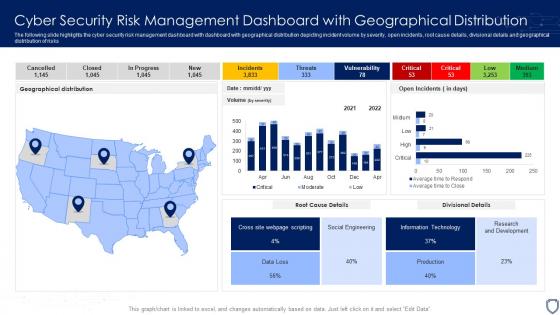
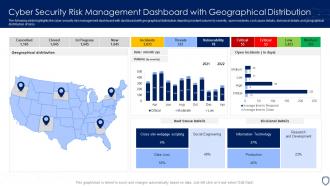
The following slide highlights the cyber security risk management dashboard with dashboard with geographical distribution depicting incident volume by severity, open incidents, root cause details, divisional details and geographical distribution of risks.
People who downloaded this PowerPoint presentation also viewed the following :
Cyber Security Risk Management Dashboard With Geographical Distribution with all 7 slides:
Use our Cyber Security Risk Management Dashboard With Geographical Distribution to effectively help you save your valuable time. They are readymade to fit into any presentation structure.






FAQs for Cyber Security Risk Management Dashboard
Honestly, start with figuring out what you actually have - can't protect stuff you don't even know exists, right? Map out all your systems, data, apps, everything. After that, look at what could go wrong and how likely it is to happen. Prioritize the scary stuff that would really mess you up. Then put controls in place to deal with those risks. The annoying part? You've got to keep checking on everything because hackers don't take breaks. Oh, and don't try to boil the ocean - focus on your biggest vulnerabilities first.
Honestly, just start by figuring out what you actually have that's worth protecting - map your digital stuff first. Then think about who'd realistically come after it. External threats like hackers are obvious, but don't forget about inside problems too (employees screwing up or worse). I always put myself in the hacker's shoes - what looks juicy? NIST frameworks help you sort threats by how likely they are vs. how much damage they'd do. Hit the high-probability, high-impact stuff first obviously. Oh, and run vulnerability scans regularly - you'll miss things otherwise.
Dude, train your employees - seriously the best investment you can make. Most hacks happen because someone clicks a sketchy email or uses "password123" for everything. Hackers would rather trick Bob from accounting than spend weeks cracking your security systems, you know? Quarterly phishing tests work great, plus basic awareness training so people can spot red flags automatically. Your team goes from being the weak spot to actually protecting you. I've seen companies cut incidents in half just from this stuff. Start simple and you'll notice a difference pretty quick.
Honestly, start with the basics - track how fast you respond to incidents and how many attacks actually get through. Employee phishing test scores are gold too. I'd definitely run pen tests regularly because they'll show you real gaps, not just theoretical ones. Security training completion rates matter, plus any downtime from breaches (that one hits the wallet). The key is picking maybe 3-4 metrics that actually align with your business goals. Don't get overwhelmed trying to measure everything - I've seen teams drown in dashboards they never actually use. Monthly reviews work best.
Honestly, unpatched software and weak passwords are still the biggest culprits - boring but true. Your people will click on phishing links no matter how much training you throw at them. Cloud misconfigurations are brutal too, I've seen whole databases get exposed from one wrong setting. Oh, and don't sleep on insider threats or sketchy vendors. Their mess becomes your mess real quick. Start with getting multi-factor authentication rolled out everywhere, then fix your patching process. Those two moves alone will block most of the common stuff hackers love.
Dude, regulations are basically the government saying "you HAVE to take cybersecurity seriously now." GDPR, HIPAA, SOX - they all set baseline requirements for stuff like data protection and incident reporting. Super annoying paperwork-wise, but honestly? They force you to actually document your policies instead of just making it up as you go. Can't fly under the radar anymore. The silver lining is you get a real framework to work with. I'd start by checking what regulations hit your industry, then compare that against what you're already doing. You'll spot the gaps pretty quick that way.
Start by mapping out playbooks for different scenarios - malware, breaches, DDoS stuff. Your team needs to know who does what and when to escalate. Tabletop exercises are actually pretty helpful (and way less boring than you'd think). Set up communication templates now because during an actual incident, nobody's gonna craft perfect emails. Don't forget evidence collection procedures - that's where things get messy if you're unprepared. Oh, and test everything regularly. I've seen too many companies with these elaborate plans that fall apart the second something real happens.
Dude, third-party vendors are basically giving strangers the keys to your house. When they get hacked (and they will), you're going down with them - remember those massive supply chain attacks? You inherit all their crappy security practices, but here's the kicker: you barely know what those practices actually are beyond their fancy marketing materials. I mean, those security questionnaires are basically worthless half the time. Do real vendor assessments before signing anything and make sure security requirements are baked into the contract from day one.
Grab a good vulnerability scanner first - Nessus or Qualys will show you where you're exposed. For monitoring, you'll need a SIEM like Splunk or Sentinel. CrowdStrike and SentinelOne are both great for endpoint protection. Oh, and threat intel platforms? I used to think they were just fancy toys for big corporations, but honestly they're becoming pretty necessary now. MFA everywhere, obviously. Regular pen testing too. The key thing is picking stuff that plays nice together - you don't want five different dashboards that don't talk to each other.
First thing - figure out which business processes actually matter, then see what systems keep them running. Ask yourself what happens if stuff breaks for an hour, day, or week? Put real dollar amounts on it - lost sales, recovery costs, fines, all that crap. Reputation damage usually hurts the most anyway. Create some basic charts ranking threats by how likely they are vs how bad they'd be. Oh, and definitely loop in people from other departments since IT folks won't catch everything. You'll want to revisit this regularly too.
Honestly, start with one good monitoring tool that watches your network 24/7 - the alerts will save your butt when weird stuff happens. Run vulnerability scans regularly and do pen testing to catch problems early. Most places totally forget about their incident response plans until disaster strikes (learned that the hard way). Do quarterly security reviews and make sure your team actually discusses what went wrong after incidents. It's really more of an ongoing thing than a set-it-and-forget-it deal. Pick one tool this month and gradually build up your defenses from there.
Stop treating risk assessments like some yearly paperwork thing you check off. Build them right into your quarterly reviews and project planning so cyber stuff gets the same attention as budget decisions. Most companies I've seen just tack security on at the end - terrible idea. Your executives won't care until you translate the tech jargon into dollars. Don't say "critical vulnerability." Say "this could crash our sales system for two days and cost us $2M." They'll suddenly get very interested. Make cyber risks feel like the business risks they actually are.
So basically AI and IoT are just giving hackers way more ways to mess with you. AI attacks can actually learn from your defenses and adapt - which is honestly terrifying. Plus IoT devices are security nightmares with their default passwords and zero updates. Both technologies create tons of data you need to protect, and your current security tools probably can't handle the speed. Oh, and don't get me started on the compliance issues. You'll need to completely rethink your risk management and probably invest in AI security tools. It's like fighting fire with fire at this point.
Look, your employees can either be your biggest security weakness or your best protection - and it really comes down to culture. When people actually understand why security matters for their specific job, they'll stop clicking sketchy links and start reporting weird stuff faster. Training has to be relevant though, not some generic slideshow everyone ignores. Honestly, I've seen companies cut their risk in half just by getting staff to actually give a damn about protecting data. You're basically building human firewalls throughout the company instead of just hoping your tech catches everything. Make it engaging and you'll be surprised how much people buy in.
Track both tech stuff and business impact to get the real picture. For technical metrics, focus on how fast you detect/respond to incidents, patch timelines, and vulnerability rates going down. Business side - cyber insurance costs, compliance results, actual losses from breaches. That whole "days since last incident" thing feels super jinx-y but yeah, still worth tracking. Pick like 3-5 metrics you can actually stay on top of instead of going overboard. Set your baselines first. Then watch for improvements over time - that's where you'll see if things are actually working.
-
Stunning collection! With a wide variety of options available, I was able to find a perfect slide for my presentation. Thank you, SlideTeam!
-
Delighted to see unique and eye-catching PowerPoint designs that are so easy to customize.