

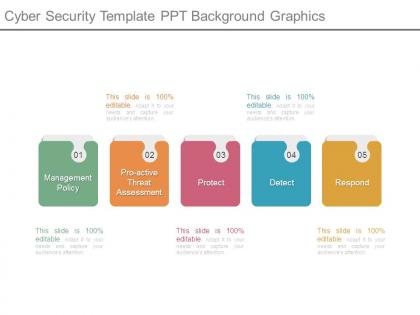
Cyber security template ppt background graphics




Try Before you Buy Download Free Sample Product
 Impress Your
Audience
 100%
Editable
 Save Hours
of Time


Our Cyber Security Template Ppt Background Graphics are topically designed to provide an attractive backdrop to any subject. Use them to look like a presentation pro.
People who downloaded this PowerPoint presentation also viewed the following :
Cyber security template ppt background graphics with all 7 slides:
Use our Cyber Security Template Ppt Background Graphics to effectively help you save your valuable time. They are readymade to fit into any presentation structure.





FAQs for Cyber security template
The most common cyber threats facing businesses today include ransomware attacks, phishing schemes, data breaches, insider threats, and DDoS attacks. These threats increasingly target sectors like healthcare, financial services, and retail through sophisticated social engineering, malware deployment, and system vulnerabilities, ultimately compromising sensitive data, disrupting operations, and causing significant financial losses across organizations of all sizes.
Human error contributes to cybersecurity breaches through phishing attacks, weak password practices, mishandling sensitive data, and failing to follow security protocols. These vulnerabilities create entry points for cybercriminals, with many organizations finding that employee training, multi-factor authentication, and automated security systems significantly reduce risks while enhancing overall security posture.
Employee training plays a critical role in cybersecurity by reducing human error vulnerabilities, improving threat recognition capabilities, establishing consistent security protocols, and fostering organizational security awareness culture. Through regular phishing simulations, password management education, and incident response procedures, organizations across industries like healthcare and financial services significantly minimize data breaches while enhancing overall security posture and regulatory compliance.
Emerging cybersecurity technologies include artificial intelligence, machine learning, zero-trust architecture, quantum cryptography, and behavioral analytics. These technologies enhance security by automating threat detection, enabling predictive analysis, and minimizing human error, with many financial institutions and healthcare organizations finding that AI-driven systems deliver faster incident response and significantly improved threat prevention capabilities.
Small businesses can implement effective cybersecurity strategies through employee training programs, regular software updates, strong password policies, basic firewalls, and cloud-based security solutions. These cost-effective approaches enable organizations to streamline protection by leveraging affordable tools, establishing clear protocols, and partnering with managed security providers, ultimately delivering enhanced protection and operational confidence without significant capital investment.
Data breaches carry significant legal implications including regulatory fines, compliance violations, litigation costs, contractual penalties, and potential criminal liability for executives. Companies face GDPR penalties up to 4% of annual revenue, class-action lawsuits, and mandatory disclosure requirements, with many organizations finding that proactive cybersecurity investments ultimately deliver lower legal exposure and enhanced stakeholder trust.
Organizations can assess their vulnerability through penetration testing, vulnerability scanning, security audits, risk assessments, and employee phishing simulations. These comprehensive evaluations help identify network weaknesses, outdated systems, and human factors, with many financial institutions and healthcare providers finding that regular assessments significantly reduce breach risks and enhance overall security posture.
Mobile device security best practices include implementing strong authentication protocols, enforcing encryption for data transmission and storage, establishing comprehensive mobile device management policies, conducting regular security updates, and providing employee training on phishing recognition. These approaches streamline organizational security by minimizing data breaches, enhancing remote work capabilities, and ensuring regulatory compliance, with many enterprises finding that integrated mobile security frameworks ultimately deliver stronger operational resilience and competitive advantage.
Zero trust architecture enhances cybersecurity by eliminating implicit trust, continuously verifying every user and device, and implementing least-privilege access controls throughout networks. This approach significantly reduces breach impact through micro-segmentation and real-time monitoring, with many financial institutions and healthcare organizations finding that zero trust delivers faster threat detection, minimized lateral movement, and ultimately stronger resilience against sophisticated cyberattacks.
Remote work significantly weakens traditional security perimeters by expanding attack surfaces, increasing endpoint vulnerabilities, and reducing IT oversight over employee devices and networks. While organizations can strengthen their posture through zero-trust architectures, endpoint detection systems, and enhanced employee training, many find that remote environments require more comprehensive security investments and monitoring capabilities to maintain effective protection.
Cyberattacks significantly damage consumer trust and brand reputation by exposing sensitive data, disrupting services, and revealing security vulnerabilities that customers perceive as negligence. Major breaches at companies like Equifax and Target resulted in massive customer defections, regulatory fines, and long-term revenue losses, with many organizations finding that rebuilding trust requires years of transparent security investments.
Essential cybersecurity tools include firewalls, antivirus software, intrusion detection systems, endpoint protection platforms, and security information event management (SIEM) solutions. These technologies streamline threat detection by monitoring network traffic, analyzing suspicious activities, and automating incident responses, with many organizations finding that this strategic combination ultimately delivers enhanced operational security and reduced vulnerability exposure.
Data encryption protects sensitive information by converting data into unreadable code that requires specific keys for decryption, rendering intercepted information useless to unauthorized users. This security measure enables organizations across healthcare, finance, and retail to safeguard customer records, financial transactions, and personal data, ultimately delivering enhanced trust and regulatory compliance while minimizing breach risks.
Recent cybersecurity regulation trends include zero-trust frameworks, mandatory breach reporting within 72 hours, stricter data localization requirements, AI governance protocols, and expanded third-party risk assessments. These regulatory shifts enhance organizational resilience by standardizing incident response, improving cross-border data protection, and strengthening supply chain security, with many financial services and healthcare institutions finding that proactive compliance delivers significant competitive advantage.
Global geopolitical events significantly reshape cybersecurity strategies by increasing threat landscapes, driving regulatory changes, and altering international cooperation frameworks. Organizations adapt through enhanced threat intelligence, diversified supply chains, and strengthened incident response protocols, with financial institutions and critical infrastructure providers finding that geopolitical awareness enables proactive defense postures and strategic resilience.
-
Innovative and Colorful designs.
-
Best way of representation of the topic.
-
Out of the box and creative design.
-
Innovative and attractive designs.