

Cyber threat security maturity model with protection levels




Try Before you Buy Download Free Sample Product
 Impress Your
Audience
 100%
Editable
 Save Hours
of Time


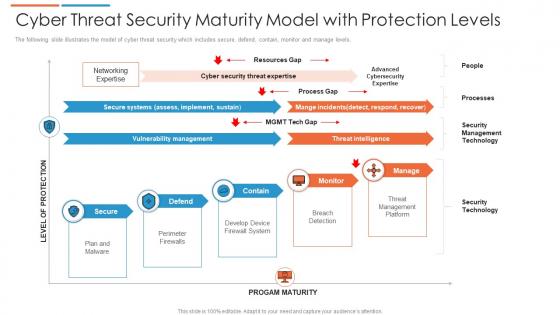
The following slide illustrates the model of cyber threat security which includes secure, defend, contain, monitor and manage levels.
People who downloaded this PowerPoint presentation also viewed the following :
Cyber threat security maturity model with protection levels with all 6 slides:
Use our Cyber Threat Security Maturity Model With Protection Levels to effectively help you save your valuable time. They are readymade to fit into any presentation structure.






FAQs for Cyber threat security maturity model
Primary components of a Cybersecurity Maturity Model include governance frameworks, risk assessment protocols, incident response procedures, access control mechanisms, and continuous monitoring systems. These components work together by establishing baseline security standards, identifying vulnerabilities across organizational levels, and enabling systematic improvements, with many enterprises finding that this structured approach delivers enhanced threat detection and operational resilience.
Organizations assess their current cybersecurity maturity level through comprehensive audits, risk assessments, compliance evaluations, gap analyses, and framework mappings against established standards like NIST or ISO 27001. These assessment methods enable companies to identify vulnerabilities, benchmark capabilities, and prioritize investments, with many financial services and healthcare organizations finding that structured evaluations ultimately deliver enhanced security postures and regulatory compliance.
Risk management serves as the foundational framework within the Cybersecurity Maturity Model, enabling organizations to identify, assess, prioritize, and mitigate cyber threats across all operational levels. Through systematic risk evaluation processes, organizations can strategically allocate resources, enhance security controls, and build resilient defense mechanisms, ultimately delivering measurable protection and competitive advantage in an increasingly complex threat landscape.
A CMM aids cybersecurity strategy development by providing structured assessment frameworks, standardized maturity levels, and clear progression pathways that align security investments with business objectives. Through systematic evaluation processes, organizations can identify current capabilities, prioritize resource allocation, and establish measurable improvement targets, with many financial institutions and healthcare providers finding that this approach delivers enhanced risk management, regulatory compliance, and strategic security roadmaps.
The key differences between cybersecurity maturity models like NIST and CMMI include scope, assessment approach, industry focus, and implementation methodology. NIST emphasizes risk management frameworks with flexible guidelines across sectors, while CMMI provides structured capability levels with formal assessments, and other models like ISO 27001 focus on certification requirements, ultimately enabling organizations to select frameworks that align with their regulatory environment and strategic security objectives.
Companies can measure cybersecurity maturity progress through regular assessments against established frameworks like NIST or ISO 27001, tracking key performance indicators such as incident response times and vulnerability remediation rates, and conducting third-party audits. These measurement approaches enable organizations to identify gaps, benchmark against industry standards, and demonstrate improved risk posture to stakeholders, ultimately delivering enhanced security resilience and regulatory compliance.
Common pitfalls include inadequate initial assessments, lack of executive buy-in, insufficient resource allocation, poor stakeholder communication, and attempting to advance too quickly between maturity levels. Organizations often underestimate the cultural change required, with many finding that rushing implementation without proper foundational controls ultimately creates security gaps, while those taking measured approaches achieve sustainable improvements and stronger defensive postures.
Smaller organizations can effectively adopt a Cybersecurity Maturity Model by starting with basic assessments, prioritizing critical assets, implementing foundational controls, and gradually scaling security measures. Through phased approaches and strategic partnerships with managed security providers, these organizations streamline compliance requirements, enhance risk management capabilities, and build competitive advantages while managing resource constraints effectively.
Effective cybersecurity maturity model metrics include incident response times, vulnerability remediation rates, security awareness training completion, compliance audit scores, and threat detection accuracy. These measurements enable organizations to track progress across maturity levels, identify gaps in manufacturing, healthcare, and financial sectors, while ultimately delivering quantifiable risk reduction and enhanced operational resilience.
Higher cybersecurity maturity significantly enhances business resilience by enabling faster threat detection, minimizing downtime during incidents, and maintaining operational continuity under cyber pressure. Organizations with mature security frameworks can recover more quickly from attacks, preserve customer trust through better data protection, and maintain competitive advantage, with many enterprises finding that strategic cybersecurity investments ultimately reduce overall business risk.
Stakeholder engagement enhances CMM implementation by ensuring alignment across departments, securing executive buy-in for resource allocation, and facilitating knowledge sharing between technical and business teams. Through collaborative workshops and regular communication, organizations streamline policy adoption, accelerate training programs, and minimize resistance to security changes, with many enterprises finding that engaged stakeholders ultimately deliver faster compliance timelines and stronger security culture adoption.
Training and awareness programs serve as foundational pillars for cybersecurity maturity, transforming employees from potential vulnerabilities into active security defenders through regular education, simulated phishing exercises, and incident response drills. These programs enable organizations across healthcare, finance, and manufacturing to significantly reduce human error-related breaches, enhance threat detection capabilities, and build security-conscious cultures, ultimately delivering stronger organizational resilience.
Organizations can align their cybersecurity maturity with industry regulations by conducting comprehensive gap analyses, implementing standardized frameworks like NIST or ISO 27001, and establishing continuous monitoring processes. Through strategic mapping of regulatory requirements to security controls, companies in healthcare, finance, and manufacturing streamline compliance efforts, reduce audit costs, and enhance operational resilience, ultimately delivering stronger security postures and competitive advantage.
Technologies supporting cybersecurity maturity assessment include vulnerability scanners, security information and event management (SIEM) systems, compliance management platforms, risk assessment tools, and automated security testing frameworks. These solutions streamline maturity evaluations by identifying gaps, monitoring compliance progress, and measuring security effectiveness, with many organizations finding that integrated platforms deliver comprehensive visibility and accelerated improvement across their cybersecurity programs.
Organizations should reassess their cybersecurity maturity level quarterly or bi-annually, with additional evaluations following major security incidents, infrastructure changes, or significant threat landscape shifts. This strategic approach enables businesses to identify emerging vulnerabilities, adapt security frameworks proactively, and maintain competitive advantage, with many financial services and healthcare institutions finding that regular assessments streamline compliance while enhancing overall resilience.
-
Amazing product with appealing content and design.
-
Excellent products for quick understanding.