

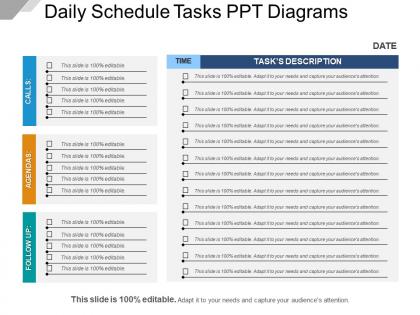
Daily schedule tasks ppt diagrams




Try Before you Buy Download Free Sample Product
 Impress Your
 Audience
 100%
100% Editable
 Save Hours
 of Time


Track your routine actions with the help of this Daily Schedule Tasks PPT Diagrams template. Organize daily activities in a synchronized manner by incorporating this professionally designed PowerPoint slide. Track the progress of the tasks keeping the projects on schedule. List down the activities you need to complete in a day and keep a proper record of all such activities. Showcase the tasks that you have completed on a daily basis. Markdown the important events or projects that need to be completed within the deadline. Plan for the completion of your projects by assigning tasks to your employees on a daily basis. This daily planner PowerPoint slide will clarify your working towards the goals, enhancing the work performance, keeping the projects up to date. Plan your time efficiently and enhance the productivity of the organization. Also, you can maintain a record of the meetings as well. Download this readymade PPT slide now and prepare impactful presentations with ease.
People who downloaded this PowerPoint presentation also viewed the following :
Daily schedule tasks ppt diagrams with all 5 slides:
Our Daily Schedule Tasks Ppt Diagrams generate euphoric feelings. Your happiness will know no bounds.


FAQs for Daily schedule
Essential components of an effective daily schedule include time blocking for focused work, prioritized task lists, buffer periods for unexpected issues, designated break intervals, and realistic deadline setting. These organizational methods streamline productivity by minimizing decision fatigue, enhancing workflow efficiency, and maintaining work-life balance, with many professionals finding that structured scheduling ultimately delivers better performance and reduced stress.
Time-blocking improves productivity by allocating specific time slots for focused work, eliminating decision fatigue, and reducing multitasking distractions. This structured approach enables professionals to prioritize high-impact activities, maintain consistent progress on projects, and create realistic daily schedules, with many organizations finding that employees accomplish 25-40% more tasks when using dedicated time blocks for strategic work.
Prioritization serves as the foundation for effective daily scheduling by helping identify high-impact tasks, allocate time resources strategically, and ensure critical deadlines are met consistently. Through systematic priority assessment, professionals streamline their workflow, minimize time spent on low-value activities, and maximize productivity outcomes, with many organizations finding that structured prioritization ultimately delivers enhanced operational efficiency and competitive advantage.
Technology optimizes daily scheduling through AI-powered calendar assistants, automated task prioritization algorithms, smart notification systems, and integration platforms that sync across devices. These tools streamline workflow management by eliminating double-bookings, suggesting optimal meeting times, and automatically adjusting schedules based on priorities, ultimately delivering enhanced productivity and reduced administrative overhead for busy professionals.
Common daily scheduling pitfalls include overestimating available time, failing to account for unexpected interruptions, scheduling tasks back-to-back without buffer periods, and neglecting to prioritize high-impact activities. These planning mistakes often lead to missed deadlines, increased stress, and reduced productivity, with many professionals finding that incorporating realistic time estimates and flexible scheduling ultimately delivers better work-life balance and enhanced performance.
A daily schedule can be adapted by incorporating buffer time between tasks, prioritizing activities using urgency-impact matrices, and maintaining flexible time blocks for unexpected demands. Successful professionals often allocate 20-25% of their day for interruptions, use time-blocking techniques with built-in cushions, and employ rapid reprioritization methods, ultimately maintaining productivity while accommodating real-world workplace dynamics.
**INPUT**: What strategies can help maintain motivation throughout a busy day? **OUTPUT**: Effective motivation strategies include breaking tasks into smaller milestones, scheduling regular short breaks, celebrating small wins, prioritizing high-impact activities, and maintaining energy through proper hydration and nutrition. These approaches streamline productivity by reducing overwhelm, sustaining focus, and creating positive momentum, with many professionals finding that strategic task sequencing and brief mindfulness moments ultimately deliver sustained performance and reduced burnout throughout demanding workdays.
Incorporating breaks into daily schedules significantly enhances productivity by preventing mental fatigue, maintaining focus levels, and reducing decision-making burnout throughout the workday. Strategic break intervals enable professionals to sustain higher performance standards, process information more effectively, and maintain creative problem-solving abilities, with many organizations finding that structured rest periods ultimately deliver improved output quality and employee satisfaction.
Visual aids for daily scheduling deliver enhanced organization, improved time management, increased accountability, better task prioritization, and reduced mental load through clear visual representation. Digital apps and planners enable users to streamline workflow management, track progress more effectively, and maintain consistent productivity habits, with many professionals finding that visual scheduling tools ultimately enhance focus and reduce stress in demanding work environments.
Integrating personal goals into daily schedules requires strategic time blocking, priority alignment, and consistent habit formation through dedicated goal-focused time slots. By treating personal objectives as non-negotiable appointments, scheduling weekly goal reviews, and connecting daily tasks to larger aspirations, individuals create sustainable progress systems that deliver measurable advancement and long-term achievement consistency.
A well-structured daily schedule significantly enhances work-life balance by establishing clear boundaries, prioritizing essential tasks, reducing decision fatigue, and creating dedicated time for personal activities. Through strategic time blocking and consistent routines, professionals streamline their workdays, minimize overtime, and protect personal time, with many organizations finding that employees with structured schedules demonstrate improved productivity and reduced burnout rates.
Effective delegation can be incorporated by identifying routine tasks suitable for transfer, scheduling regular check-ins with team members, and building buffer time for oversight activities. Through strategic task allocation, managers streamline their daily workflows while developing team capabilities, ultimately enabling focus on high-priority strategic work and enhancing overall operational efficiency across organizations.
Effective anti-procrastination techniques include time-blocking specific tasks, breaking large projects into smaller actionable steps, using the two-minute rule for quick tasks, and implementing accountability systems. These approaches streamline workflow by eliminating decision fatigue, creating momentum through quick wins, and establishing clear boundaries, with many professionals finding that structured scheduling ultimately delivers increased productivity and reduced stress.
Remote work enables flexible scheduling around personal productivity peaks and fewer interruptions, while office environments typically follow structured schedules with built-in collaboration opportunities and clearer boundaries. Many organizations find that hybrid models combine both advantages, with remote workers optimizing deep work blocks and office days facilitating team coordination, ultimately delivering enhanced productivity and improved work-life integration across different employee preferences.
Best practices for reviewing and adjusting daily schedules include analyzing task completion rates, identifying recurring bottlenecks, evaluating time estimates versus actual duration, assessing energy patterns throughout the day, and measuring progress toward larger goals. These review methods streamline productivity by highlighting ineffective time blocks, optimizing high-energy periods for critical tasks, and reallocating resources, with many professionals finding that monthly adjustments ultimately deliver enhanced focus and improved work-life balance.
-
Best Representation of topics, really appreciable.
-
Professional and unique presentations.