

Daily schedule work log ppt example





Try Before you Buy Download Free Sample Product
 Impress Your
Audience
 100%
Editable
 Save Hours
of Time


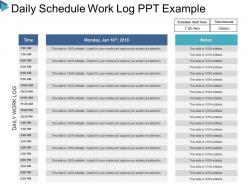
We know that you are already over burdened with a lot of work that is why to reduce your workload we bring to all of you our daily schedule work log PPT example. This daily plan diagram model will help you illustrate a number of business related processes like time, date, scheduled start time, time intervals, notes, etc. Our business experts have designed this tables and matrix business slides using high resolution and premium quality slides which will help you raise the standard of your work. This daily schedule works log diagram model has been designed in such a manner that you will get rid of all the stress and workload that you usually go through while crafting the slides all by yourself. You will also save your time as the slideshow is predesigned and ready to use in nature So, it is highly recommended that you download, edit and present this deck of slides to your audience. The audience will go gaga over our Daily Schedule Work Log Ppt Example. They will be fascinated by their design.
People who downloaded this PowerPoint presentation also viewed the following :
Daily schedule work log ppt example with all 5 slides:
Build the ethos with our Daily Schedule Work Log Ppt Example. Create an enabling environment.


FAQs for Daily schedule work
Maintaining a daily work log enhances productivity by tracking time allocation, identifying inefficiency patterns, and creating accountability for task completion. This systematic approach enables professionals to optimize workflows, eliminate time-wasting activities, and prioritize high-impact tasks, with many organizations finding that consistent logging delivers measurable improvements in project delivery and resource utilization.
A daily work log helps achieve long-term goals by tracking progress patterns, identifying productivity trends, and revealing resource allocation gaps that inform strategic adjustments. Through consistent documentation, professionals can monitor milestone completion, recognize recurring obstacles, and optimize workflows, with many organizations finding that systematic logging enhances accountability and accelerates goal attainment across departments.
**INPUT**: What are the key elements to include in an effective daily work log? **OUTPUT**: Effective daily work logs include task priorities, time allocations, completed activities, challenges encountered, and next-day objectives. These elements streamline project tracking, enhance accountability, and improve resource planning, with many organizations finding that consistent logging delivers better deadline management, clearer performance insights, and ultimately stronger operational efficiency.
Daily work logs reveal patterns by tracking task duration, productivity peaks, distraction triggers, recurring bottlenecks, and energy fluctuations throughout workdays. Through consistent logging, professionals identify their most productive hours, recognize time-wasting activities, and optimize scheduling for high-priority tasks, ultimately enhancing operational efficiency and strategic resource allocation across projects.
Effective daily work log tools include Toggl Track, RescueTime, Clockify, Monday.com, and Asana, which offer time tracking, project categorization, and productivity analytics. These platforms streamline workflow documentation by automating time capture, generating detailed reports, and integrating with existing systems, with many organizations finding that consistent digital logging enhances resource allocation and operational efficiency.
A daily work log enhances team accountability by creating transparency in task progress, deadlines, and individual contributions, while enabling managers to identify bottlenecks and provide timely support. Through shared visibility of daily activities, team members can coordinate more effectively, avoid duplicated efforts, and maintain consistent productivity standards, ultimately delivering improved project outcomes and stronger collaborative relationships.
Consistency in daily work logs requires establishing regular update times, using accessible digital tools, creating simple templates, and linking entries to existing workflows. Many professionals find that scheduling brief 10-minute sessions at day's end, integrating log updates with calendar reviews, and using mobile apps enables seamless tracking, ultimately delivering better project visibility and improved time management across teams.
A daily work log aids time tracking by recording task durations, identifying productivity patterns, and highlighting time inefficiencies across projects and activities. This detailed documentation enables managers to optimize resource allocation, redistribute workloads more effectively, and make data-driven scheduling decisions, with many organizations finding that consistent logging improves project timelines and operational efficiency.
Reviewing daily work logs facilitates better decision-making by identifying productivity patterns, resource allocation inefficiencies, and task priority misalignments that impact strategic outcomes. This systematic analysis enables managers to streamline workflows, optimize team assignments, and allocate resources more effectively, with many organizations finding that data-driven insights ultimately enhance operational efficiency and competitive advantage.
Common mistakes include inconsistent entries, overly detailed documentation, focusing only on tasks rather than outcomes, neglecting to track time spent, and failing to review logs regularly. These oversights limit the log's effectiveness in identifying productivity patterns, with many professionals finding that sporadic maintenance and lack of strategic reflection ultimately reduce their ability to optimize workflows and demonstrate value to stakeholders.
Visual presentation templates enhance daily work log usability by providing structured formats, clear data visualization, consistent tracking methods, and intuitive navigation systems. These templates streamline information capture and review processes, with many project managers and team leaders finding that well-designed visual formats significantly reduce time spent on documentation while improving communication clarity and stakeholder engagement.
Reflection transforms daily work logs from simple record-keeping into strategic improvement tools by identifying patterns, inefficiencies, and successful approaches within your documented activities. Through regular review of logged tasks and outcomes, professionals can optimize time allocation, recognize productivity trends, and adjust workflows accordingly, with many finding that weekly reflection sessions ultimately deliver enhanced decision-making and sustained performance growth.
A daily work log supports professional development by tracking skill applications, identifying knowledge gaps, documenting learning opportunities, and recording feedback received throughout projects. This systematic approach enables professionals to recognize patterns in their growth areas, measure progress against specific competencies, and create targeted development plans, with many finding that consistent logging accelerates career advancement and skill mastery.
Digitizing daily work logs offers enhanced searchability, automatic backups, real-time collaboration, integration with project management tools, and data analytics capabilities. These digital advantages streamline workflow tracking and performance analysis, with many organizations finding that electronic logs enable faster reporting, better resource allocation, and improved productivity insights compared to traditional paper methods.
Daily work logs adapt to remote environments through digital platforms, time-tracking software, collaborative dashboards, video check-ins, and asynchronous communication tools. These systems enable distributed teams to maintain transparency and accountability while accommodating flexible schedules, with many organizations finding that structured logging actually enhances productivity and team cohesion in hybrid settings.
-
Easily Editable.
-
Designs have enough space to add content.