


Dark Data And Its Utilization Powerpoint Presentation Slides




Try Before you Buy Download Free Sample Product
 Impress Your
 Audience
 100%
100% Editable
 Save Hours
 of Time


This Dark Data and its Utilization IT presentation highlights how vast amount of untapped potential that lies within organizations data repositories has major benefits for an organization. It also explains how dark data is much like the submerged portion of an iceberg. Un-indexed data encompasses various types, including untapped data that has not been utilized for decision-making, non-traditional unstructured data like emails and social media content, and data residing in the deep web, which is not easily accessible through standard search engines. This Redundant data module has a huge impact of various industries, by harnessing this data organizations can gain insights into customer behavior, identify patterns, and optimize their offerings. The concept of unstructured data PPT encompasses various challenges associated with it. These challenges include difficulties in organizing, analyzing, and extracting meaningful insights from data that lacks a predefined format or structure. Download our 100 percent editable and customizable template, which is also compatible with Google Slides.
People who downloaded this PowerPoint presentation also viewed the following :
Content of this Powerpoint Presentation
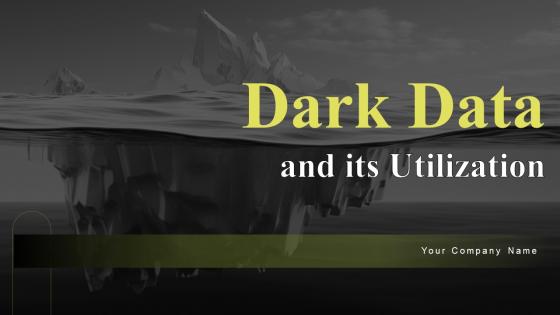
Slide 1: This slide introduces Dark Data and its Utilization. State your company name and begin.
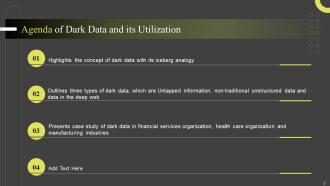
Slide 2: This slide states Agenda of the presentation.
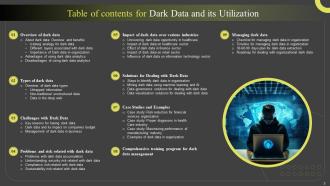
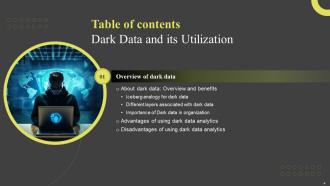
Slide 3: This slide shows Table of Content for the presentation.
Slide 4: This slide highlights title for topics that are to be covered next in the template.
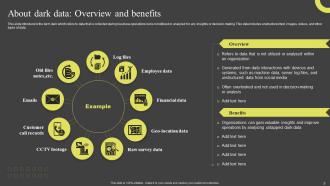
Slide 5: This slide introduce to the term dark which refers to data that is collected during business operations.
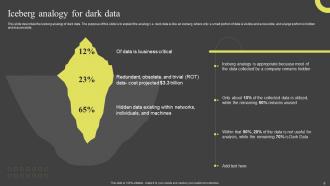
Slide 6: This slide presents Iceberg analogy for dark data.
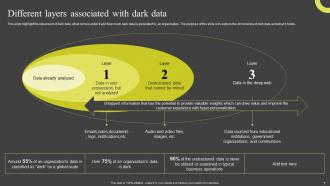
Slide 7: This slide displays Different layers associated with dark data.
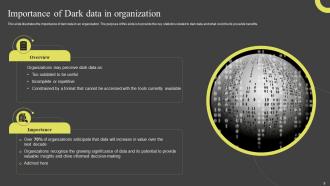
Slide 8: This slide represents Importance of Dark data in organization.
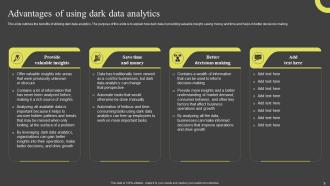
Slide 9: This slide showcases Advantages of using dark data analytics.
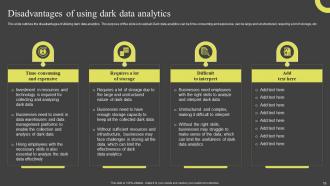
Slide 10: This slide shows Disadvantages of using dark data analytics.
Slide 11: This slide highlights title for topics that are to be covered next in the template.
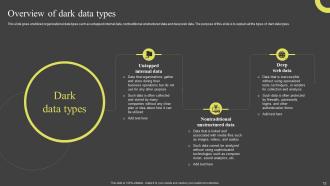
Slide 12: This slide presents Overview of dark data types.
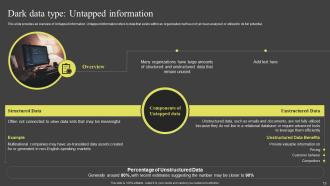
Slide 13: This slide provides an overview of Untapped information.
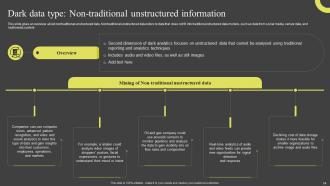
Slide 14: This slide displays Mining of Non-traditional unstructured data.
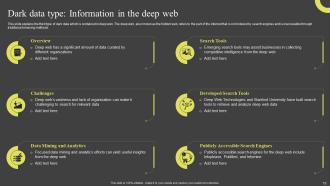
Slide 15: This slide explains the third type of dark data which is contained in deep web.
Slide 16: This slide highlights title for topics that are to be covered next in the template.
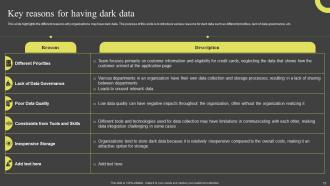
Slide 17: This slide represents Key reasons for having dark data.
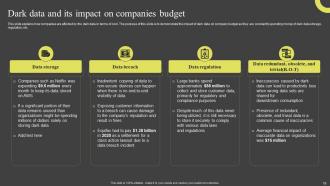
Slide 18: This slide showcases Dark data and its impact on companies budget.
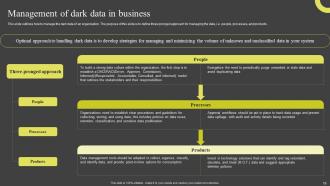
Slide 19: This slide shows Management of dark data in business.
Slide 20: This slide highlights title for topics that are to be covered next in the template.
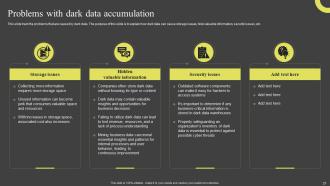
Slide 21: This slide presents Problems with dark data accumulation.
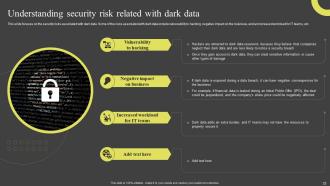
Slide 22: This slide displays Understanding security risk related with dark data.
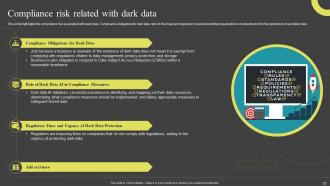
Slide 23: This slide represents Compliance risk related with dark data.
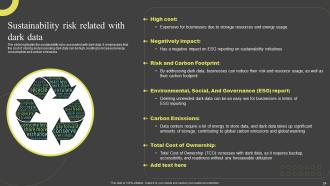
Slide 24: This slide showcases Sustainability risk related with dark data.
Slide 25: This slide highlights title for topics that are to be covered next in the template.
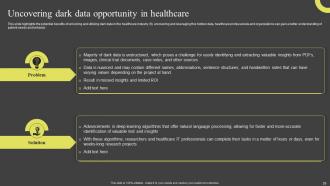
Slide 26: This slide shows Uncovering dark data opportunity in healthcare.
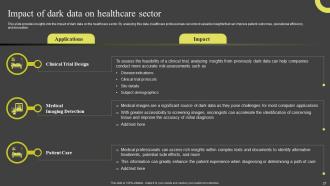
Slide 27: This slide presents Impact of dark data on healthcare sector.
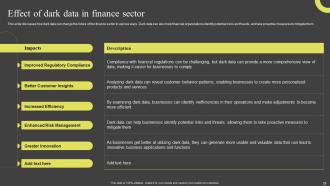
Slide 28: This slide displays Effect of dark data in finance sector.
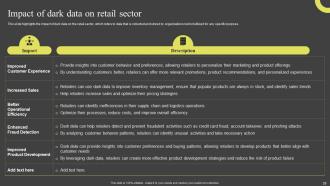
Slide 29: This slide represents Impact of dark data on retail sector.
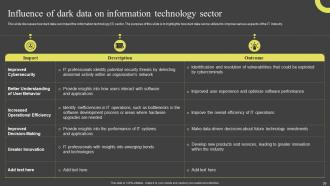
Slide 30: This slide showcases Influence of dark data on information technology sector.
Slide 31: This slide highlights title for topics that are to be covered next in the template.
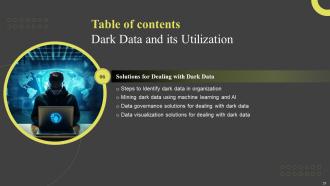
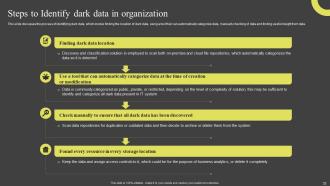
Slide 32: This slide shows Steps to Identify dark data in organization.
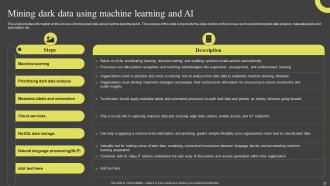
Slide 33: This slide presents Mining dark data using machine learning and AI.
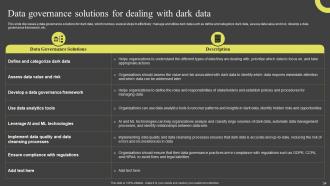
Slide 34: This slide displays Data governance solutions for dealing with dark data.
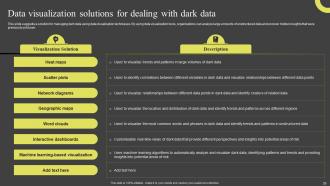
Slide 35: This slide represents Data visualization solutions for dealing with dark data.
Slide 36: This slide highlights title for topics that are to be covered next in the template.
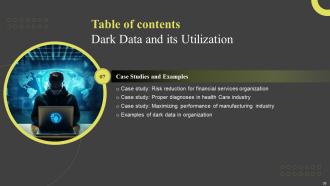
Slide 37: This slide showcases Case study: Risk reduction for financial services organization.
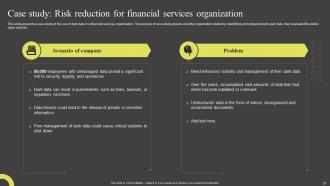
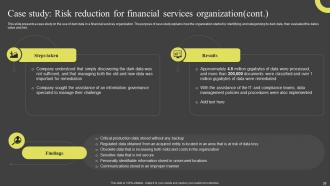
Slide 38: This slide presents a case study on the use of dark data in a financial services organization.
Slide 39: This slide presents a case study on the use of dark data in a health care organization.
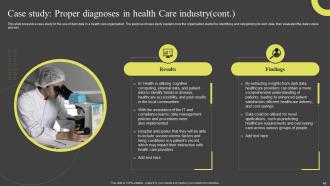
Slide 40: This is another slide continuing Case study: Proper diagnoses in health Care industry.
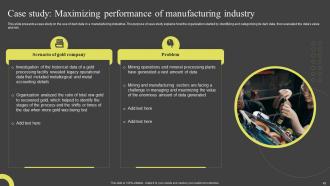
Slide 41: This slide presents a case study on the use of dark data in a manufacturing industries.
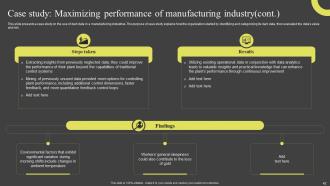
Slide 42: This is another slide continuing Case study: Maximizing performance of manufacturing industry.
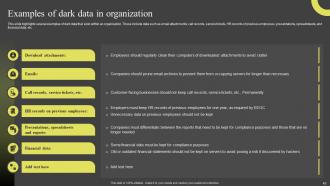
Slide 43: This slide displays Examples of dark data in organization.
Slide 44: This slide highlights title for topics that are to be covered next in the template.
Slide 45: This slide represents Comprehensive training program for dark data management.
Slide 46: This slide highlights title for topics that are to be covered next in the template.
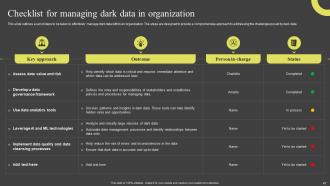
Slide 47: This slide showcases Checklist for managing dark data in organization.
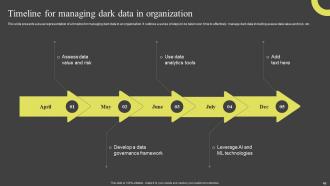
Slide 48: This slide shows Timeline for managing dark data in organization.
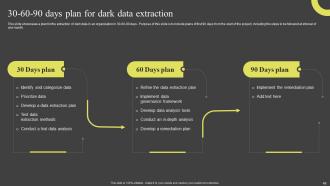
Slide 49: This slide provides 30 60 90 Days Plan with text boxes.
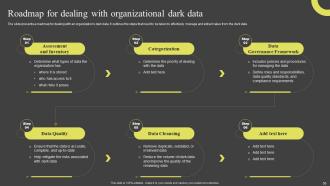
Slide 50: This slide presents Roadmap for dealing with organizational dark data.
Slide 51: This slide highlights title for topics that are to be covered next in the template.
Slide 52: This slide is titled as Additional Slides for moving forward.
Slide 53: This slide shows Post It Notes. Post your important notes here.
Slide 54: This slide contains Puzzle with related icons and text.
Slide 55: This slide depicts Venn diagram with text boxes.
Slide 56: This is an Idea Generation slide to state a new idea or highlight information, specifications etc.
Slide 57: This is Our Goal slide. State your firm's goals here.
Slide 58: This is a Thank You slide with address, contact numbers and email address.
Dark Data And Its Utilization Powerpoint Presentation Slides with all 66 slides:
Use our Dark Data And Its Utilization Powerpoint Presentation Slides to effectively help you save your valuable time. They are readymade to fit into any presentation structure.













FAQs for Dark Data And Its Utilization
Dark data refers to information collected and stored by organizations but never analyzed or utilized for decision-making, including unused logs, archived files, and redundant datasets. Unlike structured data organized in databases or unstructured data like emails and documents that organizations actively process, dark data remains dormant, representing untapped competitive advantage for companies seeking operational insights and strategic opportunities.
Organizations can identify dark data sources through comprehensive data audits, system inventories, log file analysis, and metadata examination across databases, applications, and storage systems. IT teams typically discover significant volumes in backup files, email archives, sensor logs, and legacy databases, with many finding that automated discovery tools reveal 60-80% more unutilized data than manual assessments alone.
Not utilizing dark data creates significant risks including missed competitive opportunities, inefficient resource allocation, poor strategic decision-making, regulatory compliance gaps, and lost revenue potential. Organizations that ignore their dark data often find themselves outpaced by competitors who leverage hidden insights for customer personalization, operational optimization, and predictive analytics, ultimately limiting their market positioning and growth capabilities.
Dark data transforms into actionable insights through advanced analytics platforms, machine learning algorithms, data mining techniques, and automated processing systems that extract patterns from previously unused information. These technologies enable organizations to uncover customer preferences, operational inefficiencies, and market opportunities, with many financial services and retail companies finding significant competitive advantages through enhanced decision-making capabilities.
**INPUT**: What tools and technologies are most effective for extracting value from dark data? **OUTPUT**: Effective dark data extraction tools include machine learning platforms, data mining software, natural language processing engines, advanced analytics frameworks, and automated discovery solutions. These technologies streamline unstructured data analysis by identifying patterns, extracting insights, and converting dormant information into actionable intelligence, with many organizations finding that strategic dark data utilization delivers competitive advantages and operational efficiency. **Word count: 56 words**
Dark data utilization significantly enhances organizational decision-making by transforming previously unused information into actionable insights, revealing hidden patterns, and enabling more comprehensive analysis across departments. Through advanced analytics and AI technologies, companies in healthcare, finance, and retail can identify emerging trends, optimize resource allocation, and predict customer behaviors more accurately, ultimately delivering competitive advantages and faster strategic responses.
Common use cases for dark data include predictive maintenance in manufacturing, fraud detection in financial services, customer behavior analytics in retail, supply chain optimization in logistics, and regulatory compliance monitoring across sectors. These applications enable organizations to streamline operations, reduce costs, and enhance decision-making by transforming previously unused information into strategic insights, with many companies finding significant competitive advantages through comprehensive data utilization.
Organizations ensure compliance with dark data by implementing comprehensive data governance frameworks, conducting regular data audits, establishing clear retention policies, and deploying automated classification tools. Through systematic discovery and cataloging processes, companies can identify sensitive information within unstructured datasets, apply appropriate security controls, and maintain regulatory alignment, with many finding that proactive dark data management ultimately delivers enhanced transparency and reduced compliance risks.
Artificial intelligence transforms dark data management through automated discovery, pattern recognition, machine learning algorithms, natural language processing, and predictive analytics capabilities. AI systems enable organizations to systematically identify, categorize, and extract valuable insights from previously inaccessible data repositories, with financial services and healthcare institutions finding significant competitive advantages in fraud detection and patient outcomes optimization.
Organizations can prioritize dark data by assessing business impact potential, data quality, accessibility, and alignment with strategic objectives, while considering regulatory requirements and competitive advantage opportunities. Financial services often start with customer interaction logs and transaction records, while healthcare organizations prioritize patient records and diagnostic data, ultimately delivering faster insights and improved operational efficiency.
Best practices for storing and securing dark data include implementing tiered storage architectures, establishing comprehensive data governance frameworks, deploying advanced encryption protocols, creating automated classification systems, and maintaining regular audit trails. These approaches enable organizations to minimize storage costs while maximizing security compliance, with many financial services and healthcare institutions finding that strategic dark data management ultimately delivers enhanced regulatory adherence and operational efficiency.
Data governance frameworks can be adapted to include dark data considerations through automated discovery tools, metadata management systems, comprehensive data cataloging, risk assessment protocols, and retention policy updates. These enhanced frameworks enable organizations to identify hidden data assets across storage systems, classify information by sensitivity and value, and establish clear compliance procedures, ultimately transforming overlooked data repositories into strategic business intelligence resources.
Businesses can utilize interactive dashboards, heat maps, network diagrams, predictive analytics visualizations, and real-time monitoring displays to represent dark data insights effectively. These visualization methods enable organizations to transform hidden patterns into actionable intelligence through advanced charting, geographical mapping, and trend analysis, with many companies finding that visual representation accelerates decision-making and reveals previously overlooked operational efficiencies.
Companies face challenges including data quality inconsistencies, format compatibility issues, privacy compliance requirements, storage infrastructure limitations, and analytical skill gaps when integrating dark data. These integration hurdles require strategic investments in data governance, advanced analytics platforms, and specialized talent, with many organizations finding that overcoming these obstacles ultimately delivers enhanced business insights and competitive advantages.
Dark data utilization contributes to competitive advantages by uncovering hidden customer insights, identifying untapped market opportunities, and enabling predictive analytics that competitors cannot access. Organizations leveraging dark data can optimize pricing strategies, personalize customer experiences more effectively, and anticipate market trends faster, ultimately delivering superior products and services while reducing operational costs.
-
SlideTeam is very efficient when it comes to saving time. I am happy that I chose them for my presentation.
-
Appreciate the research and its presentable format.