

Dashboard To Analyze Employees Industrial Relations In Human Resource Management




Try Before you Buy Download Free Sample Product
 Impress Your
 Audience
 100%
100% Editable
 Save Hours
 of Time


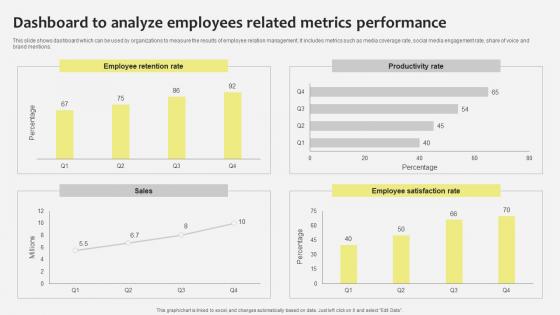
This slide shows dashboard which can be used by organizations to measure the results of employee relation management. It includes metrics such as media coverage rate, social media engagement rate, share of voice and brand mentions.
People who downloaded this PowerPoint presentation also viewed the following :
Dashboard To Analyze Employees Industrial Relations In Human Resource Management with all 10 slides:
Use our Dashboard To Analyze Employees Industrial Relations In Human Resource Management to effectively help you save your valuable time. They are readymade to fit into any presentation structure.









FAQs for Dashboard To Analyze Employees Industrial Relations In
An ideal industrial relations dashboard should include employee satisfaction scores, grievance resolution times, collective bargaining agreement compliance rates, workplace incident frequencies, and union engagement metrics. These KPIs enable organizations to proactively monitor labor relations health, identify potential disputes early, and maintain productive workforce relationships, with many manufacturing and logistics companies finding that comprehensive tracking ultimately delivers improved operational stability and reduced labor-related disruptions.
Real-time data visualization improves industrial relations decision-making by providing instant insights into workforce trends, grievance patterns, productivity metrics, and employee satisfaction levels through interactive dashboards and automated alerts. Manufacturing companies and logistics firms increasingly use these visual analytics to identify potential conflicts early, optimize resource allocation, and enhance communication strategies, ultimately delivering faster resolutions and improved workplace harmony.
Employee engagement significantly enhances industrial relations dashboard effectiveness by driving data accuracy, encouraging feedback participation, and fostering transparency in workplace communications. When employees actively contribute to dashboard metrics and trust the system, organizations see improved conflict resolution, stronger union-management relationships, and more proactive issue identification, ultimately delivering better workplace harmony and operational efficiency.
Organizations ensure dashboard data accuracy through automated data validation systems, regular audits, standardized input protocols, real-time error detection, and integration with verified HR systems. These approaches minimize human error, maintain consistent reporting standards, and enable immediate correction of discrepancies, with many manufacturing and logistics companies finding that robust validation processes ultimately deliver more reliable labor analytics and strategic decision-making capabilities.
Tools for creating industrial relations dashboards include Microsoft Power BI, Tableau, SAP Analytics Cloud, Qlik Sense, and specialized HR platforms like Workday Analytics. These platforms streamline workforce data visualization by integrating payroll systems, union databases, and compliance tracking, while enabling real-time monitoring of labor metrics, grievance patterns, and negotiation outcomes, ultimately delivering enhanced transparency and strategic decision-making capabilities.
Common implementation challenges include data integration complexity, employee privacy concerns, resistance to change, ensuring real-time accuracy, and establishing meaningful metrics across diverse departments. While these obstacles require strategic planning, organizations in manufacturing, healthcare, and logistics find that phased rollouts, comprehensive training, and clear communication protocols streamline adoption, ultimately delivering enhanced transparency and improved workplace relationships.
Historical data enables predictive analytics for industrial relations through pattern recognition, trend analysis, employee sentiment tracking, and grievance forecasting models. By analyzing past strikes, contract negotiations, and workplace incidents, organizations can anticipate potential conflicts, optimize labor strategies, and implement proactive interventions, ultimately delivering enhanced workforce stability and reduced operational disruptions.
Organizations should track metrics including grievance frequency and resolution times, employee satisfaction scores, union negotiation outcomes, workplace safety incidents, and absenteeism rates. These indicators enable management to identify potential issues early, strengthen communication channels, and improve working conditions, with many companies finding that proactive monitoring ultimately delivers better employee retention and operational efficiency.
Feedback mechanisms can be integrated through employee survey modules, grievance tracking systems, suggestion boxes, real-time pulse surveys, and anonymous reporting channels. These tools enable organizations to capture worker sentiment, monitor resolution timelines, and identify emerging issues across departments, ultimately delivering improved employee satisfaction and stronger labor-management relationships through data-driven insights.
Benchmarking against industry standards enables organizations to evaluate their employee relations practices, compensation structures, and workplace policies relative to competitors and sector leaders. Through comparative analysis, companies identify performance gaps, optimize talent retention strategies, and enhance negotiation positions with unions, while ensuring competitive compensation packages that attract top talent and maintain operational excellence in increasingly competitive markets.
Dashboards facilitate better communication by providing transparent, real-time visibility into key metrics, performance indicators, and organizational updates that both management and employees can access simultaneously. This shared visibility streamlines information flow, reduces miscommunication, and enables data-driven discussions, with many organizations finding that dashboard transparency builds trust while empowering employees to better understand business priorities and their individual contributions.
Best practices for designing user-friendly industrial relations dashboards include intuitive navigation, real-time data visualization, customizable metrics displays, mobile responsiveness, and role-based access controls. These design elements streamline workforce management by enabling quick grievance tracking, enhancing labor analytics visibility, and facilitating seamless communication between HR teams and union representatives, ultimately delivering improved employee relations and operational efficiency.
Custom dashboards adapt to organizational structures through flexible hierarchical views, role-based access controls, department-specific metrics, and scalable reporting frameworks that align with company workflows. These systems enable manufacturing plants to track production KPIs while corporate offices monitor strategic indicators, ultimately delivering targeted insights that enhance decision-making across all organizational levels.
Analyzing grievance and dispute resolution patterns reveals recurring complaint categories, resolution timeframes, departmental hotspots, seasonal trends, and employee satisfaction correlations. These insights enable organizations to identify systemic issues, streamline resolution processes, and implement preventive measures, with many companies finding that proactive pattern analysis reduces grievance volumes by 30-40% while enhancing workplace harmony.
Technology adoption revolutionizes industrial relations management by automating grievance tracking, enabling real-time communication between stakeholders, and providing data-driven insights for decision-making. Through digital platforms and analytics tools, organizations streamline conflict resolution, enhance transparency in negotiations, and deliver faster dispute settlements, ultimately improving workplace harmony and operational efficiency across industries.
-
Easy to use and customize templates. Helped me give a last minute presentation.
-
I took a chance with SlideTeam. I never looked back. Great products and great service.