

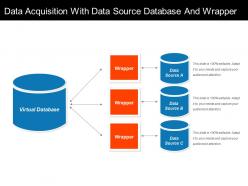
Data acquisition with data source database and wrapper





Try Before you Buy Download Free Sample Product
 Impress Your
Audience
 100%
Editable
 Save Hours
of Time


Slideteam’s data analytics ppt templates can help you get the most out of your data. With our easy-to-use drag and drop interface, you can create beautiful and insightful presentations in minutes. Plus, with our wide range of professionally designed templates, you can find the perfect template for your needs. So don’t wait any longer! Grab our data analytics ppt templates now and start getting insights into your data that will help you drive more sales and better performance.
People who downloaded this PowerPoint presentation also viewed the following :
Data acquisition with data source database and wrapper with all 5 slides:
Ensure correct inputs with our Data Acquisition With Data Source Database And Wrapper. The authenticity of the information is assured.


FAQs for Data acquisition with data source
Primary data acquisition methods include surveys, interviews, observational studies, experiments, sensor networks, web scraping, and database mining. These approaches enable researchers across healthcare, finance, and retail sectors to gather comprehensive datasets efficiently, ultimately delivering faster insights, improved decision-making capabilities, and competitive advantages in increasingly data-driven research environments.
Sensor technologies enhance data acquisition efficiency by automating collection, reducing manual intervention, and enabling real-time monitoring across multiple parameters simultaneously. These devices streamline operations in manufacturing plants, environmental monitoring stations, and healthcare facilities, delivering faster processing speeds, improved accuracy, and continuous data streams that ultimately minimize costs while maximizing operational insights.
Data acquisition serves as the foundational layer of IoT ecosystems, enabling sensors, devices, and connected systems to collect real-time information from physical environments, operational processes, and user interactions. This continuous data collection streamlines monitoring in smart cities, enhances predictive maintenance in manufacturing, and optimizes energy consumption in buildings, ultimately delivering operational efficiency and competitive advantage across industries.
Businesses leverage data acquisition to improve decision-making by collecting comprehensive customer insights, market intelligence, operational metrics, and competitive analysis from multiple sources. Through advanced analytics platforms, organizations can identify emerging trends, predict consumer behavior, and optimize resource allocation, with many financial services and retail companies finding that real-time data integration delivers faster strategic responses and enhanced competitive positioning.
Key factors include sampling rate requirements, signal conditioning capabilities, input/output channel specifications, resolution accuracy, and environmental operating conditions. These hardware considerations enable optimal data capture by matching sensor compatibility, ensuring measurement precision, and delivering reliable performance across industrial, research, and monitoring applications, ultimately streamlining project implementation while minimizing costly system redesigns.
Data acquisition systems integrate with existing software and databases through APIs, middleware platforms, database connectors, cloud-based integration services, and standardized communication protocols. These technologies streamline data flow by automating real-time synchronization, enabling seamless database updates, and facilitating cross-platform compatibility, with many organizations finding that strategic integration ultimately delivers enhanced operational efficiency and comprehensive data accessibility across their entire technology ecosystem.
Real-time data acquisition faces challenges including network latency, system integration complexity, data quality inconsistencies, storage scalability limitations, and processing bottlenecks. These obstacles can be addressed through edge computing deployment, robust API frameworks, automated data validation protocols, and cloud-based infrastructure, with many organizations finding that strategic technology combinations ultimately deliver faster decision-making and enhanced operational efficiency.
Data acquisition improves manufacturing quality control by enabling real-time monitoring of production parameters, automated defect detection, and predictive maintenance scheduling. Through IoT sensors and machine learning algorithms, manufacturers streamline inspection processes, reduce waste, and minimize downtime, with automotive and electronics companies finding that continuous data collection ultimately delivers faster problem resolution and enhanced product consistency.
**INPUT**: What ethical considerations arise in the data acquisition process? **OUTPUT**: Data acquisition presents ethical considerations including informed consent, data minimization, transparency in collection methods, security protocols, and fair representation across demographics. While organizations increasingly implement privacy-by-design frameworks, they must balance comprehensive data needs with user rights, ensuring collection practices build trust rather than exploit vulnerabilities, ultimately delivering sustainable competitive advantage. **Word count: 54 words**
The choice of data acquisition methodology significantly impacts data quality through sampling accuracy, collection consistency, and validation protocols. Strategic methodologies enhance reliability by minimizing bias, ensuring representative samples, and implementing robust quality controls, with organizations in healthcare, finance, and research finding that systematic approaches deliver more actionable insights and competitive advantages.
Manual data acquisition involves human operators collecting information through surveys, interviews, observations, and direct measurements, while automated techniques use sensors, APIs, web scraping, and IoT devices for continuous collection. Automated systems streamline operations by reducing errors, accelerating processing, and enabling real-time insights, with many organizations finding that combining both approaches delivers optimal accuracy and comprehensive coverage.
Big data is driving data acquisition technologies toward greater speed, scalability, and real-time processing capabilities, with streaming analytics, edge computing, and cloud-native architectures becoming essential components. These advanced systems enable organizations to capture, process, and analyze massive datasets from IoT devices, social media, and transactional systems simultaneously, ultimately delivering faster insights and competitive advantages in increasingly data-driven markets.
Data acquisition presents both compliance challenges and strategic opportunities under privacy regulations like GDPR, CCPA, and HIPAA, requiring transparent consent mechanisms, purpose limitation, data minimization, and robust security frameworks. While organizations must navigate complex regulatory landscapes, these requirements ultimately enhance customer trust, reduce legal risks, and create competitive advantages, with many companies finding that proactive privacy compliance streamlines operations and strengthens market positioning.
Cloud computing enhances data acquisition by providing scalable storage, real-time processing capabilities, and seamless integration across distributed systems and remote sensors. Through cloud platforms, organizations streamline remote monitoring, automate data collection from IoT devices, and enable instant analysis, with many industries like manufacturing and healthcare finding faster insights and reduced infrastructure costs.
Emerging trends in healthcare data acquisition include real-time patient monitoring through wearable devices, AI-powered diagnostic imaging analysis, blockchain-secured health records, telemedicine data integration, and IoT-enabled hospital equipment networks. These technologies streamline clinical workflows, enhance diagnostic accuracy, and improve patient outcomes, with hospitals and healthcare systems increasingly finding that automated data collection reduces costs while delivering faster, more personalized care.
-
Informative presentations that are easily editable.
-
I discovered this website through a google search, the services matched my needs perfectly and the pricing was very reasonable. I was thrilled with the product and the customer service. I will definitely use their slides again for my presentations and recommend them to other colleagues.