

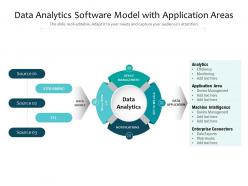
Data analytics software model with application areas





Try Before you Buy Download Free Sample Product
 Impress Your
Audience
 100%
Editable
 Save Hours
of Time


The data analytics software model is gaining immense popularity with the advent of big data. This model has various application areas in different industries. We have explored some of these applications with the help of our data analytics ppt templates. If you are looking for insights about data analytics software, then you should grab our templates now. Our templates will give you a deep understanding of this model and its various applications.
People who downloaded this PowerPoint presentation also viewed the following :
Data analytics software model with application areas with all 2 slides:
Use our Data Analytics Software Model With Application Areas to effectively help you save your valuable time. They are readymade to fit into any presentation structure.

FAQs for Data analytics software model
Key features include real-time processing capabilities, intuitive visualization tools, advanced statistical modeling, seamless data integration, and automated reporting functions. These technologies enhance decision-making by streamlining complex analysis, enabling predictive insights, and delivering actionable intelligence, with many organizations finding that comprehensive analytics platforms ultimately provide competitive advantage through faster, data-driven strategies.
Predictive analytics models forecast future trends and outcomes using historical data patterns, while descriptive analytics models analyze past data to understand what happened and why. Predictive models enable banks to assess loan default risks, retailers to forecast demand, and hospitals to predict patient readmissions, ultimately delivering proactive decision-making and competitive advantage over reactive approaches.
Machine learning enhances data analytics software models by automating pattern recognition, enabling predictive insights, and continuously improving accuracy through algorithmic learning. These capabilities streamline decision-making processes across industries like healthcare, finance, and retail, with many organizations finding that machine learning-powered analytics deliver faster insights, reduced manual analysis time, and significantly improved forecasting precision.
Data visualization tools transform complex datasets into intuitive charts, graphs, dashboards, and interactive displays, enabling stakeholders to quickly identify patterns, trends, and anomalies. These visual representations streamline decision-making by reducing analysis time, enhancing cross-departmental communication, and facilitating faster strategic responses, with many organizations finding that visual analytics delivers more accurate insights and improved operational efficiency.
Structured datasets work best for traditional statistical models, while unstructured data like text and images suit machine learning algorithms, and time-series data optimizes predictive analytics models. Financial services leverage transaction data for fraud detection, healthcare institutions use patient records for diagnostic models, and retail companies apply customer behavior data for recommendation engines, ultimately enabling faster insights and competitive advantage.
Cloud-based data analytics models deliver superior scalability through elastic resource allocation, automatic infrastructure scaling, and pay-as-you-grow pricing, while on-premise solutions require significant upfront hardware investments and manual capacity planning. Organizations across retail, healthcare, and financial services increasingly find that cloud platforms enable seamless expansion during peak demands, ultimately delivering cost efficiency and competitive agility.
Organizations face challenges including data quality issues, integration complexities with existing systems, skill gaps in analytics expertise, high implementation costs, and resistance to change from employees. While these obstacles can slow adoption, many companies find that strategic planning, phased rollouts, and comprehensive training programs help overcome barriers, ultimately delivering improved decision-making capabilities and competitive advantage.
Data privacy regulations impact analytics models by requiring data minimization techniques, anonymization protocols, and consent management systems throughout the design process. These compliance frameworks, while presenting implementation challenges, ultimately enhance customer trust and competitive positioning, with many financial services and healthcare organizations finding that privacy-first analytics delivers both regulatory compliance and superior long-term business outcomes.
Key performance metrics for data analytics software models include accuracy, precision, recall, F1-score, ROI, processing speed, and scalability measures. These metrics enable organizations to assess model reliability, business impact, and operational efficiency across sectors like finance, healthcare, and retail, ultimately delivering better decision-making capabilities and competitive advantage.
Open-source data analytics tools offer cost-effectiveness, customization flexibility, and community-driven innovation, while commercial solutions provide comprehensive support, enterprise security, and streamlined implementation. Many organizations find that open-source tools like R and Python excel for specialized analytics, whereas commercial platforms deliver integrated workflows, professional support, and regulatory compliance, ultimately enabling faster deployment and reduced operational complexity.
Data analytics models integrate with business intelligence tools through APIs, embedded dashboards, automated reporting systems, real-time data pipelines, and shared visualization platforms. These integrations enable organizations to streamline decision-making processes, enhance operational efficiency, and deliver comprehensive insights across departments, with many enterprises finding that strategic combinations ultimately provide competitive advantages and faster business responses.
Organizations tailor data analytics models through industry-specific data integration, customized algorithms, and sector-relevant metrics and dashboards. Financial services focus on fraud detection and risk assessment, while healthcare emphasizes patient outcomes and regulatory compliance, with manufacturing prioritizing predictive maintenance and supply chain optimization, ultimately delivering targeted insights that enhance operational efficiency and competitive advantage.
Future trends in data analytics software include real-time analytics, augmented analytics with AI assistance, edge computing integration, automated machine learning, and enhanced data visualization capabilities. These technologies streamline decision-making by delivering instant insights, reducing technical barriers, and enabling faster processing, with many organizations finding that early adoption of these trends delivers significant competitive advantage and operational efficiency.
The algorithm choice fundamentally determines model accuracy, processing speed, and interpretability by defining how data patterns are identified, relationships are analyzed, and predictions are generated. Different algorithms excel in specific scenarios, with linear regression optimizing for interpretable relationships, neural networks handling complex patterns, and decision trees providing transparent decision paths, ultimately enabling organizations to balance precision with computational efficiency based on their strategic objectives.
Best practices for maintaining data analytics software models include regular performance monitoring, systematic retraining with fresh data, version control implementation, automated testing protocols, and continuous validation against business objectives. Through proactive model governance, organizations in healthcare, finance, and retail streamline decision-making accuracy while minimizing deployment risks, ultimately delivering sustained competitive advantage and operational efficiency.
-
Good research work and creative work done on every template.
-
Great product with effective design. Helped a lot in our corporate presentations. Easy to edit and stunning visuals.
-
Helpful product design for delivering presentation.
-
Very well designed and informative templates.
-
Excellent template with unique design.
-
Best way of representation of the topic.