

Data Analytics Transformation Toolkit Powerpoint Presentation Slides




Try Before you Buy Download Free Sample Product
 Impress Your
 Audience
 100%
100% Editable
 Save Hours
 of Time


Data analytics is the process of extracting, transforming, cleaning, and modeling organizational data to identify the hidden patterns in it so that the insights retrieved from data can be used to optimize the business operations for more significant growth. Check out our efficiently designed Data Analytics Transformation Toolkit to plan and deploy the data analytics suite for converting the organizations raw data into actionable information. This presentation also has aspects that document and present details of the data analytics software desired by the firm and multiple vendors providing such suites. The user can use these templates to choose and select the optimum analytics solution to fulfill the business objective. Also, this ppt presentation contains templates for the data analytics program checklist and training plan to coach employees on the usability of the data analytics solution. This deck will assist the project manager in better planning, deployment, and monitoring of data analytics solutions in the organization for improved decision making and more efficient operations to provide an edge over the competitors. Book a free demo with our expert team and grab a 100 percent editable presentation.
People who downloaded this PowerPoint presentation also viewed the following :
Content of this Powerpoint Presentation
Slide 1: This slide introduces Data Analytics Transformation Toolkit. State Your Company Name and begin.
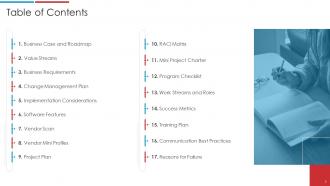
Slide 2: This slide presents Table of Content for the presentation.
Slide 3: This slide highlights title for topics that are to be covered next in the template.
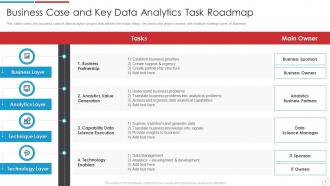
Slide 4: This slide shows Business Case and Key Data Analytics Task Roadmap.
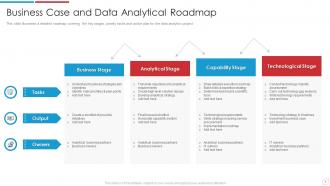
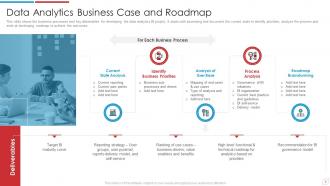
Slide 5: This slide presents Business Case and Data Analytical Roadmap.
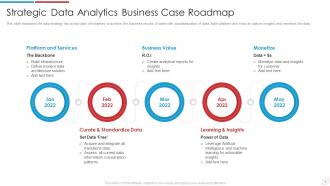
Slide 6: This slide displays Strategic Data Analytics Business Case Roadmap.
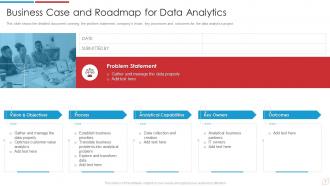
Slide 7: This slide represents Business Case and Roadmap for Data Analytics.
Slide 8: This slide showcases Data Analytics Business Case and Roadmap.
Slide 9: This slide highlights title for topics that are to be covered next in the template.
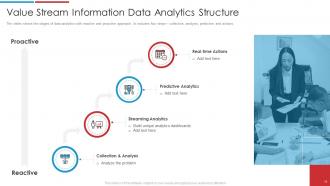
Slide 10: This slide shows Value Stream Information Data Analytics Structure.
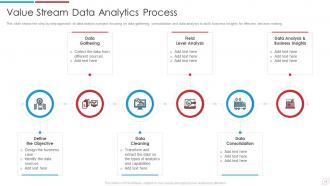
Slide 11: This slide presents step by step approach of data analytics project.
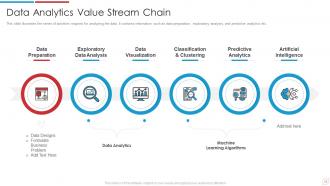
Slide 12: This slide illustrates the series of activities required for analyzing the data.
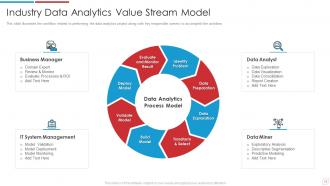
Slide 13: This slide displays Industry Data Analytics Value Stream Model.
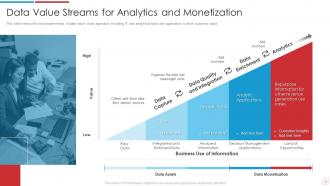
Slide 14: This slide represents Data Value Streams for Analytics and Monetization.
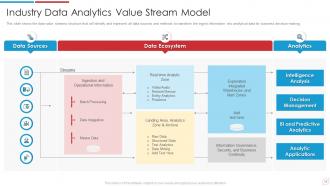
Slide 15: This slide showcases Industry Data Analytics Value Stream Model.
Slide 16: This slide highlights title for topics that are to be covered next in the template.
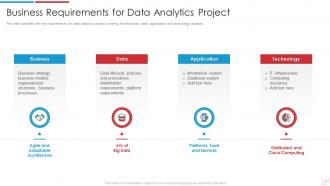
Slide 17: This slide shows Business Requirements for Data Analytics Project.
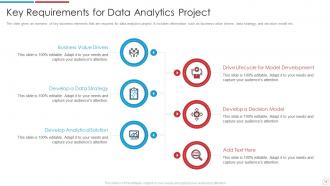
Slide 18: This slide presents Key Requirements for Data Analytics Project.
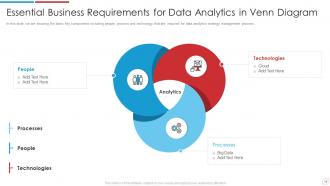
Slide 19: This slide displays Essential Business Requirements for Data Analytics in Venn Diagram.
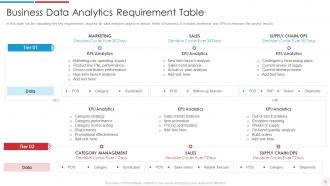
Slide 20: This slide represents Business Data Analytics Requirement Table.
Slide 21: This slide highlights title for topics that are to be covered next in the template.
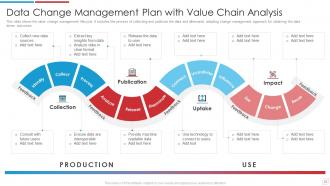
Slide 22: This slide showcases Data Change Management Plan with Value Chain Analysis.
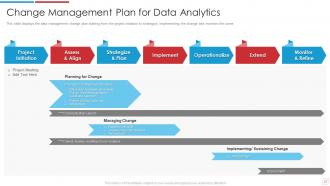
Slide 23: This slide shows Change Management Plan for Data Analytics.
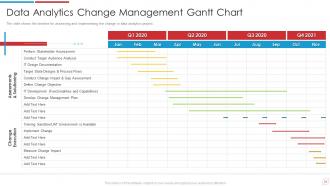
Slide 24: This slide presents Data Analytics Change Management Gantt Chart.
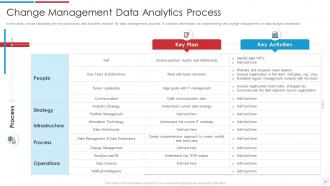
Slide 25: This slide displays Change Management Data Analytics Process.
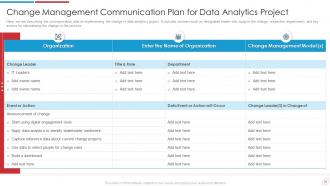
Slide 26: This slide represents Change Management Communication Plan for Data Analytics Project.
Slide 27: This slide showcases Project Data Management Activities with Change Management Plan.
Slide 28: This slide highlights title for topics that are to be covered next in the template.
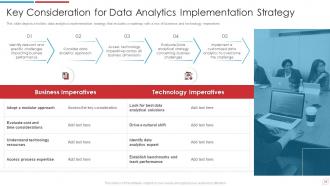
Slide 29: This slide represents Key Consideration for Data Analytics Implementation Strategy.
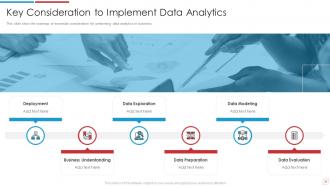
Slide 30: This slide shows Key Consideration to Implement Data Analytics.
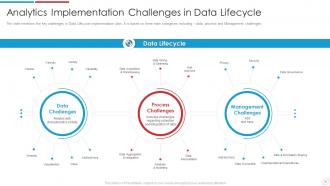
Slide 31: This slide presents Analytics Implementation Challenges in Data Lifecycle.
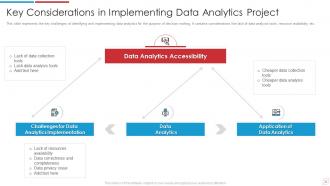
Slide 32: This slide displays Key Considerations in Implementing Data Analytics Project.
Slide 33: This slide highlights title for topics that are to be covered next in the template.
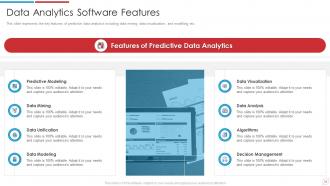
Slide 34: This slide represents the key features of predictive data analytics.
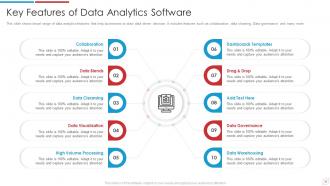
Slide 35: This slide showcases Key Features of Data Analytics Software.
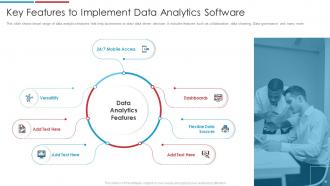
Slide 36: This slide shows Key Features to Implement Data Analytics Software.
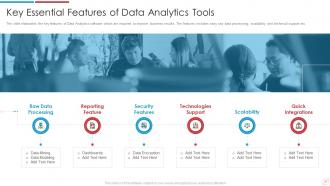
Slide 37: This slide presents Key Essential Features of Data Analytics Tools.
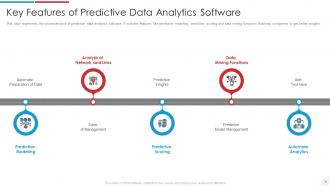
Slide 38: This slide displays Key Features of Predictive Data Analytics Software.
Slide 39: This slide highlights title for topics that are to be covered next in the template.
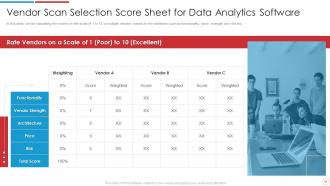
Slide 40: This slide represents Vendor Scan Selection Score Sheet for Data Analytics Software.
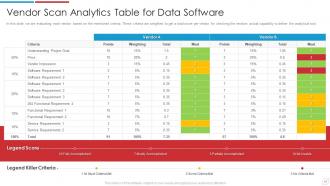
Slide 41: This slide showcases Vendor Scan Analytics Table for Data Software.
Slide 42: This slide highlights title for topics that are to be covered next in the template.
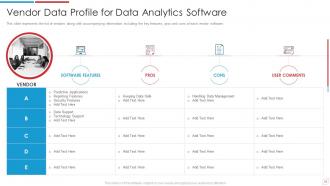
Slide 43: This slide shows Vendor Data Profile for Data Analytics Software.
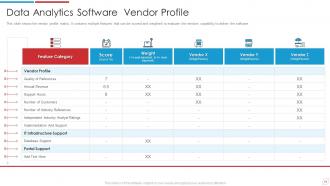
Slide 44: This slide presents Data Analytics Software Vendor Profile.
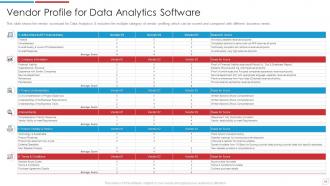
Slide 45: This slide displays Vendor Profile for Data Analytics Software.
Slide 46: This slide highlights title for topics that are to be covered next in the template.
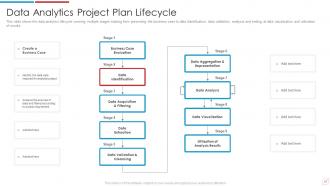
Slide 47: This slide shows the data analytics lifecycle covering multiple stages starting from presenting the business case to data identification.
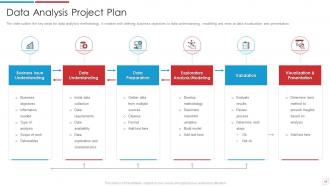
Slide 48: The slide outline the key steps for data analytics methodology.
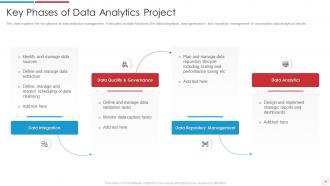
Slide 49: The slide explains the key phases of data analytics management.
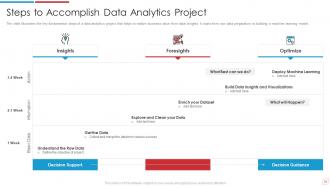
Slide 50: This slide represents Steps to Accomplish Data Analytics Project.
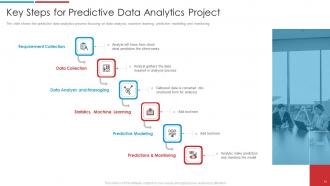
Slide 51: This slide showcases Key Steps for Predictive Data Analytics Project.
Slide 52: This slide highlights title for topics that are to be covered next in the template.
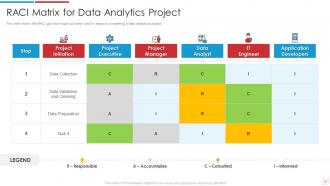
Slide 53: The slide shows the RACI grid that maps out every task or steps in completing a data analytical project.
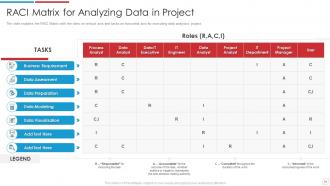
Slide 54: This slide presents RACI Matrix for Analyzing Data in Project.
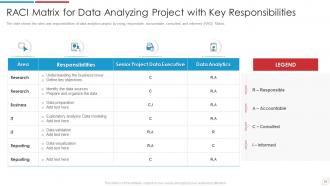
Slide 55: This slide displays RACI Matrix for Data Analyzing Project with Key Responsibilities.
Slide 56: This slide highlights title for topics that are to be covered next in the template.
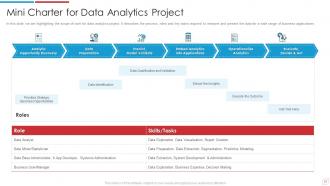
Slide 57: This slide represents Mini Charter for Data Analytics Project.
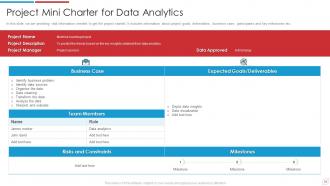
Slide 58: This slide showcases Project Mini Charter for Data Analytics.
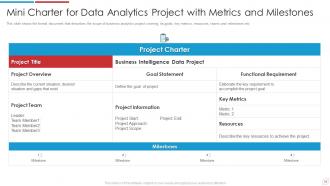
Slide 59: This slide shows Mini Charter for Data Analytics Project with Metrics and Milestones.
Slide 60: This slide highlights title for topics that are to be covered next in the template.
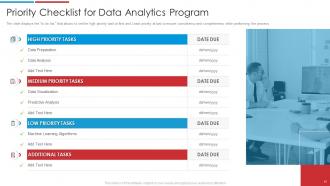
Slide 61: This slide presents Priority Checklist for Data Analytics Program.
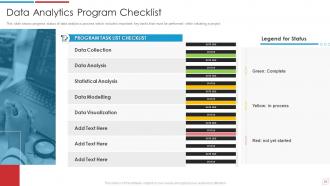
Slide 62: This slide shows progress status of data analytics process which includes important key tasks that must be performed.
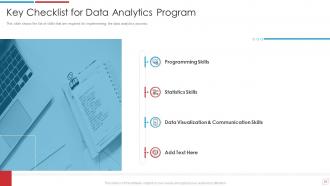
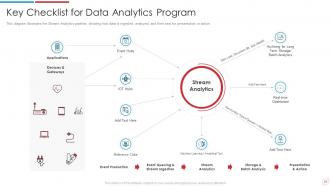
Slide 63: This slide presents Key Checklist for Data Analytics Program.
Slide 64: This slide highlights title for topics that are to be covered next in the template.
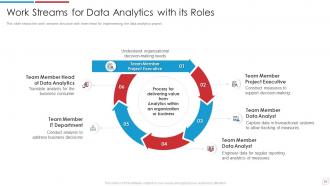
Slide 65: This slide displays Work Streams for Data Analytics with its Roles.
Slide 66: This slide represents Data Analytics Work Streams with its Roles and Responsibilities.
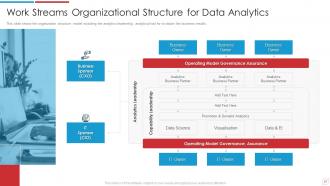
Slide 67: This slide showcases Work Streams Organizational Structure for Data Analytics.
Slide 68: This slide shows Key Checklist for Data Analytics Program.
Slide 69: This slide highlights title for topics that are to be covered next in the template.
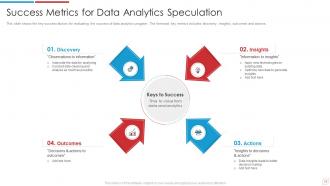
Slide 70: This slide presents Success Metrics for Data Analytics Speculation.
Slide 71: This slide highlights title for topics that are to be covered next in the template.
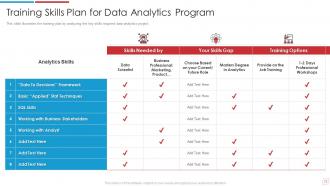
Slide 72: This slide displays Training Skills Plan for Data Analytics Program.
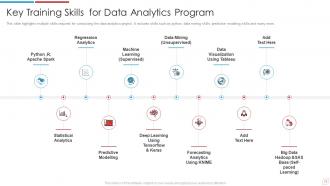
Slide 73: This slide represents Key Training Skills for Data Analytics Program.
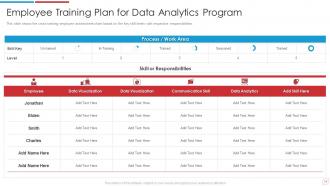
Slide 74: This slide showcases Employee Training Plan for Data Analytics Program.
Slide 75: This slide highlights title for topics that are to be covered next in the template.
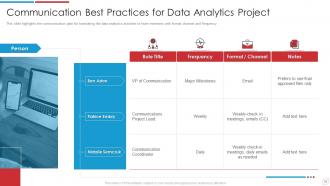
Slide 76: This slide shows Communication Best Practices for Data Analytics Project.
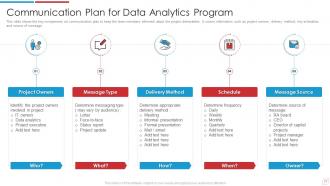
Slide 77: This slide presents Communication Plan for Data Analytics Program.
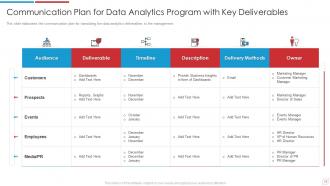
Slide 78: This slide displays Communication Plan for Data Analytics Program with Key Deliverables.
Slide 79: This slide highlights title for topics that are to be covered next in the template.
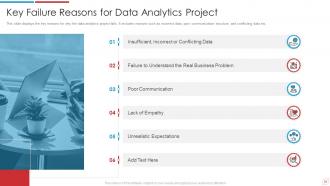
Slide 80: This slide represents Key Failure Reasons for Data Analytics Project.
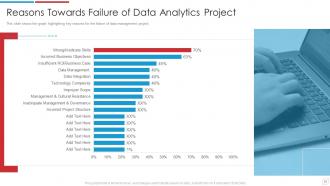
Slide 81: This slide showcases Reasons Towards Failure of Data Analytics Project.
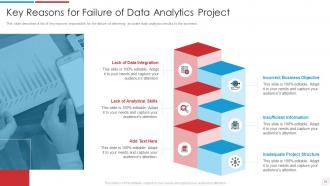
Slide 82: This slide shows Key Reasons for Failure of Data Analytics Project.
Slide 83: This slide displays Icons for Data Analytics Transformation Toolkit.
Slide 84: This slide is titled as Additional Slides for moving forward.
Slide 85: This is Our Mission slide with related imagery and text.
Slide 86: This is About Us slide to show company specifications etc.
Slide 87: This is Our Team slide with names and designation.
Slide 88: This slide shows Post It Notes. Post your important notes here.
Slide 89: This is Our Goal slide. State your firm's goals here.
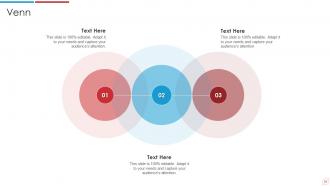
Slide 90: This slide depicts Venn diagram with text boxes.
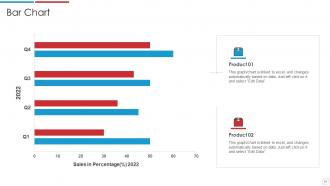
Slide 91: This slide presents Bar chart with two products comparison.
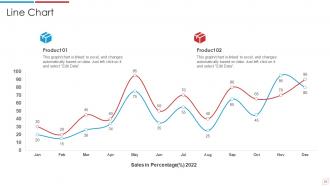
Slide 92: This slide describes Line chart with two products comparison.
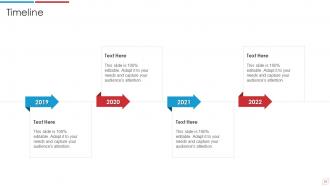
Slide 93: This is a Timeline slide. Show data related to time intervals here.
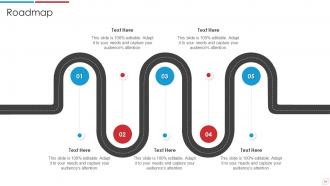
Slide 94: This slide presents Roadmap with additional textboxes.
Slide 95: This is a Thank You slide with address, contact numbers and email address.
Data Analytics Transformation Toolkit Powerpoint Presentation Slides with all 100 slides:
Use our Data Analytics Transformation Toolkit Powerpoint Presentation Slides to effectively help you save your valuable time. They are readymade to fit into any presentation structure.










FAQs for Data Analytics Transformation Toolkit
A comprehensive data analytics transformation toolkit includes advanced visualization platforms, predictive modeling software, data integration systems, automated reporting tools, and real-time monitoring dashboards. These technologies streamline operations by consolidating fragmented data sources, accelerating decision-making processes, and enhancing analytical capabilities, with organizations across healthcare, finance, and retail finding that integrated toolkits deliver measurable competitive advantages and operational efficiency.
Organizations can assess their current data analytics capabilities through comprehensive audits examining data quality, infrastructure scalability, team skills, existing tools, and governance frameworks. Financial services firms, healthcare systems, and retail companies typically conduct capability maturity assessments, stakeholder interviews, and technology inventories, ultimately identifying gaps between current state and strategic objectives while establishing clear transformation roadmaps.
Data governance establishes the framework for data quality, security, compliance, and accessibility throughout analytics transformation initiatives. It ensures consistent data standards, defines ownership responsibilities, and creates policies for data usage, while enabling organizations to maintain regulatory compliance, reduce risks, and ultimately deliver reliable insights that drive strategic decision-making and competitive advantage.
Businesses ensure scalable data analytics toolkits by implementing cloud-based platforms, establishing modular architectures, and prioritizing automated data pipelines that adapt to increasing volumes. Through strategic infrastructure planning, organizations streamline resource allocation, enhance processing capabilities, and maintain consistent performance across expanding operations, with many enterprises finding that scalable analytics ultimately deliver competitive advantages and support long-term strategic growth initiatives.
Best practices for integrating machine learning into data analytics transformation toolkits include establishing clear data governance frameworks, selecting scalable algorithms aligned with business objectives, implementing robust model validation processes, and ensuring seamless integration with existing analytics infrastructure. These approaches streamline deployment by automating predictive insights, enhancing decision-making accuracy, and enabling real-time analytics capabilities, with many organizations finding that strategic ML integration ultimately delivers competitive advantage and operational efficiency.
Organizations measure analytics transformation ROI through metrics like cost reduction, revenue growth, operational efficiency gains, decision-making speed improvements, and customer satisfaction scores. By tracking baseline performance before implementation and comparing post-transformation outcomes, companies calculate tangible returns, with many finding 15-25% efficiency improvements and significantly faster strategic decision-making capabilities.
Common pitfalls include inadequate data governance, insufficient stakeholder buy-in, lack of clear strategy, poor data quality management, and underestimating change management requirements. Organizations often rush implementation without proper foundation work, leading to fragmented systems and user resistance, while successful transformations prioritize comprehensive planning, training, and gradual scaling to ensure sustainable adoption and measurable business outcomes.
User training and adoption are critical for data analytics toolkit success, as even the most sophisticated platforms fail without proper user engagement, comprehensive skill development, and organizational buy-in. Effective training programs enable teams to maximize analytical capabilities, reduce implementation resistance, and accelerate time-to-insight, with many organizations finding that investing in user education delivers significantly higher ROI and sustainable competitive advantage.
When building a data analytics transformation toolkit, prioritize cloud platforms, machine learning frameworks, data visualization tools, automated ETL pipelines, and real-time processing systems. These technologies streamline data collection, enhance predictive capabilities, and accelerate decision-making processes, with many organizations finding that this strategic combination ultimately delivers improved operational efficiency and competitive advantage in increasingly data-driven markets.
Data visualization enhances analytics toolkit effectiveness by transforming complex datasets into intuitive charts, graphs, and dashboards that facilitate rapid pattern recognition, trend identification, and actionable insights. Through interactive visual elements, organizations streamline decision-making processes, improve stakeholder communication, and accelerate time-to-insight, with many financial services and healthcare institutions finding that visual analytics ultimately delivers faster strategic responses and enhanced operational transparency.
Organizations can foster a data-driven culture through executive leadership commitment, comprehensive employee training programs, accessible self-service analytics platforms, cross-functional data literacy initiatives, and clear success metrics tied to business outcomes. These approaches work by democratizing data access, building analytical capabilities across departments, and establishing accountability frameworks, with many companies finding that combining cultural change management with robust technology infrastructure ultimately delivers faster decision-making and sustainable competitive advantage.
Companies can effectively manage data privacy and security through comprehensive data governance frameworks, encryption protocols, access controls, privacy-by-design principles, and regulatory compliance measures. These approaches streamline protection by establishing clear data handling policies, implementing role-based permissions, and conducting regular security audits, with many organizations finding that proactive governance ultimately delivers enhanced customer trust and competitive advantage.
Cloud services form the foundational infrastructure of modern data analytics transformation toolkits, providing scalable storage, computing power, advanced analytics platforms, machine learning capabilities, and real-time processing tools. These services enable organizations to streamline data operations, reduce infrastructure costs, and accelerate insights delivery, with many enterprises finding that cloud-based analytics ultimately delivers enhanced flexibility and competitive advantage.
Organizations can tailor their data analytics toolkit by selecting industry-specific algorithms, integrating relevant data sources, customizing visualization dashboards, and implementing compliance-aligned frameworks that address sector requirements. Healthcare organizations focus on predictive modeling for patient outcomes, while financial institutions emphasize fraud detection and risk assessment, ultimately delivering enhanced operational efficiency and competitive advantage.
Real-time data processing significantly accelerates data analytics transformation by enabling instant decision-making, reducing latency in critical operations, and providing immediate insights into customer behaviors and market trends. Organizations leveraging real-time capabilities streamline fraud detection in banking, optimize inventory management in retail, and enhance patient monitoring in healthcare, ultimately delivering competitive advantages through faster response times and improved operational efficiency.
-
Excellent products for quick understanding.
-
Really like the color and design of the presentation.