

Data integration framework ppt images




Try Before you Buy Download Free Sample Product
 Impress Your
Audience
 100%
Editable
 Save Hours
of Time


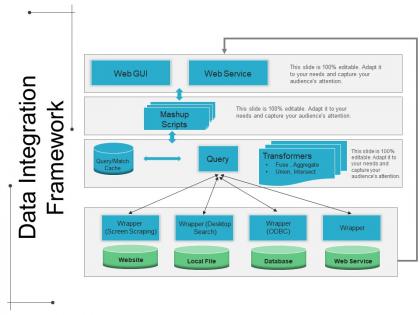
Guide the educational environment with several technology techniques by using Data Integration Framework PPT Images. You can share the information on how to integrate your data in a secure place with the help of data mapping PowerPoint template. Take the assistance of this information integration presentation layout and outline the different tools like Myddleware, Pimcore, Skool, Jitterbit, Talend cloud integration, MuleSoft anypoint program, and Dell Boomi atomsphere. Use the database model PPT slideshow to describe the designing and management of data processing and architecture. Included here are various high-quality icons with which you can make your presentation more precise and descriptive. Employ the professionally designed business architecture presentation layout to briefly explain the data integration framework that includes the functions like Web GUI, Web service, Mashup scripts, Match cache, query, and transformers. Hence, mention the steps that bring information from one application to another by downloading our ready-to-use PPT slideshow.
People who downloaded this PowerPoint presentation also viewed the following :
Data integration framework ppt images with all 5 slides:
Find out exactly how the error was committed with our Data Integration Framework Ppt Images. Be able to investigate cause factors.


FAQs for Data integration
**INPUT**: What are the key components of an effective data integration framework? **OUTPUT**: Effective data integration frameworks include data ingestion tools, transformation engines, quality validation systems, metadata management, and governance protocols. These components work together by streamlining data flows, ensuring consistency across sources, and enabling real-time analytics, with many organizations finding that strategic integration ultimately delivers enhanced decision-making capabilities and operational efficiency. [Word count: 53 words]
Data quality significantly impacts integration success by determining accuracy of insights, reliability of automated processes, and trustworthiness of business decisions derived from combined datasets. Poor quality data creates cascading errors across integrated systems, while high-quality data enables organizations to streamline operations, enhance customer experiences, and gain competitive advantages, with many financial services and healthcare institutions finding that investing in data quality validation ultimately delivers measurable ROI and operational efficiency.
Data governance establishes critical policies, standards, and procedures that ensure data quality, security, and compliance throughout the integration process. It enables organizations to maintain consistent data definitions, implement proper access controls, and establish clear accountability frameworks, while ensuring regulatory compliance and data lineage tracking, ultimately delivering reliable, trustworthy integrated datasets that support strategic decision-making.
Organizations can effectively manage data silos by implementing centralized data governance policies, establishing standardized APIs and data formats, creating cross-departmental integration teams, and deploying middleware solutions that enable seamless connectivity. These approaches streamline data flow by breaking down departmental barriers, ensuring consistent data quality, and facilitating real-time access, with many enterprises finding that strategic integration ultimately delivers enhanced decision-making capabilities and operational efficiency.
Modern data integration frameworks utilize ETL/ELT tools, API management platforms, cloud connectors, streaming technologies like Apache Kafka, and data virtualization solutions. These technologies streamline operations by enabling real-time processing, automating data workflows, and ensuring seamless connectivity across systems, with many organizations finding that strategic combinations ultimately deliver enhanced operational efficiency and competitive advantage.
Machine learning enhances data integration by automating data mapping, detecting anomalies in real-time, and optimizing ETL processes through predictive algorithms. These capabilities enable organizations to streamline complex integrations across multiple systems, reduce manual errors, and accelerate data processing speeds, with financial services and healthcare sectors finding significantly improved operational efficiency and data accuracy.
Best practices for real-time data integration include establishing robust data pipelines, implementing stream processing technologies, ensuring data quality validation, maintaining proper error handling, and creating scalable architecture frameworks. These practices enable organizations to streamline operations by minimizing latency, enhancing decision-making accuracy, and delivering seamless customer experiences, with many financial services and retail companies finding significant competitive advantages through faster, more responsive data-driven insights.
Cloud technologies revolutionize data integration strategies by enabling real-time data processing, eliminating infrastructure constraints, and providing scalable storage solutions across multiple platforms. Through cloud-native integration tools, organizations streamline data workflows, reduce operational costs, and enhance accessibility, with many financial services and retail companies finding that hybrid cloud approaches deliver faster analytics and improved customer experiences.
Integrating structured and unstructured data presents challenges including format incompatibility, varying data quality standards, complex transformation requirements, scalability limitations, and security considerations. These integration obstacles require strategic approaches that streamline processing workflows, enhance data standardization protocols, and automate validation processes, with many organizations finding that comprehensive frameworks ultimately deliver improved analytics capabilities and competitive advantage.
APIs facilitate data integration by establishing standardized communication protocols, enabling real-time data exchange, and providing secure authentication mechanisms between different software systems. Through RESTful APIs and webhooks, organizations streamline workflows across CRM, ERP, and analytics platforms, while minimizing manual data entry and reducing integration costs, ultimately delivering seamless operational efficiency and enhanced business intelligence capabilities.
Organizations should monitor data processing speed, error rates, system uptime, data quality scores, integration latency, and resource utilization metrics to evaluate framework performance. These measurements enable businesses to identify bottlenecks, optimize workflows, and ensure reliable data flows, with many enterprises finding that comprehensive monitoring ultimately delivers improved operational efficiency and faster decision-making capabilities.
Data integration frameworks support regulatory compliance by centralizing data governance, implementing automated audit trails, and ensuring consistent privacy controls across all connected systems. Through unified data management, organizations can streamline GDPR consent tracking, automate HIPAA access logging, and maintain comprehensive data lineage documentation, ultimately delivering enhanced regulatory transparency and significantly reducing compliance risks.
Metadata management provides critical context and structure for data integration by documenting data sources, transformations, lineage, and business definitions across systems. It enables organizations to maintain data quality, ensure compliance, and accelerate integration projects, with many enterprises finding that robust metadata significantly reduces integration complexity while enhancing data governance and user trust.
Data integration frameworks evolve with big data by adopting cloud-native architectures, real-time streaming capabilities, and distributed processing technologies like Apache Kafka and Spark. These enhanced frameworks enable organizations to handle petabyte-scale datasets through automated scalability, parallel processing, and intelligent data routing, ultimately delivering faster analytics and more responsive business intelligence across industries.
ETL serves as the backbone of data integration by extracting data from multiple sources, transforming it into consistent formats, and loading it into target systems like data warehouses. This process enables organizations to consolidate disparate information from CRM systems, databases, and applications, ultimately delivering unified analytics and streamlined reporting capabilities across enterprises.
-
Excellent Designs.
-
Excellent Designs.