


Data Lake Future Of Analytics Centralized Repository Data Lake Reporting Dashboard Ppt Tips





Try Before you Buy Download Free Sample Product
 Impress Your
Audience
 100%
Editable
 Save Hours
of Time


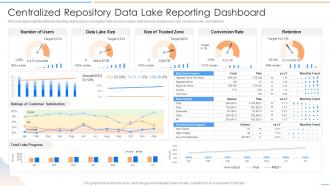
This slide represents the data lake reporting dashboard by covering the total number of users, total lake size, trusted zone size, conversion rate, and retention.
People who downloaded this PowerPoint presentation also viewed the following :
Data Lake Future Of Analytics Centralized Repository Data Lake Reporting Dashboard Ppt Tips with all 7 slides:
Use our Data Lake Future Of Analytics Centralized Repository Data Lake Reporting Dashboard Ppt Tips to effectively help you save your valuable time. They are readymade to fit into any presentation structure.






FAQs for Data Lake Future Of Analytics Centralized Repository Data Lake Reporting
Data lakes store raw, unstructured data in its native format, while data warehouses contain processed, structured data organized for specific business queries. Data lakes offer greater flexibility and lower storage costs, enabling organizations to capture diverse data sources like social media, IoT sensors, and transaction logs, whereas data warehouses deliver faster query performance and more reliable reporting for traditional business intelligence needs.
Data lakes support big data analytics by storing vast amounts of raw, structured and unstructured data in its native format, enabling advanced analytics, machine learning, and real-time processing. This flexible architecture allows organizations across healthcare, finance, and retail to perform complex queries, predictive modeling, and pattern recognition at scale, ultimately delivering faster insights and competitive advantage.
Data lakes accommodate diverse formats including structured data like CSV and SQL tables, semi-structured formats such as JSON and XML, and unstructured content like videos, images, and documents. This flexibility enables organizations to consolidate information from multiple sources, streamlining analytics processes and reducing storage costs, with many enterprises finding that unified data repositories ultimately enhance decision-making capabilities.
Best practices for structuring data in a data lake include implementing a layered architecture with raw, refined, and curated zones, establishing consistent naming conventions, organizing data by business domain or source system, and maintaining comprehensive metadata catalogs. These approaches streamline data discovery, enhance governance, and accelerate analytics workflows, with many organizations finding that structured zones ultimately deliver faster insights and improved data quality across teams.
Effective data governance in data lakes requires establishing clear data ownership, implementing automated metadata management, and creating standardized access controls across all stored data. Through comprehensive cataloging systems, organizations streamline data discovery, ensure regulatory compliance, and maintain data quality standards, while enabling self-service analytics capabilities that ultimately deliver faster insights and reduced operational overhead.
Data lakes serve as foundational infrastructure for machine learning and AI projects by providing scalable storage for diverse datasets, enabling data scientists to access raw and processed information seamlessly. Through centralized repositories, organizations streamline model training, accelerate algorithm development, and enhance predictive analytics capabilities, with many financial services and healthcare institutions finding that consolidated data access significantly reduces project timelines while improving model accuracy.
Organizations ensure data lake quality through automated validation frameworks, data lineage tracking, schema enforcement, regular profiling audits, and standardized ingestion protocols. These approaches streamline quality management by establishing governance rules, monitoring data freshness, and implementing real-time error detection, with many enterprises finding that proactive quality controls ultimately deliver improved analytics accuracy and faster decision-making capabilities.
Security risks in data lakes include unauthorized access to sensitive data, inadequate encryption protocols, data breach vulnerabilities, compliance violations with regulations like GDPR, and insufficient access controls across distributed storage systems. While these challenges require strategic planning, organizations in healthcare, finance, and retail increasingly find that implementing robust authentication, encryption, and monitoring frameworks ultimately delivers enhanced data protection and regulatory compliance advantages.
Data lakes facilitate real-time processing by storing diverse data formats in their native state, enabling streaming analytics, event processing, and immediate data ingestion from multiple sources. Through technologies like Apache Kafka and Spark Streaming, organizations in finance, retail, and healthcare achieve faster fraud detection, dynamic pricing, and patient monitoring, ultimately delivering competitive advantages through instantaneous insights.
Cloud-based data lakes offer superior scalability, cost-effectiveness, reduced maintenance overhead, faster deployment, and enhanced collaboration capabilities compared to on-premise solutions. These advantages enable organizations to handle massive data volumes without infrastructure investments, with companies in retail and healthcare finding that cloud solutions deliver automatic scaling, pay-as-you-use pricing, and seamless integration across distributed teams.
Organizations efficiently manage data lifecycle within data lakes through automated data tiering, metadata management systems, retention policy enforcement, and regular data quality audits. These approaches streamline storage costs, enhance data accessibility, and ensure compliance, with many financial institutions and healthcare organizations finding that strategic lifecycle management reduces operational expenses by 30-40% while improving data retrieval speeds.
Data lake development relies on Apache Hadoop, Apache Spark, Amazon S3, Azure Data Lake Storage, and Google Cloud Storage for scalable infrastructure. These technologies streamline data ingestion, processing, and analytics by supporting diverse data formats, enabling real-time processing, and delivering automated workflows, with many organizations finding enhanced operational efficiency and faster insights.
Data lakes enable democratization by providing centralized access to raw, structured, and unstructured data across departments, eliminating traditional data silos and complex retrieval processes. Through self-service analytics tools and standardized interfaces, teams in marketing, finance, and operations can independently explore datasets, generate insights, and make data-driven decisions, ultimately reducing IT bottlenecks while enhancing organizational agility and innovation.
Data lakes significantly reduce data silos by creating centralized repositories that aggregate information from multiple departments, systems, and sources across enterprises. Through cloud-based platforms and advanced integration tools, organizations like banks and healthcare systems streamline data accessibility, enhance cross-departmental collaboration, and ultimately deliver more comprehensive analytics capabilities, with many finding improved operational efficiency.
Successful data lake implementations include Netflix's content recommendation system, Capital One's fraud detection platform, GE's industrial analytics framework, and Airbnb's pricing optimization model. These organizations streamline data processing, enhance customer experiences, and accelerate decision-making by consolidating diverse data sources, with many finding that strategic data lake adoption delivers significant competitive advantages and operational efficiency.
-
Happy to found you SlideTeam. You guys are value for money. Amazing slides.
-
SlideTeam is very efficient when it comes to saving time. I am happy that I chose them for my presentation.