

Data Schema In DBMS Roadmap To Make Data Model




Try Before you Buy Download Free Sample Product
 Impress Your
Audience
 100%
Editable
 Save Hours
of Time


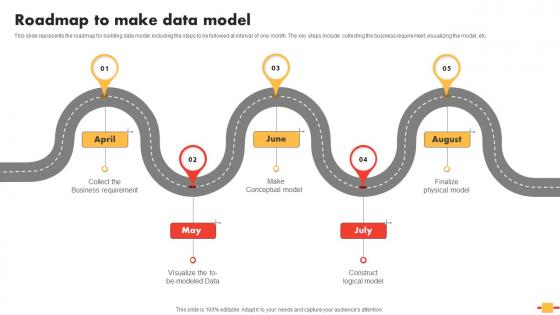
This slide represents the roadmap for building data model, including the steps to be followed at interval of one month. The key steps include collecting the business requirement, visualizing the model, etc.
People who downloaded this PowerPoint presentation also viewed the following :
Data Schema In DBMS Roadmap To Make Data Model with all 6 slides:
Use our Data Schema In DBMS Roadmap To Make Data Model to effectively help you save your valuable time. They are readymade to fit into any presentation structure.






FAQs for Data Schema In DBMS Roadmap To
Key components of a data schema include tables, fields, data types, relationships, constraints, and indexes that define data structure and organization. These components work together by establishing how data is stored, connected, and validated, with tables containing fields of specific types, relationships linking related information, and constraints ensuring data integrity, ultimately enabling efficient data retrieval and management across applications.
A well-defined data schema improves data integrity and consistency by establishing clear data types, validation rules, relationships, and constraints that prevent invalid entries and maintain accuracy. Through standardized structures, organizations streamline data management, reduce errors, and ensure reliable information flow across systems, with many financial institutions and healthcare providers finding that robust schemas ultimately deliver enhanced operational efficiency and regulatory compliance.
Relational schemas use structured tables with predefined relationships and strict data types, while non-relational schemas offer flexible, document-based or key-value structures without fixed relationships. While relational models excel in financial services and banking for transaction consistency, non-relational approaches enable retail and healthcare organizations to handle diverse data formats, ultimately delivering faster scalability and enhanced operational flexibility.
Data schemas can evolve through versioning strategies, backward compatibility maintenance, and gradual migration approaches that preserve existing functionality while introducing new features. Many organizations implement schema evolution using techniques like additive changes, field deprecation rather than removal, and API versioning, enabling seamless transitions that minimize application downtime while delivering enhanced data capabilities.
Data schemas serve as critical blueprints during data migration, ensuring structural consistency, data integrity, and compatibility between source and target systems. They enable organizations to map field relationships, validate data types, and identify potential conflicts before migration, while streamlining the transformation process and minimizing errors, ultimately delivering faster, more reliable migrations with reduced downtime.
Determining appropriate normalization levels involves balancing data integrity requirements with query performance needs, considering factors like update frequency, storage costs, and application complexity. Organizations typically evaluate their specific use cases, with transactional systems like banking often requiring higher normalization for consistency, while analytical environments may use denormalized schemas for faster reporting, ultimately delivering optimal performance and maintainability.
Big data schema design requires denormalization for performance, partitioning strategies for scalability, flexible schema evolution capabilities, and optimized data types for storage efficiency. Financial institutions and healthcare organizations increasingly implement columnar storage formats, automated partitioning by date ranges, and schema versioning systems, ultimately delivering faster query performance and reduced infrastructure costs while maintaining data integrity.
Data schema aids integration by providing a unified structure that maps disparate data formats, defines consistent field types and relationships, and establishes standardized naming conventions across sources. Through schema mapping and transformation rules, organizations can seamlessly combine data from databases, APIs, and files, while ensuring data quality and consistency, ultimately enabling comprehensive analytics and reducing integration complexity significantly.
Effective data schema visualization and management tools include MySQL Workbench, pgAdmin, Lucidchart, ER/Studio, and DbSchema, alongside cloud-native solutions like AWS Schema Conversion Tool. These technologies streamline database design, automate documentation, and enhance collaboration across development teams, with many organizations finding that visual schema management reduces development time, minimizes errors, and ultimately delivers faster deployment cycles and improved data governance.
Schema-less databases offer flexibility for rapid development and handling diverse data types, but present challenges around data consistency, query optimization, and long-term maintenance. While organizations like startups and content management platforms benefit from faster iteration and reduced structural constraints, enterprises increasingly find that hybrid approaches balance agility with governance, ultimately delivering operational flexibility while maintaining data integrity and performance standards.
Data schemas support governance and compliance by establishing standardized data definitions, enforcing quality rules, and ensuring regulatory alignment across organizational systems. Through structured metadata management and automated validation controls, schemas enable consistent data classification, audit trails, and privacy protection, while streamlining compliance reporting and reducing regulatory risks for financial services and healthcare organizations.
Common data schema pitfalls include inadequate normalization, poor naming conventions, insufficient data type planning, lack of indexing strategy, and ignoring future scalability requirements. These oversights create significant operational challenges, with many organizations finding that poorly designed schemas lead to performance bottlenecks, maintenance difficulties, and costly restructuring efforts that ultimately hinder competitive advantage.
Data schemas significantly influence database performance through optimized indexing strategies, efficient query execution paths, normalized table structures, and strategic data partitioning approaches. Well-designed schemas enable faster data retrieval, minimize storage overhead, and support horizontal scaling, with many financial services and e-commerce platforms finding that strategic schema optimization delivers improved response times and enhanced system reliability.
Machine learning models benefit from well-structured data schemas through improved data quality, faster preprocessing, enhanced feature engineering, reduced training time, and better model accuracy. These structured frameworks enable data scientists to streamline model development, minimize data inconsistencies, and accelerate deployment cycles, with organizations in healthcare and finance finding that standardized schemas ultimately deliver more reliable predictions and scalable AI solutions.
Data schemas facilitate better data sharing by establishing standardized structures, common definitions, clear documentation, consistent formats, and unified access protocols across teams. Through well-defined schemas, organizations streamline cross-departmental collaboration, eliminate data interpretation conflicts, and accelerate project timelines, with many enterprises finding that standardized schemas ultimately deliver faster decision-making and enhanced operational efficiency.
-
This visual representation is stunning and easy to understand. I like how organized it is and informative it is.
-
Making a presentation has never been this easy for me. Thank you SlideTeam for offering a splendid template library.