Data science it critical components of data science
Try Before you Buy Download Free Sample Product
Audience
Editable
of Time
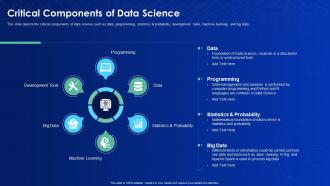
This slide depicts the critical components of data science such as data, programming, statistics and probability, development tools, machine learning, and big data.
People who downloaded this PowerPoint presentation also viewed the following :
Data science it critical components of data science with all 6 slides:
Use our Data Science It Critical Components Of Data Science to effectively help you save your valuable time. They are readymade to fit into any presentation structure.
FAQs for Data science it critical components
Supervised learning uses labeled training data to predict outcomes, while unsupervised learning discovers hidden patterns in unlabeled datasets through clustering, association rules, and dimensionality reduction techniques. These approaches enable organizations to enhance customer segmentation, fraud detection, and recommendation systems, with many financial institutions and retailers finding that combining both methods delivers comprehensive insights and competitive advantages.
Data preprocessing and cleaning significantly impact machine learning model accuracy by removing inconsistencies, handling missing values, normalizing data formats, and eliminating outliers that can skew predictions. Through systematic data preparation, organizations in healthcare, finance, and retail enhance model reliability by 20-40%, ultimately delivering more precise customer insights, fraud detection capabilities, and predictive analytics that drive competitive advantage.
Feature engineering significantly improves model performance by creating, selecting, transforming, and optimizing input variables to enhance predictive accuracy and interpretability. Through techniques like dimensionality reduction, categorical encoding, and feature scaling, data scientists streamline model training, reduce overfitting, and extract meaningful patterns, with organizations in healthcare, finance, and retail finding substantially improved prediction accuracy and business outcomes.
Effective classification metrics include accuracy, precision, recall, F1-score, ROC-AUC, and confusion matrices, each serving different analytical needs and business contexts. These metrics enable data scientists to evaluate model performance comprehensively, with financial institutions using precision for fraud detection, healthcare organizations leveraging recall for disease diagnosis, and retail companies applying F1-scores for customer segmentation, ultimately delivering more reliable predictive insights.
Choosing the right machine learning algorithm depends on your dataset size, problem type (classification, regression, clustering), data quality, and desired interpretability. Through systematic evaluation of algorithms like random forests for structured data, neural networks for complex patterns, and linear models for interpretable results, organizations streamline model selection, ultimately delivering accurate predictions and competitive advantage.
**INPUT**: What are the ethical considerations involved in data collection and analysis? **OUTPUT**: Ethical considerations include privacy protection, informed consent, data transparency, algorithmic bias prevention, and secure storage practices. These principles enable organizations to build customer trust while maintaining compliance, with many financial services and healthcare institutions finding that ethical frameworks ultimately deliver competitive advantage and sustainable growth. **Word count: 50 words**
Data visualization enhances interpretation by transforming complex numerical data into intuitive charts, graphs, heat maps, and interactive dashboards that reveal patterns, trends, and outliers instantly. These visual tools enable analysts across industries like healthcare, finance, and retail to identify correlations, communicate insights effectively, and make data-driven decisions faster, ultimately streamlining strategic planning.
Common big data challenges include storage limitations, processing speed bottlenecks, data quality inconsistencies, integration complexities, and privacy compliance requirements. Organizations address these through cloud infrastructure, distributed computing frameworks, automated data validation tools, and robust governance protocols, with many enterprises finding that strategic investments in scalable architectures ultimately deliver faster insights and competitive advantages.
Overfitting occurs when models memorize training data rather than learning generalizable patterns, resulting in poor performance on new data and reduced predictive accuracy. Data scientists mitigate this through techniques like cross-validation, regularization, early stopping, and dropout methods, with many organizations finding that proper validation frameworks ultimately deliver more reliable models and better business outcomes.
Data science contributes to business decision-making through predictive analytics, customer segmentation, market trend analysis, risk assessment, and operational optimization. By leveraging machine learning algorithms and statistical models, organizations across retail, finance, and healthcare can identify emerging opportunities, minimize operational costs, and enhance strategic planning, ultimately delivering data-driven insights that provide significant competitive advantage in increasingly complex markets.
Python and R dominate data science programming, alongside SQL for database management, with tools like Jupyter Notebooks, Tableau, and Apache Spark gaining widespread adoption. These technologies streamline data analysis, visualization, and machine learning workflows, with many organizations finding that Python's versatility and R's statistical capabilities deliver faster insights and enhanced analytical precision.
Deep learning uses neural networks with multiple hidden layers to automatically discover patterns and features from raw data, while traditional machine learning requires manual feature engineering and explicit programming of data relationships. Through advanced architectures like convolutional and recurrent networks, organizations in healthcare, finance, and retail achieve superior accuracy in image recognition, natural language processing, and predictive analytics, ultimately delivering more sophisticated automation and competitive intelligence capabilities.
Latest data science trends include automated machine learning (AutoML), explainable AI, edge computing analytics, real-time streaming analytics, and federated learning. These technologies streamline model development, enhance transparency, and enable faster decision-making, with many organizations finding that combining these approaches delivers significant competitive advantages while reducing operational complexity and improving customer experiences.
Data science enhances customer experience through predictive analytics, recommendation engines, sentiment analysis, behavioral segmentation, and real-time personalization algorithms. Through machine learning models, retailers deliver targeted product suggestions, banks streamline loan approvals, and streaming services curate personalized content, ultimately reducing churn rates while increasing customer satisfaction and lifetime value.
Cloud computing and big data technologies serve as the foundational infrastructure for modern data science, enabling scalable storage, distributed processing, real-time analytics, and collaborative model development. These platforms streamline complex computations by providing on-demand resources, automated scaling, and integrated machine learning services, with organizations across healthcare, finance, and retail finding that cloud-based data science delivers faster insights and reduced operational costs.
-
Good research work and creative work done on every template.
-
Top Quality presentations that are easily editable.