

Data warehouse it roadmap for data warehouse implementation in company




Try Before you Buy Download Free Sample Product
 Impress Your
 Audience
 100%
100% Editable
 Save Hours
 of Time


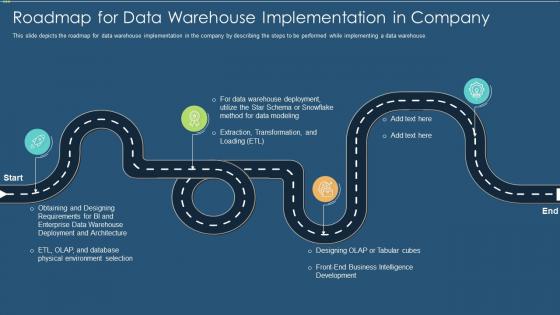
This slide depicts the roadmap for data warehouse implementation in the company by describing the steps to be performed while implementing a data warehouse.
People who downloaded this PowerPoint presentation also viewed the following :
Data warehouse it roadmap for data warehouse implementation in company with all 6 slides:
Use our Data Warehouse IT Roadmap For Data Warehouse Implementation In Company to effectively help you save your valuable time. They are readymade to fit into any presentation structure.





FAQs for Data warehouse it roadmap for data warehouse
Key phases include requirements analysis, architecture design, data modeling, ETL development, testing, and deployment. These phases streamline implementation by establishing clear business objectives, designing scalable infrastructure, and ensuring data quality, with many organizations finding that structured approaches reduce project timelines, minimize costs, and deliver measurable ROI through enhanced analytics capabilities.
Determining business requirements involves conducting stakeholder interviews across departments, analyzing current data workflows, identifying key performance indicators, and mapping critical business processes that need data support. Through comprehensive requirement gathering sessions, organizations can prioritize data sources, define reporting needs, and establish success metrics, while ensuring alignment between technical capabilities and strategic business objectives for measurable ROI.
Data modeling techniques serve as the architectural foundation for data warehouse implementation, encompassing dimensional modeling, entity-relationship diagrams, star and snowflake schemas, data flow mapping, and normalization strategies. These methodologies enable organizations to structure complex data relationships, optimize query performance, and ensure scalable integration across departments, with many enterprises finding that strategic data modeling significantly reduces implementation timelines while enhancing analytical accuracy.
Organizations can effectively assess their current data architecture through comprehensive data audits, system inventory mapping, performance benchmarking, integration complexity analysis, and stakeholder requirement gathering. This evaluation process enables businesses to identify data quality issues, technical gaps, and scalability limitations across existing infrastructure, while many enterprises finding that thorough upfront assessment streamlines migration planning and ultimately delivers faster implementation timelines.
Technology stack selection criteria include scalability requirements, data volume projections, integration capabilities, performance benchmarks, and budget constraints. Organizations should evaluate cloud versus on-premise options, compatibility with existing systems, and vendor support quality, with many enterprises finding that hybrid approaches deliver optimal flexibility while maintaining cost efficiency and operational control.
Stakeholders can ensure alignment by conducting comprehensive requirements analysis, establishing cross-functional governance committees, and implementing regular review cycles that map data capabilities to strategic goals. Through collaborative workshops and stakeholder interviews, organizations streamline communication between IT and business units, ultimately delivering measurable ROI and enhanced decision-making capabilities across departments.
Common pitfalls include inadequate data quality assessment, insufficient stakeholder alignment, underestimating migration complexity, poor change management, and neglecting user training requirements. These challenges can significantly delay project timelines and increase costs, with many organizations finding that thorough planning, cross-functional collaboration, and phased implementation approaches ultimately deliver smoother transitions and better user adoption.
Data quality management should be embedded throughout every phase of the data warehouse roadmap, including data profiling during planning, validation rules during ETL development, monitoring dashboards post-deployment, and governance frameworks for ongoing maintenance. This integrated approach enables organizations to prevent costly data issues, reduce remediation time, and ensure reliable analytics, with many enterprises finding that proactive quality management delivers significantly better user adoption and decision-making confidence.
**INPUT**: What strategies can be employed to manage user adoption and change management during implementation? **OUTPUT**: Effective change management strategies include comprehensive training programs, stakeholder engagement initiatives, phased rollout approaches, clear communication channels, and ongoing support systems. These methods streamline adoption by addressing user concerns early, demonstrating tangible benefits through pilot programs, and providing hands-on learning opportunities, with many organizations finding that dedicated change champions and regular feedback loops ultimately deliver higher user satisfaction and faster implementation success. [Word count: 60 words]
Scalability is critical in data warehouse design as it enables organizations to handle growing data volumes, increasing user demands, and expanding analytical requirements without performance degradation. It can be achieved through cloud-based architectures, distributed computing frameworks, modular schema designs, and automated scaling technologies, with many enterprises finding that scalable solutions ultimately deliver lower costs, faster query performance, and competitive advantage in increasingly data-driven markets.
On-premises data warehouses offer complete control and customization but require significant infrastructure investment, dedicated IT resources, and longer deployment timelines. Cloud-based implementations deliver faster setup, automatic scaling, and reduced maintenance overhead, with many organizations finding that cloud solutions streamline costs while enabling rapid data analytics deployment and enhanced accessibility across distributed teams.
Organizations ensure data security and compliance during warehouse implementation through encryption protocols, access controls, audit trails, regulatory framework alignment, and continuous monitoring systems. These measures streamline compliance with standards like GDPR and HIPAA while enhancing data protection, with many financial institutions and healthcare organizations finding that proactive security integration ultimately delivers operational transparency and competitive advantage.
Effective testing methods include data quality validation, performance benchmarking, user acceptance testing, integration verification, and end-to-end workflow testing. These approaches streamline validation by comparing source-to-target data accuracy, stress-testing query performance, and ensuring business users can access critical reports seamlessly, with many organizations finding that comprehensive testing phases ultimately deliver faster deployment and enhanced user confidence.
Data governance should be structured through centralized policies, defined data stewardship roles, quality standards, access controls, and compliance frameworks that align with warehouse architecture. This strategic combination enables organizations to maintain data integrity, streamline regulatory compliance, and enhance operational efficiency, with many enterprises finding that early governance integration significantly reduces implementation risks while delivering faster, more reliable analytics capabilities.
Best practices for training data warehouse teams include comprehensive technical education, hands-on workshops, role-specific curriculum development, ongoing certification programs, and cross-functional collaboration sessions. These training approaches enhance team capabilities by building technical expertise, improving data governance understanding, and strengthening analytical skills, with many organizations finding that structured training programs ultimately deliver faster problem resolution and more strategic data utilization.
-
Design layout is very impressive.
-
I discovered this website through a google search, the services matched my needs perfectly and the pricing was very reasonable. I was thrilled with the product and the customer service. I will definitely use their slides again for my presentations and recommend them to other colleagues.
-
Great product with effective design. Helped a lot in our corporate presentations. Easy to edit and stunning visuals.
-
Professional and unique presentations.
-
Great product with effective design. Helped a lot in our corporate presentations. Easy to edit and stunning visuals.