

Demand Of Ransom In Ransomware Attacks Training Ppt





Try Before you Buy Download Free Sample Product
 Impress Your
Audience
 100%
Editable
 Save Hours
of Time


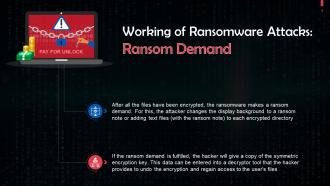
This slide gives information about ransom demand in ransomware attacks. After all the files have been encrypted, the ransomware makes a ransom demand. This is usually done by changing the display background to a ransom note or adding text files with the ransom note to each encrypted directory.
People who downloaded this PowerPoint presentation also viewed the following :
Demand Of Ransom In Ransomware Attacks Training Ppt with all 20 slides:
Use our Demand Of Ransom In Ransomware Attacks Training Ppt to effectively help you save your valuable time. They are readymade to fit into any presentation structure.










FAQs for Demand Of Ransom In Ransomware
Common ransomware infiltration methods include phishing emails with malicious attachments, exploit kits targeting software vulnerabilities, remote desktop protocol breaches, malicious downloads, and supply chain compromises. These attack vectors enable cybercriminals to encrypt critical data across organizations, with many healthcare systems, financial institutions, and municipal governments finding that multi-layered security approaches significantly reduce successful infiltration attempts.
Organizations can effectively assess ransomware vulnerability through comprehensive security audits, penetration testing, employee phishing simulations, backup system evaluations, and network segmentation reviews. These assessments enable companies to identify critical gaps in endpoint protection, access controls, and incident response protocols, with many financial institutions and healthcare systems finding that regular vulnerability testing significantly reduces attack surface and enhances overall cybersecurity resilience.
Employee training plays a crucial role in preventing ransomware by teaching staff to recognize phishing emails, suspicious links, and social engineering tactics that serve as primary attack vectors. Through regular cybersecurity awareness programs, organizations significantly reduce human error incidents, enhance threat detection capabilities, and create a security-conscious culture, with many companies finding that well-trained employees serve as their strongest defense against ransomware attacks.
Ransomware attacks typically unfold through initial access, reconnaissance, lateral movement, privilege escalation, data exfiltration, and encryption deployment. These phases enable cybercriminals to systematically compromise networks by identifying vulnerabilities, escalating permissions, and strategically positioning malware, with many organizations finding that understanding these sequential stages enhances their defensive strategies and incident response capabilities.
Ransomware differs from other malware by encrypting victims' files and demanding payment for decryption keys, while traditional malware typically steals data, corrupts systems, or creates backdoors. Unlike viruses or trojans that operate covertly, ransomware announces itself immediately, with healthcare systems and municipal governments finding that attacks halt operations entirely until resolved.
Best practices for developing a ransomware response plan include establishing clear incident response teams, creating comprehensive backup strategies, implementing network segmentation protocols, defining communication procedures, and conducting regular recovery drills. These frameworks enable organizations to minimize downtime, preserve critical data, and maintain business continuity, with many financial institutions and healthcare systems finding that proactive planning significantly reduces recovery costs and operational disruption.
Paying ransoms to cybercriminals creates significant legal risks including potential violations of sanctions laws, money laundering regulations, and compliance requirements across industries like healthcare and finance. While organizations face operational pressures to restore services quickly, many are finding that comprehensive incident response planning, cyber insurance coverage, and legal consultation deliver better outcomes than ransom payments, ultimately minimizing regulatory penalties and reputational damage.
Companies can recover data through comprehensive backup systems, incident response protocols, data restoration from offline archives, system isolation techniques, and cybersecurity partnerships with recovery specialists. Organizations across sectors like healthcare and finance increasingly implement multi-layered backup strategies, enabling rapid data reconstruction while maintaining operational continuity, ultimately delivering enhanced resilience without surrendering to cybercriminal demands.
Ransomware attacks significantly damage company reputation through operational disruptions, data breaches, customer service interruptions, and perceived security weaknesses that erode stakeholder confidence. These incidents often result in lasting trust issues, with many customers switching to competitors, partners questioning reliability, and investors reassessing risk profiles, ultimately requiring extensive reputation rebuilding efforts.
Emerging ransomware trends include double extortion schemes, ransomware-as-a-service models, targeted supply chain attacks, AI-enhanced social engineering, and cloud infrastructure targeting. These evolving tactics streamline cybercriminal operations while maximizing financial impact, with many organizations finding that proactive security frameworks, employee training, and incident response planning deliver significantly enhanced protection and operational resilience.
Endpoint security solutions mitigate ransomware risk by implementing real-time threat detection, behavioral analysis, application whitelisting, and automated response capabilities. These technologies enable organizations to identify suspicious file encryption activities, block malicious processes, and isolate infected devices before ransomware spreads, with many financial institutions and healthcare providers finding significantly reduced attack success rates.
Organizations like Maersk, which recovered from NotPetya within ten days through robust backup systems, and Colonial Pipeline, which minimized damage through rapid incident response protocols, demonstrate effective ransomware defense strategies. These companies succeeded by implementing multi-layered security, employee training, and comprehensive disaster recovery plans, ultimately maintaining operational continuity and protecting customer data while competitors faced extended downtime.
Double extortion ransomware variants fundamentally escalate cyber threats by combining data encryption with theft and public exposure threats, creating dual pressure points that dramatically increase victim compliance rates. These sophisticated attacks enable cybercriminals to demand higher ransoms while bypassing traditional backup recovery strategies, with many organizations in healthcare, finance, and manufacturing finding that reputational damage and regulatory penalties often outweigh initial ransom demands, ultimately forcing comprehensive security overhauls.
Nonprofits and small businesses can protect themselves through regular data backups, employee cybersecurity training, updated software patches, network segmentation, and endpoint protection solutions. These measures work together by minimizing attack vectors, containing potential breaches, and ensuring rapid recovery, with many organizations finding that combining basic security hygiene with staff awareness significantly reduces their vulnerability while maintaining operational continuity.
Government regulations significantly increase organizational accountability through mandatory breach notifications, compliance audits, and potential fines for inadequate cybersecurity measures. These frameworks, including GDPR, HIPAA, and sector-specific requirements, establish clear incident response timelines and disclosure obligations, with many organizations finding that proactive compliance ultimately delivers stronger security postures and reduced regulatory penalties.
-
Mesmerized with the fantastic collection! Super sleek, relevant infographics.
-
I was never satisfied with my own presentation design but SlideTeam has solved that problem for me. Thank you SlideTeam!