

Denial Of Service Attack In Cybersecurity Training Ppt




Try Before you Buy Download Free Sample Product
 Impress Your
Audience
 100%
Editable
 Save Hours
of Time


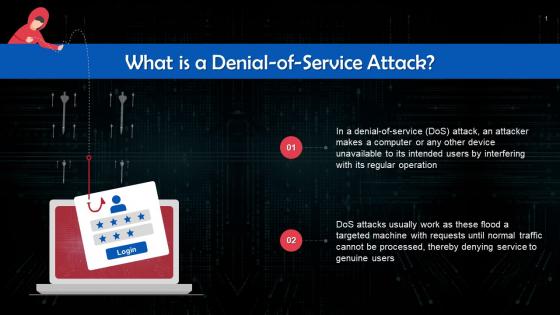
This slide contains details about DoS attacks. In a Denial-of-Service DoS attack, an attacker makes a computer or any other device unavailable to its intended users by interfering with its regular operation.
People who downloaded this PowerPoint presentation also viewed the following :
Denial Of Service Attack In Cybersecurity Training Ppt with all 20 slides:
Use our Denial Of Service Attack In Cybersecurity Training Ppt to effectively help you save your valuable time. They are readymade to fit into any presentation structure.










FAQs for Denial Of Service Attack In
Common DoS attacks include volumetric floods, protocol exploitation attacks, application-layer attacks, distributed botnets, and resource exhaustion techniques, each targeting different network vulnerabilities and system components. These attack vectors differ by targeting bandwidth versus server resources, with financial institutions and e-commerce platforms increasingly implementing layered defense strategies that combine traffic filtering, rate limiting, and behavioral analysis to maintain operational continuity.
Businesses can effectively prepare for DDoS attacks through robust network monitoring, redundant infrastructure, traffic filtering systems, incident response planning, and strategic partnerships with DDoS mitigation services. These comprehensive defenses enable organizations to maintain operational continuity, protect customer access, and minimize revenue losses during attacks, with many financial institutions and e-commerce platforms finding that proactive preparation significantly reduces downtime and preserves competitive advantage.
Bandwidth acts as a critical bottleneck that determines how easily attackers can overwhelm network resources through volumetric DoS attacks, with limited bandwidth making systems more vulnerable to traffic flooding. Organizations with constrained bandwidth, particularly smaller businesses and remote facilities, find that strategic bandwidth scaling and traffic filtering technologies help minimize attack impact while maintaining operational efficiency during security incidents.
Cloud services enhance DoS protection through distributed infrastructure, auto-scaling capabilities, traffic filtering, content delivery networks, and specialized security services. These cloud-based solutions enable organizations to absorb massive traffic spikes, automatically distribute loads across multiple servers, and filter malicious requests before they reach critical systems, ultimately delivering improved uptime and resilient network performance.
Launching DoS attacks carries serious legal consequences including federal cybercrime charges, substantial fines, and imprisonment, even in simulated environments without proper authorization and documented consent. Organizations conducting penetration testing or security assessments must establish clear legal frameworks, obtain written permissions, and work within controlled boundaries, with many cybersecurity firms finding that professional liability insurance and formal agreements ultimately protect against unintended legal exposure.
IoT devices contribute to DDoS attacks by creating massive botnets when compromised, with their weak default passwords, infrequent updates, and limited security features making them vulnerable targets for cybercriminals. Organizations can secure these devices through network segmentation, regular firmware updates, strong authentication protocols, and comprehensive monitoring systems, ultimately delivering enhanced cybersecurity resilience and protecting critical business operations from increasingly sophisticated threats.
DoS attack indicators include unusually slow network performance, inaccessible websites or services, dramatic increase in spam emails, unexplained network traffic spikes, and system crashes or timeouts. These warning signs enable IT teams to implement rapid response protocols, activate traffic filtering systems, and deploy mitigation strategies, with many organizations finding that early detection significantly minimizes operational disruption and maintains service availability.
Organizations utilize traffic analysis to detect DoS attacks through real-time monitoring systems that analyze traffic patterns, bandwidth consumption, connection frequencies, and request origins to identify anomalies. These systems enable automated responses like traffic filtering, rate limiting, and IP blocking, with many financial institutions and e-commerce platforms finding that proactive traffic analysis reduces attack impact by 80% while maintaining service availability.
DoS attacks and ransomware threats often work synergistically in today's cyber landscape, with attackers using denial-of-service techniques to overwhelm systems while deploying ransomware payloads, creating diversionary tactics during data encryption, or pressuring victims into faster payment. These combined attack vectors enable cybercriminals to maximize disruption across healthcare networks, financial institutions, and manufacturing systems, ultimately delivering greater leverage over organizations while significantly increasing recovery complexity and costs.
DNS level protections mitigate Denial of Service attacks by filtering malicious traffic, implementing rate limiting, and using anycast routing to distribute requests across multiple servers. These technologies streamline defense mechanisms by blocking suspicious domains, throttling excessive queries, and maintaining service availability, with many organizations finding that DNS-based solutions deliver faster response times and enhanced network resilience.
Firewalls and intrusion detection systems serve as critical first-line defenses against DoS attacks by filtering malicious traffic, monitoring network patterns, and automatically blocking suspicious connection attempts before they overwhelm system resources. These security technologies work together to identify attack signatures, rate-limit incoming requests, and alert administrators to emerging threats, with many financial institutions and healthcare organizations finding that layered security approaches significantly reduce their vulnerability to service disruptions.
Rate limiting and throttling effectively combat DoS attacks by controlling incoming request volumes, blocking suspicious traffic patterns, and preventing server overload through automated bandwidth restrictions. These techniques enable organizations like financial institutions and e-commerce platforms to maintain service availability during attacks, though sophisticated distributed attacks may require additional layered security measures for comprehensive protection.
Botnets serve as the primary infrastructure for large-scale DDoS attacks, providing attackers with networks of compromised devices that can generate massive traffic volumes simultaneously. These distributed networks enable cybercriminals to overwhelm enterprise servers, financial services platforms, and e-commerce sites with coordinated attacks, ultimately forcing organizations to invest significantly in advanced DDoS mitigation technologies and robust cybersecurity frameworks.
Incident response plans for DoS attacks should include early detection systems, traffic analysis protocols, communication frameworks, mitigation strategies, and recovery procedures. Through automated monitoring tools and predefined escalation paths, organizations can minimize downtime, coordinate with ISPs and security vendors, and restore normal operations quickly, ultimately protecting revenue streams and maintaining customer trust during cyber incidents.
Financial services, healthcare, e-commerce, gaming, and government sectors face the highest DoS vulnerability due to their critical uptime requirements and valuable data assets. These industries present attractive targets because disruptions directly impact revenue streams, customer trust, and operational continuity, with attackers often finding that even brief outages can cause significant reputational damage and financial losses.
-
Fantastic collection of visually appealing PowerPoint templates. They certainly uplift the look of the presentation.
-
Wonderful templates design to use in business meetings.