

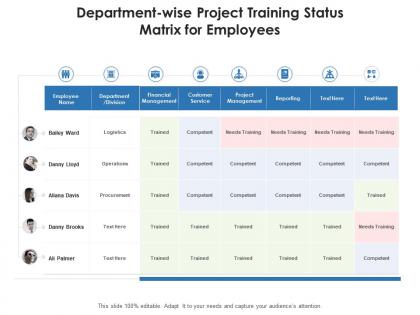
Department wise project training status matrix for employees




Try Before you Buy Download Free Sample Product
 Impress Your
 Audience
 100%
100% Editable
 Save Hours
 of Time


Our Department Wise Project Training Status Matrix For Employees are topically designed to provide an attractive backdrop to any subject. Use them to look like a presentation pro.
People who downloaded this PowerPoint presentation also viewed the following :
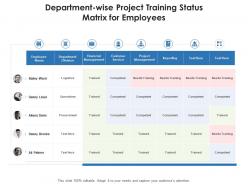
Department wise project training status matrix for employees with all 2 slides:
Use our Department Wise Project Training Status Matrix For Employees to effectively help you save your valuable time. They are readymade to fit into any presentation structure.
FAQs for Department wise project training status
A Project Training Status Matrix should include employee names and roles, required training modules, completion dates, certification levels, and compliance deadlines. This comprehensive tracking system enables project managers to identify skill gaps, ensure regulatory compliance, and optimize resource allocation across teams, while many organizations finding that systematic training oversight significantly enhances project delivery timelines and quality outcomes.
A Project Training Status Matrix enhances project management efficiency by tracking team competencies, identifying skill gaps, and aligning training needs with project requirements. Through centralized visibility into training progress, project managers can optimize resource allocation, reduce delays from unqualified personnel, and ensure deliverable quality, ultimately enabling faster project completion and improved team performance.
Visualizing training progress in a matrix format delivers enhanced transparency, streamlined resource allocation, improved accountability, faster identification of skill gaps, and simplified progress tracking across multiple participants and programs. This strategic approach enables organizations to optimize training investments, accelerate competency development, and ensure comprehensive coverage, with many institutions finding that matrix visualization significantly reduces administrative overhead while improving training outcomes.
Organizations tailor Project Training Status Matrices by incorporating industry-specific competencies, compliance requirements, role hierarchies, and performance metrics relevant to their sector. Healthcare systems might focus on patient safety certifications while manufacturing companies emphasize equipment handling protocols, with many finding that customized matrices significantly enhance training relevance, accelerate skill development, and ultimately deliver better project outcomes.
Essential metrics include completion rates, assessment scores, skill competency improvements, time-to-proficiency, and post-training performance indicators. These measurements enable organizations to track learning outcomes, identify knowledge gaps, and optimize resource allocation, with many companies finding that combining quantitative data with qualitative feedback ultimately delivers enhanced employee capabilities and measurable business impact.
Project training status matrices should be updated weekly during active training phases and bi-weekly during project execution phases, with more frequent updates during critical milestones or when new team members join. This regular cadence ensures training gaps are quickly identified and addressed, while organizations like manufacturing companies and financial institutions find that consistent updates enhance team readiness, minimize project delays, and ultimately deliver improved project outcomes through better-prepared teams.
A Project Training Status Matrix facilitates better communication by providing centralized visibility into each team member's skill levels, training progress, and competency gaps across all project requirements. This transparency enables managers to make informed resource allocation decisions, helps team members identify collaboration opportunities with skilled colleagues, and streamlines knowledge transfer planning, ultimately delivering enhanced project coordination and reduced miscommunication risks.
Common pitfalls include creating overly complex tracking systems, failing to define clear skill benchmarks, neglecting regular updates, and not aligning training metrics with project requirements. Organizations should streamline their matrix design, establish measurable competency standards, and maintain consistent monitoring processes, with many project managers finding that simple, focused matrices deliver better visibility and accountability than comprehensive but unwieldy alternatives.
Technology tools streamline Project Training Status Matrix creation through automated data collection, real-time progress tracking, centralized dashboards, and integration with learning management systems. These platforms enable project managers to monitor training completion rates, identify skill gaps, and generate compliance reports instantly, while team members access personalized learning paths, ultimately delivering enhanced project readiness and reduced administrative overhead.
Stakeholder feedback enables continuous refinement of the Project Training Status Matrix by identifying skill gaps, training effectiveness issues, and evolving competency requirements across project phases. Through regular input from project managers, team leads, and training coordinators, organizations can adjust matrix parameters, update skill assessments, and align training priorities with actual project needs, ultimately delivering more targeted development programs and improved project outcomes.
A Project Training Status Matrix assists in identifying skill gaps by systematically mapping required competencies against current team capabilities, highlighting discrepancies between needed expertise and actual proficiency levels. This visual assessment enables project managers to pinpoint specific training needs, allocate resources strategically, and develop targeted skill enhancement programs, ultimately ensuring teams possess necessary capabilities for successful project delivery.
Project Training Status Matrices enable tracking through automated progress monitoring, real-time completion dashboards, color-coded visual indicators, milestone-based reporting, and integration with learning management systems. These methods streamline oversight by providing instant visibility into individual and team progress, generating automated compliance reports, and identifying training gaps, ultimately delivering enhanced accountability and faster project readiness across organizations.
A Project Training Status Matrix integrates with project management tools through API connections, shared databases, automated reporting dashboards, and workflow synchronization systems. This strategic combination enhances resource allocation and milestone tracking across platforms like Gantt charts, Kanban boards, and performance management systems, ultimately delivering streamlined project oversight and improved team development coordination for organizations managing complex, multi-phase initiatives.
Best practices for visually representing data in a Project Training Status Matrix include using color-coded status indicators, progress bars for completion percentages, clear categorical groupings, standardized icons for different training types, and intuitive legends for quick interpretation. These visual elements streamline project oversight by enabling instant status recognition, facilitating resource allocation decisions, and enhancing team communication, with many project managers finding that consistent visual standards ultimately deliver faster project delivery and improved training outcomes.
Regulatory compliance scenarios requiring Project Training Status Matrix customization include healthcare organizations tracking HIPAA training, financial services monitoring anti-money laundering certifications, manufacturing ensuring safety protocol adherence, and pharmaceutical companies documenting FDA compliance training. These matrices must incorporate compliance deadlines, certification expiry dates, audit trail requirements, and role-specific training mandates, ultimately delivering regulatory transparency and minimizing compliance risks across regulated industries.
-
Attractive design and informative presentation.
-
Excellent Designs.
-
The Designed Graphic are very professional and classic.