

Detailed Components In A Legal Feasibility Study Project Viability Assessment To Evaluate




Try Before you Buy Download Free Sample Product
 Impress Your
 Audience
 100%
100% Editable
 Save Hours
 of Time


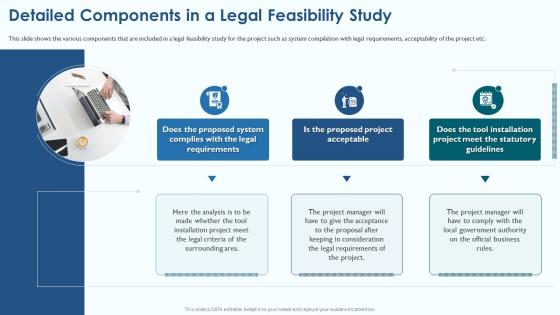
This slide shows the various components that are included in a legal feasibility study for the project such as system compilation with legal requirements, acceptability of the project etc.
People who downloaded this PowerPoint presentation also viewed the following :
Detailed Components In A Legal Feasibility Study Project Viability Assessment To Evaluate with all 6 slides:
Use our Detailed Components In A Legal Feasibility Study Project Viability Assessment To Evaluate to effectively help you save your valuable time. They are readymade to fit into any presentation structure.





FAQs for Detailed Components In A Legal Feasibility Study Project Viability
The primary objectives of conducting a legal feasibility study include assessing regulatory compliance requirements, identifying potential legal risks and liabilities, evaluating contract and licensing obligations, analyzing zoning and permit requirements, and ensuring adherence to industry-specific regulations. These comprehensive evaluations streamline project planning by minimizing legal obstacles, reducing compliance costs, and accelerating approval processes, ultimately delivering strategic advantage and operational certainty for organizations navigating increasingly complex regulatory environments.
A legal feasibility study specifically examines regulatory compliance, licensing requirements, intellectual property concerns, and potential legal barriers, while other feasibility assessments focus on technical capabilities, market demand, or financial viability. Through comprehensive legal analysis, organizations identify contractual obligations, zoning restrictions, and statutory requirements early in project development, ultimately avoiding costly legal challenges and ensuring smoother project implementation across industries.
Key legal frameworks include regulatory compliance requirements, environmental laws, zoning ordinances, employment regulations, intellectual property protections, and industry-specific standards. These frameworks work together to define operational boundaries, liability exposures, and compliance costs, with many organizations finding that early legal assessment streamlines project development, minimizes regulatory delays, and ultimately delivers competitive advantage through proactive risk management.
Regulatory environments serve as the foundational framework for legal feasibility studies, determining compliance requirements, licensing procedures, operational constraints, and risk parameters that directly impact project viability. These regulatory landscapes shape strategic decision-making across industries like healthcare, financial services, and manufacturing, with organizations finding that thorough regulatory analysis ultimately delivers competitive advantage and minimizes costly compliance failures.
Potential legal risks are identified through comprehensive regulatory analysis, compliance audits, contract reviews, intellectual property assessments, and stakeholder liability evaluations. Legal teams systematically examine applicable laws, industry regulations, and jurisdictional requirements, with many organizations finding that early risk identification streamlines project timelines, minimizes costly compliance issues, and ultimately delivers stronger legal foundations for business operations.
Methods include legal audits, regulatory gap analysis, compliance mapping, stakeholder consultations with legal experts, and comparative jurisdictional studies. These approaches streamline project planning by identifying potential legal obstacles, ensuring regulatory alignment, and minimizing compliance risks, with many organizations finding that proactive legal analysis ultimately delivers faster project approvals and reduced operational uncertainties.
Common legal challenges in feasibility studies include regulatory compliance requirements, intellectual property conflicts, zoning and land use restrictions, environmental regulations, and contractual obligations with existing partners. These legal hurdles can significantly impact project timelines and budgets, with many organizations finding that early legal consultation streamlines approval processes, minimizes costly delays, and ultimately delivers greater project certainty and competitive advantage.
Stakeholders can ensure alignment by establishing regular legal review schedules, subscribing to regulatory update services, and maintaining relationships with specialized legal counsel who monitor industry-specific changes. Many organizations implement quarterly compliance audits and cross-functional teams that include legal experts, ultimately delivering proactive risk management and sustained operational compliance in increasingly dynamic regulatory environments.
Essential documentation for a comprehensive legal feasibility study includes regulatory compliance requirements, zoning ordinances, environmental impact assessments, permit applications, and intellectual property clearances. These documents enable organizations to identify potential legal obstacles, assess regulatory requirements, and ensure project viability, with many businesses finding that thorough documentation streamlines approval processes and minimizes costly legal complications.
Assessing financial implications involves calculating compliance costs, potential penalties, legal fees, and ongoing monitoring expenses while comparing these against projected revenues. Organizations should evaluate implementation timelines, resource allocation requirements, and regulatory changes that could impact costs, with many companies finding that early compliance investment ultimately delivers competitive advantage and reduced long-term risk exposure.
Neglecting legal feasibility can result in project shutdowns, regulatory fines, costly litigation, compliance violations, and significant financial losses. These consequences often force organizations to redesign entire initiatives, with many companies in healthcare, finance, and manufacturing finding that early legal assessment prevents millions in remediation costs while ensuring sustainable market entry.
Organizations can incorporate community input through public consultations, stakeholder surveys, community advisory panels, focus groups, and regulatory hearings during legal feasibility assessments. These engagement methods help identify potential legal challenges, local regulatory concerns, and compliance requirements early in the process, while building community support and minimizing future litigation risks, ultimately streamlining project approval timelines.
**INPUT**: What best practices should be followed to ensure thorough legal risk assessment in feasibility studies? **OUTPUT**: Best practices include engaging qualified legal counsel early, conducting comprehensive regulatory compliance audits, analyzing contractual obligations, assessing intellectual property rights, and evaluating litigation risks across all jurisdictions. These practices enable organizations to identify potential legal obstacles, streamline regulatory approvals, and minimize costly compliance issues, with many companies finding that proactive legal assessment ultimately delivers faster project implementation and competitive advantage. [Word count: 59 words]
International laws and treaties create a complex regulatory framework that significantly influences project feasibility through compliance requirements, cross-border operational standards, and jurisdictional variations in enforcement mechanisms. These legal structures impact everything from environmental regulations to trade agreements, with many multinational corporations finding that strategic legal analysis across jurisdictions ultimately delivers competitive advantage and minimizes regulatory risks.
Legal counsel provides essential expertise in identifying regulatory requirements, assessing compliance obligations, evaluating potential legal risks, and ensuring accurate interpretation of applicable laws and regulations. Through their specialized knowledge, attorneys help organizations navigate complex legal frameworks, anticipate potential obstacles, and develop strategic recommendations, ultimately delivering comprehensive risk assessments and regulatory clarity that enable informed business decisions.
-
The presentations are very helpful. I am always able to get appropriate templates for the different topics related to my profession.
-
I was able to find the right choice of PPT template for my thesis with SlideTeam. Thank you for existing.