

Detailed SWOT Analysis For A Landscaping Start Up Garden Design Business Plan BP SS V




Try Before you Buy Download Free Sample Product
 Impress Your
Audience
 100%
Editable
 Save Hours
of Time


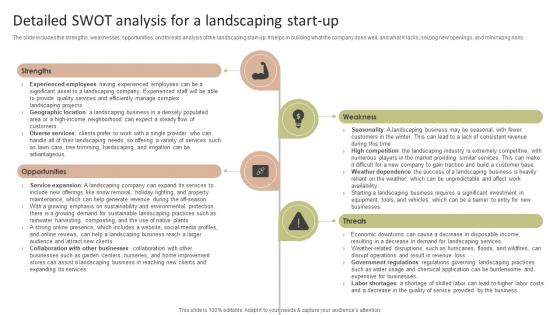
The slide includes the strengths, weaknesses, opportunities, and threats analysis of the landscaping start-up. It helps in building what the company does well, and what it lacks, seizing new openings, and minimizing risks.
People who downloaded this PowerPoint presentation also viewed the following :
Detailed SWOT Analysis For A Landscaping Start Up Garden Design Business Plan BP SS V with all 9 slides:
Use our Detailed SWOT Analysis For A Landscaping Start Up Garden Design Business Plan BP SS V to effectively help you save your valuable time. They are readymade to fit into any presentation structure.








FAQs for Detailed SWOT Analysis For A Landscaping Start Up Garden Design Business Plan
Primary strengths include lower operational overhead, agility in service customization, direct client relationships, competitive pricing flexibility, and adoption of modern technologies like design software and sustainable practices. These advantages enable landscaping start-ups to respond quickly to market trends, offer personalized solutions, and build strong community connections, with many finding that their nimbleness and innovative approaches deliver significant competitive advantages over established competitors.
A landscaping start-up can leverage unique selling points by emphasizing specialized services like eco-friendly practices, smart irrigation systems, or native plant expertise through targeted marketing campaigns, local partnerships, and digital showcases. These differentiators help establish competitive advantage in crowded markets, with many start-ups finding that combining visual portfolios with sustainability credentials attracts environmentally conscious homeowners and commercial clients seeking distinctive outdoor solutions.
New landscaping businesses typically face weaknesses including limited brand recognition, smaller customer bases, restricted financial resources for equipment and marketing, and lack of established supplier relationships. These challenges often result in higher operational costs, difficulty securing large commercial contracts, and slower service delivery compared to established competitors, though many startups overcome these by focusing on personalized service, competitive pricing, and niche market specialization.
Inadequate capital restricts a landscaping start-up's ability to purchase essential equipment, hire skilled crews, maintain inventory, and execute marketing campaigns effectively. This limitation forces businesses to decline larger projects, delay service expansion, and struggle with cash flow gaps during seasonal transitions, ultimately hindering competitive positioning and sustainable growth in local markets.
External opportunities for landscaping businesses in urban areas include sustainable design demand, green infrastructure initiatives, smart irrigation technologies, vertical gardening solutions, and urban agriculture projects. These trends enable companies to diversify services through eco-friendly installations, municipal partnerships, and technology integration, with many firms finding that specializing in sustainable urban solutions delivers premium pricing and competitive differentiation.
Seasonal demand requires landscaping start-ups to diversify service offerings across peak and off-seasons, implementing snow removal, holiday lighting, or indoor plant maintenance during winter months while maximizing lawn care and installation projects in spring and summer. This strategic approach enables consistent cash flow, year-round employee retention, and operational stability, with many successful landscaping businesses finding that seasonal diversification ultimately delivers competitive advantage and sustainable growth.
Economic downturns present significant threats to new landscaping companies through reduced discretionary spending on non-essential services, delayed commercial property development projects, and increased competition from established firms competing for fewer clients. During recessions, residential customers often postpone landscaping investments while businesses cut facility maintenance budgets, with many startups finding that cash flow challenges and difficulty securing financing can threaten operational sustainability.
Technological advancements enhance landscaping service delivery through GPS-enabled fleet management, drone surveillance for property assessments, automated irrigation systems, mobile apps for customer communication, and precision equipment for efficient operations. These technologies streamline scheduling and routing, minimize water waste, accelerate project completion times, and improve customer experiences, with many landscaping businesses finding that strategic technology adoption delivers significant competitive advantages and operational cost reductions.
Landscaping start-ups must navigate pesticide and fertilizer regulations, water usage restrictions, waste disposal requirements, native plant protection laws, and soil disturbance permits. These environmental compliance frameworks vary by municipality and state, with many successful landscaping businesses finding that proactive adherence to sustainable practices ultimately delivers competitive advantages through eco-friendly service offerings and reduced regulatory risks.
Effective marketing strategies overcome common landscaping start-up weaknesses by building brand recognition through digital presence, establishing credibility via customer testimonials and portfolio showcases, and creating competitive differentiation through specialized services. These approaches enable new businesses to attract clients despite limited reputation, generate consistent leads while building market presence, and ultimately accelerate revenue growth in an increasingly competitive landscape.
Customer feedback enables landscaping start-ups to refine service offerings by identifying service gaps, seasonal preferences, pricing sensitivities, and quality expectations from actual client experiences. Through systematic feedback collection, many landscaping businesses streamline their service portfolios, enhance customer satisfaction rates, and develop targeted offerings that address specific market demands, ultimately delivering competitive differentiation and improved client retention.
Partnerships with local suppliers provide landscaping start-ups competitive advantages through reduced transportation costs, faster material delivery, and stronger community relationships that enhance credibility. These strategic alliances enable negotiated bulk pricing, priority access during peak seasons, and collaborative marketing opportunities, with many start-ups finding that supplier partnerships accelerate growth while building sustainable operational foundations.
New landscaping businesses face significant challenges in hiring skilled labor, including intense competition from established companies offering higher wages, seasonal workforce fluctuations, limited budgets for competitive compensation packages, and difficulty finding workers with specialized knowledge in horticulture, irrigation systems, and equipment operation. These hiring constraints often result in longer project timelines, reduced service quality, and limited growth capacity, with many start-ups finding that strategic partnerships with vocational schools and apprenticeship programs help build reliable talent pipelines while offering competitive training opportunities.
A landscaping start-up can create sustainable practices through eco-friendly materials, native plant selections, water-efficient irrigation systems, organic fertilizers, and renewable energy equipment. These approaches differentiate by reducing operational costs, attracting environmentally conscious clients, and enabling premium pricing, with many green-focused landscaping companies finding that sustainable practices ultimately deliver stronger customer loyalty and competitive advantage in an increasingly eco-aware market.
New landscaping businesses should capitalize on sustainable practices, smart irrigation systems, native plant landscaping, outdoor living spaces, and low-maintenance xeriscaping designs. These trends enable companies to attract environmentally conscious homeowners while delivering cost-effective solutions, with many residential and commercial clients increasingly prioritizing water conservation and year-round usability, ultimately providing competitive differentiation.
-
Helpful product design for delivering presentation.
-
“The presentation template I got from you was a very useful one.My presentation went very well and the comments were positive.Thank you for the support. Kudos to the team!”