

Determine B2b Account Management Dashboard Effective B2b Demand Generation Plan




Try Before you Buy Download Free Sample Product
 Impress Your
 Audience
 100%
100% Editable
 Save Hours
 of Time


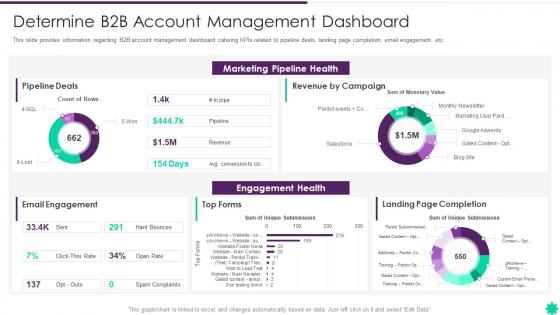
This slide provides information regarding B2B account management dashboard catering KPIs related to pipeline deals, landing page completion, email engagement, etc.
People who downloaded this PowerPoint presentation also viewed the following :
Determine B2b Account Management Dashboard Effective B2b Demand Generation Plan with all 7 slides:
Use our Determine B2b Account Management Dashboard Effective B2b Demand Generation Plan to effectively help you save your valuable time. They are readymade to fit into any presentation structure.






FAQs for Determine B2b Account Management Dashboard Effective B2b
Effective B2B demand generation strategies include targeted content marketing, account-based marketing campaigns, marketing automation workflows, lead scoring systems, and multi-channel nurturing programs. These elements work together by attracting qualified prospects, personalizing buyer journeys, and accelerating sales cycles, with many organizations finding that this strategic combination ultimately delivers higher conversion rates and stronger pipeline growth.
Content marketing boosts B2B demand generation by creating educational resources, thought leadership pieces, case studies, and targeted industry insights that attract qualified prospects throughout the buyer's journey. Through strategic content distribution across multiple channels, B2B companies nurture leads more effectively, establish credibility with decision-makers, and accelerate sales cycles, ultimately delivering higher conversion rates and stronger pipeline growth.
Lead nurturing plays a critical role in B2B demand generation by maintaining consistent engagement with prospects throughout extended sales cycles, delivering targeted content based on buyer behavior, and systematically moving leads through qualification stages. Through automated email sequences, personalized messaging, and strategic touchpoints, organizations enhance conversion rates, reduce sales cycle length, and maximize pipeline value, with many finding that nurturing increases qualified opportunities significantly.
Businesses can measure demand generation success through key metrics including lead quality scores, conversion rates, customer acquisition costs, pipeline velocity, and revenue attribution. These measurements enable organizations to optimize campaigns by tracking engagement across touchpoints, analyzing cost-per-lead efficiency, and connecting marketing activities to actual sales outcomes, ultimately delivering improved ROI and strategic resource allocation.
Common B2B demand generation mistakes include targeting too broadly, neglecting lead nurturing, focusing solely on quantity over quality, inconsistent messaging across channels, and inadequate sales-marketing alignment. These pitfalls often result from rushed campaigns or siloed approaches, with many organizations finding that strategic segmentation, personalized content, and integrated workflows ultimately deliver higher conversion rates and stronger pipeline quality.
The sales funnel directly shapes B2B demand generation tactics by aligning content, messaging, and channels to each buyer journey stage. Top-funnel tactics like thought leadership and educational content build awareness, while mid-funnel strategies including webinars and case studies nurture prospects, with bottom-funnel approaches ultimately converting qualified leads into customers through personalized demonstrations and consultations.
Buyer personas guide demand generation strategies by defining ideal customer profiles, pain points, preferred communication channels, decision-making processes, and content preferences. These detailed profiles enable B2B marketers to create targeted campaigns, personalized messaging, and strategic touchpoint optimization across industries like SaaS and manufacturing, ultimately delivering higher conversion rates and more qualified leads.
Businesses optimize websites for lead generation through strategic landing pages, compelling call-to-action buttons, lead magnets like whitepapers, progressive web forms, and personalized content experiences. These elements work together by reducing friction in the conversion process, capturing visitor information at multiple touchpoints, and nurturing prospects through targeted messaging, ultimately delivering higher conversion rates and qualified leads.
Essential technologies for automating B2B demand generation include marketing automation platforms, CRM systems, lead scoring algorithms, email marketing tools, and social media management software. These technologies streamline prospect identification, nurture campaigns, and conversion tracking, with many organizations finding that strategic automation delivers faster lead qualification, improved sales alignment, and significantly enhanced ROI across their demand generation efforts.
Social media drives B2B demand generation through targeted LinkedIn campaigns, thought leadership content sharing, strategic engagement with industry professionals, and precise audience segmentation. Through platforms like LinkedIn and Twitter, organizations build brand authority, nurture prospect relationships, and generate qualified leads, with many B2B companies finding that consistent social engagement ultimately delivers higher conversion rates and stronger sales pipelines.
Data analytics enables B2B marketers to optimize demand generation by identifying high-converting channels, tracking customer journey touchpoints, and measuring campaign ROI across multiple platforms. Through predictive modeling and performance insights, organizations can refine targeting strategies, allocate budgets more effectively, and enhance lead quality, with many finding that data-driven approaches increase conversion rates while reducing acquisition costs significantly.
Businesses should integrate account-based marketing by identifying high-value target accounts, creating personalized content experiences, and aligning sales and marketing teams around specific prospects. This strategic approach enables more focused resource allocation, higher conversion rates, and stronger customer relationships, with many B2B organizations finding that ABM delivers significantly better ROI than traditional broad-spectrum demand generation tactics.
Innovative B2B demand generation tactics include interactive content experiences, account-based personalization, social selling through LinkedIn engagement, AI-powered chatbots for qualification, and community-building initiatives. These approaches streamline prospect engagement by delivering targeted value, fostering genuine relationships, and creating memorable touchpoints, with many organizations finding that personalized, multi-channel strategies significantly accelerate pipeline development and enhance conversion rates.
Partnerships enhance B2B demand generation by expanding reach through co-marketing campaigns, joint webinars, and shared content creation, while leveraging complementary audiences and expertise. Strategic collaborations with technology vendors, industry associations, and non-competing businesses enable access to new markets, reduce customer acquisition costs, and deliver enhanced credibility through trusted recommendations.
B2B marketers should monitor AI-powered personalization, intent data utilization, multi-touch attribution models, conversational marketing platforms, and account-based marketing automation. These technologies enhance targeting precision, streamline lead qualification, and accelerate sales cycles, with many organizations finding that strategic combinations of these approaches ultimately deliver higher conversion rates and competitive advantage.
-
Very unique and reliable designs.
-
Colors used are bright and distinctive.