

Determine Segmentation Of Target Progressive Insurance And Financial




Try Before you Buy Download Free Sample Product
 Impress Your
 Audience
 100%
100% Editable
 Save Hours
 of Time


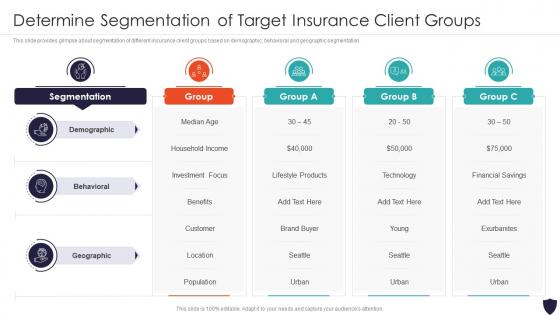
This slide provides glimpse about segmentation of different insurance client groups based on demographic, behavioral and geographic segmentation.
People who downloaded this PowerPoint presentation also viewed the following :
Determine Segmentation Of Target Progressive Insurance And Financial with all 6 slides:
Use our Determine Segmentation Of Target Progressive Insurance And Financial to effectively help you save your valuable time. They are readymade to fit into any presentation structure.





FAQs for Determine Segmentation Of Target Progressive
Key factors include demographic characteristics, geographic location, psychographic profiles, behavioral patterns, and purchasing power. These segmentation variables enable businesses to identify distinct customer groups with similar needs, preferences, and buying behaviors, ultimately delivering targeted marketing strategies and personalized experiences that drive higher conversion rates and customer loyalty.
Psychographic segmentation focuses on consumer attitudes, values, interests, and lifestyle choices, while demographic segmentation categorizes audiences by age, income, gender, education, and geographic location. Through psychographic insights, marketers can create more personalized campaigns that resonate emotionally with consumers, ultimately delivering higher engagement rates and stronger brand loyalty than traditional demographic approaches alone.
Behavioral segmentation influences consumer decision-making by analyzing purchase patterns, brand loyalty, usage frequency, and response to marketing campaigns. This approach enables businesses to predict buying behaviors, customize product recommendations, and optimize timing for promotions, with retailers and subscription services finding that targeted behavioral insights significantly enhance conversion rates and customer lifetime value.
B2B segmentation typically focuses on firmographics, industry verticals, company size, and decision-making processes, while B2C emphasizes demographics, psychographics, behavioral patterns, and purchase frequency. B2B marketers find success targeting specific industries like healthcare or manufacturing with account-based approaches, whereas B2C companies leverage lifestyle segmentation and digital behavior analytics, ultimately delivering more personalized campaigns and higher conversion rates.
Data analytics enables businesses to segment customers through behavioral analysis, demographic profiling, purchase pattern identification, predictive modeling, and real-time preference tracking. Through advanced algorithms and machine learning, organizations can uncover hidden customer segments, personalize marketing campaigns more effectively, and optimize resource allocation, with many retailers and financial services companies finding that data-driven segmentation delivers significantly higher conversion rates and customer lifetime value.
Targeting niche segments in crowded markets presents challenges including intense competition for limited audiences, higher customer acquisition costs, difficulty achieving economies of scale, and risk of segment saturation. While these constraints require strategic resource allocation, many companies find that focused niche targeting ultimately delivers stronger customer loyalty, premium pricing opportunities, and sustainable competitive advantages through specialized expertise.
Geographic segmentation enhances regional marketing by enabling targeted campaigns based on local preferences, cultural nuances, climate considerations, and regional economic conditions. Through location-specific messaging and product positioning, regional brands can deliver more relevant customer experiences, optimize resource allocation across territories, and build stronger community connections, ultimately achieving higher conversion rates and market penetration.
Common market segmentation mistakes include over-segmenting into too many micro-groups, relying on outdated demographic data, creating segments without actionable insights, and failing to validate segment viability through testing. These missteps often result from insufficient market research and inadequate cross-departmental alignment, ultimately leading to scattered marketing efforts, resource waste, and missed revenue opportunities across target markets.
Social media has revolutionized segmentation strategies by enabling behavioral tracking, psychographic profiling, real-time engagement analysis, and micro-targeting capabilities that weren't previously available. Platforms like Facebook and Instagram allow businesses to segment audiences based on interests, online behaviors, and social interactions, while retail and entertainment companies leverage these insights for highly personalized campaigns, ultimately delivering improved conversion rates.
Effective segmentation analysis tools include CRM platforms like Salesforce and HubSpot, analytics software such as Google Analytics and Adobe Analytics, statistical tools like SPSS and R, and specialized platforms including Segment and Mixpanel. These technologies streamline data collection, automate customer clustering, and deliver actionable insights, with many organizations finding that integrated platforms ultimately enhance targeting precision and campaign effectiveness.
Segmentation improves customer retention by enabling personalized experiences, targeted messaging, tailored product recommendations, and customized service levels that address specific customer needs and preferences. Through strategic segmentation, businesses deliver more relevant communications, optimize resource allocation, and build stronger emotional connections, with many companies finding that personalized approaches increase customer lifetime value and reduce churn significantly.
Cultural segmentation significantly transforms global marketing strategies by enabling personalized messaging, localized product offerings, culturally appropriate channels, and region-specific pricing models. Through cultural insights, multinational companies streamline their campaigns across diverse markets like Asia-Pacific retail, European financial services, and Latin American healthcare, ultimately delivering higher engagement rates and competitive advantage in increasingly complex international landscapes.
Lifestyle changes reshape segmentation trends by altering consumer priorities, purchasing behaviors, and brand preferences, with demographic shifts like remote work, health consciousness, and digital adoption creating new market segments. Companies increasingly adapt by developing flexible segmentation models that capture evolving preferences, enabling more targeted marketing strategies and ultimately delivering enhanced customer experiences and competitive advantage.
Segmentation in product development enables companies to create targeted solutions, reduce development costs, improve market fit, enhance customer satisfaction, and accelerate time-to-market. By understanding distinct customer groups, organizations can streamline resource allocation and prioritize features effectively, with many technology and consumer goods companies finding that segmented approaches deliver higher success rates and competitive advantage.
Brands can assess segment profitability by analyzing revenue potential, cost-to-serve ratios, customer acquisition costs, lifetime value metrics, and competitive intensity within each segment. Through detailed financial modeling and market research, companies like retail chains and financial services firms evaluate segment margins, growth trajectories, and resource requirements, ultimately identifying the most strategically valuable segments for investment prioritization.
-
Wow, never been this impressed with any online service provider. Really appreciate the customer support all along from the navigation to purchasing the right products.
-
“I always have a wonderful experience with SlideTeam. It's my ""go to"" when I need a template.”