


Developing 5G Transformative Technology Powerpoint Presentation Slides






Try Before you Buy Download Free Sample Product
 Impress Your
Audience
 100%
Editable
 Save Hours
of Time


The PowerPoint template is a useful tool for presenting Developing 5G Transformative Technology for telecom operators who are considering the implementation of the latest 5G technology across various geographical locations. It will cover slides about 5G, an upcoming technology opportunity, along with the objectives of 5G, industry expectations of 5G, and the contribution of 5G to the global economy. The template covers slides depicting uniqueness related to 5G in terms of its design specifications, comparative assessment, and unique features such as latency, speed, intelligent connectivity, heterogeneous network, and use cases in the context of 5G. The template covers slides regarding value creation and enablers with 5G deployment in terms of economic benefits enterprise opportunity, enhanced mobile broadband, and fixed wireless access. It caters to slides on various 5G value enablers such as resilient networks, horizontal APIs, operator cloud, network slicing, etc. It covers slides about cost determination for 5G by assessing cost-impacting factors such as network capacity, network coverage, network flexibility, network energy efficiency, and network equipment sourcing for 5G. Get access to our 5g technology ppt now.
People who downloaded this PowerPoint presentation also viewed the following :
Content of this Powerpoint Presentation
Slide 1: This slide displays the title Developing 5G Transformative Technology.
Slide 2: This slide displays the title Agenda.
Slide 3: This slide exhibit table of content.
Slide 4: This slide exhibit table of content- Inception of 5G Era.
Slide 5: This slide provides details regarding 5G as next generation mobile technology and emerging as network of opportunity.
Slide 6: This slide provides details regarding progressive timeline of 5G era in terms of technology, mobile internet users and unique mobile subscribers.
Slide 7: This slide provides details regarding objectives of 5G era and emerging as digital economy enabler.
Slide 8: This slide provides details regarding industry expectations from 5G era in terms of market structure, sustainability, opportunities.
Slide 9: This slide provides details regarding contribution of 5G to global economy with key enablers to digital economy.
Slide 10: This slide exhibit table of content- Uniqueness Associated to 5G.
Slide 11: This slide provides details regarding design specifications associated to 5G.
Slide 12: This slide provides details regarding comparative assessment of broadband technologies such as 3G, 4G and 5G networks.
Slide 13: This slide provides details regarding unique features of 5G in terms of reduced latency and high data throughput data speed with 5G for better customer experience.
Slide 14: This slide provides details regarding unique features of 5G.
Slide 15: This slide provides details regarding unique features of AI enabled 5G for intelligent connectivity.
Slide 16: This slide provides details regarding unique features of 5G with use cases.
Slide 17: This slide exhibit table of content- 5G Readiness.
Slide 18: This slide provides details regarding 5G deployment models such as Non – Standalone 5G deployment model , Standalone 5G deployment model.
Slide 19: This slide provides details regarding comparative assessment of SA and NSA in 5G and addressing their equipment readiness.
Slide 20: This slide provides details regarding technical aspects associated to 5G network including technical features for radio layer and service layer.
Slide 21: This slide provides details regarding voice and messaging capability of 5G network with IMS based IP communication services transformation.
Slide 22: This slide provides details regarding cellular vehicle to everything (C- V2X) associated to 5G along with its features.
Slide 23: This slide provides details regarding identity and access management with 5G in terms of 5G identifiers and 5G authentication.
Slide 24: This slide provides details regarding identity and access management with 5G in terms of 5G authentication.
Slide 25: This slide provides details regarding role of eSIM in 5G networks and act as enabler to connect various devices to different networks.
Slide 26: This slide provides details regarding vendor ecosystem associated to 5G.
Slide 27: This slide provides details regarding key security considerations associated to 5G in order to handle threats.
Slide 28: This slide exhibit table of content- Technology Readiness
Slide 29: This slide provides details regarding policy framework for 5G.
Slide 30: This slide provides details regarding network deployment regulations of 5G addressing key consideration for policymakers.
Slide 31: This slide provides details regarding 5G regulatory costs and flexibility along with key consideration for policy makers.
Slide 32: This slide provides details regarding various 5G era spectrum in terms of 5G spectrum bands, spectrum access and spectrum pricing.
Slide 33: This slide exhibit table of content- Market Readiness
Slide 34: This slide provides details regarding competitive landscape of 5G along with other technologies in terms of latency, mobility, coverage and bandwidth.
Slide 35: This slide provides details regarding success factors associated to 5G handsets with better battery capacity, performance and safety performance.
Slide 36: This slide provides details regarding collaboration and new skills requirement for 5G deployment such as data science, analytics, machine learning, etc.
Slide 37: This slide provides details regarding BECEMS framework for 5G market readiness assessment.
Slide 38: This slide exhibit table of content- 5G Opportunity for Value Creation.
Slide 39: This slide provides details regarding opportunity framework for 5G including enhanced mobile broadband, fixed wireless broadband and 5G value enablers.
Slide 40: This slide provides details regarding economic benefits associated to 5G in terms of indirect impact, direct impact and induced impact.
Slide 41: This slide provides details regarding economic benefits associated to 5G across various verticals such as manufacturing, retail, healthcare, automobile, etc.
Slide 42: This slide provides details regarding value creation for 5G operators in terms of core business, use cases and ecosystem investment.
Slide 43: This slide provides details regarding enterprise opportunity and engagement associated to 5G for operators.
Slide 44: This slide provides details regarding enterprise engagement associated to 5G for operators in terms of basic connectivity, differentiated connectivity, etc.
Slide 45: This slide provides details regarding enhanced mobile broadband (eMBB) opportunity and drivers such as high capacity, low latency and digital ID.
Slide 46: This slide provides details regarding fixed wireless access (FWA) offerings for operators.
Slide 47: This slide exhibit table of content- 5G Value Enablers.
Slide 48: This slide provides details regarding value enabler for operator as 5G resilient networks system including importance and key components associated to it.
Slide 49: This slide provides details regarding value enabler for operator as horizontal APIs including its importance.
Slide 50: This slide provides details regarding value enabler for operator as operator cloud.
Slide 51: This slide provides details regarding value enabler for network slicing including its importance.
Slide 52: This slide provides details regarding various business models for 5G operators.
Slide 53: This slide exhibit table of content- Cost Determination for 5G.
Slide 54: This slide provides details regarding cost determination framework for 5G network including network capacity, network coverage, energy efficient network, etc.
Slide 55: This slide provides details regarding network capacity drivers such as spectral efficiency and spectral capacity.
Slide 56: This slide provides details regarding 5G spectrum network coverage including hotspots, urban coverage and rural coverage.
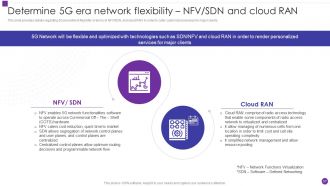
Slide 57: This slide provides details regarding 5G era network flexibility in terms of NFV/SDN and cloud RAN in order to cater customized services for major clients.
Slide 58: This slide provides details regarding various ways to optimize 5G network energy efficiency by utilizing alternate energy sources and network load optimization.
Slide 59: This slide provides details regarding network ownership approaches associated to 5G networks.
Slide 60: This slide provides details regarding 5G network equipment sourcing by operators such as open source or mobile operators and system integrators.
Slide 61: This slide presents title for additional slides.
Slide 62: This is the icons slide.
Slide 63: This slide depicts 30-60-90 days plan for projects.
Slide 64: This slide depicts Weekly timeline with task name
Slide 65: This slide showcase Roadmap for process flow.
Slide 66: This slide showcase about Our team.
Slide 67: This slide shows puzzle for displaying elements of company.
Slide 68: This slide display Venn.
Slide 69: This slide presents your company's vision, mission and goals.
Slide 70: This slide exhibit Timeline.
Slide 71: This slide depicts posts for past experiences of clients.
Slide 72: This is thank you slide & contains contact details of company like office address, phone no., etc.
Developing 5G Transformative Technology Powerpoint Presentation Slides with all 77 slides:
Use our Developing 5G Transformative Technology Powerpoint Presentation Slides to effectively help you save your valuable time. They are readymade to fit into any presentation structure.









FAQs for Developing 5G Transformative Technology
5G technology delivers significantly faster speeds, ultra-low latency, massive device connectivity, enhanced reliability, and improved energy efficiency compared to previous generations. These capabilities enable real-time applications like autonomous vehicles, remote surgery, and smart manufacturing, while supporting dense IoT deployments, ultimately delivering superior customer experiences and competitive advantages across industries.
5G technology revolutionizes IoT connectivity by delivering ultra-low latency, massive device capacity, and enhanced bandwidth, enabling real-time data processing and seamless communication between devices. Through network slicing and edge computing capabilities, smart cities, manufacturing plants, and healthcare facilities achieve faster response times, improved operational efficiency, and more reliable automated systems, ultimately transforming how interconnected devices operate at scale.
Spectrum allocation determines which radio frequencies carriers can use for 5G services, directly impacting network capacity, coverage, and performance through low-band, mid-band, and high-band assignments. Proper allocation enables telecommunications companies to deliver faster speeds, support more connected devices, and provide enhanced services across urban and rural areas, ultimately creating the foundation for widespread 5G adoption.
5G technology enhances remote healthcare by enabling real-time high-definition consultations, instant medical data transmission, and seamless integration of IoT monitoring devices. Through ultra-low latency and massive bandwidth, hospitals can deliver remote surgeries, continuous patient monitoring, and AI-powered diagnostics, ultimately reducing costs while expanding access to specialized care.
5G introduces amplified security challenges including expanded attack surfaces through massive IoT device connections, network slicing vulnerabilities, edge computing exposure points, and increased reliance on software-defined infrastructure. While these complexities present new risks, they also enable enhanced security protocols, real-time threat detection capabilities, and more granular network control, with telecommunications providers increasingly implementing zero-trust architectures and AI-driven monitoring systems.
5G will revolutionize smart city development by enabling real-time data processing, seamless IoT connectivity, autonomous vehicle coordination, and enhanced public safety systems through ultra-low latency networks. Urban planners can leverage this connectivity to optimize traffic flow, reduce energy consumption, and improve citizen services, with cities like Barcelona and Singapore already implementing 5G-powered infrastructure solutions.
5G infrastructure deployment presents both environmental challenges and opportunities, including increased energy consumption from denser network infrastructure, electronic waste from equipment upgrades, carbon emissions from manufacturing, but also enhanced operational efficiency through smart technologies. Many telecommunications companies are finding that 5G enables better resource management, reduced travel through remote capabilities, and optimized energy usage across industries, ultimately delivering sustainability benefits when strategically implemented.
5G technology enhances autonomous vehicles by delivering ultra-low latency communication, high-speed data processing, and real-time connectivity between vehicles, infrastructure, and traffic systems. Through these capabilities, autonomous fleets can make split-second decisions, coordinate seamlessly with smart traffic networks, and access cloud-based AI processing, ultimately enabling safer, more efficient transportation systems.
Widespread 5G adoption can deliver significant economic benefits through enhanced productivity, new business models, reduced operational costs, and accelerated digital transformation across industries. These improvements enable faster manufacturing processes, remote healthcare services, autonomous transportation systems, and smart city infrastructure, with many economists projecting substantial GDP growth and job creation in telecommunications, technology, and innovation sectors.
Industries can leverage 5G for enhanced operational efficiency through ultra-low latency communications, massive IoT connectivity, and real-time data processing capabilities. Manufacturing facilities utilize 5G-enabled robotics and predictive maintenance, while logistics companies streamline supply chain tracking and autonomous vehicle coordination, ultimately delivering faster response times, reduced downtime, and significantly improved productivity across operations.
Essential 5G protocols include 5G NR (New Radio), network slicing standards, Massive MIMO specifications, beamforming protocols, and edge computing frameworks. These standards work together by enabling ultra-low latency communications, supporting diverse IoT applications, and delivering enhanced mobile broadband, with telecommunications companies finding that proper implementation ultimately streamlines network operations and accelerates service deployment.
5G networks deliver ultra-low latency of 1-5 milliseconds compared to 4G's 30-50 milliseconds, enabling real-time responsiveness through advanced network slicing, edge computing, and optimized signal processing. This dramatic reduction revolutionizes applications like autonomous vehicles, remote surgery, and industrial automation, where split-second delays can impact safety and operational efficiency, ultimately delivering competitive advantages in increasingly time-sensitive business environments.
Telecommunications companies face significant infrastructure investment requirements, spectrum allocation complexities, regulatory compliance hurdles, equipment compatibility issues, and cybersecurity concerns when deploying 5G networks. These challenges present both technical and financial obstacles, with many providers finding that strategic partnerships, phased rollouts, and government collaboration help streamline implementation while ultimately delivering faster services and competitive advantage.
Edge computing and cloud services serve as foundational infrastructure for 5G ecosystems, enabling ultra-low latency processing, distributed data management, and scalable network orchestration. These technologies work together to deliver real-time applications like autonomous vehicles and smart manufacturing, while cloud services provide the backend scalability that telecommunications providers need to manage massive data volumes and deliver enhanced customer experiences across industries.
5G technology will revolutionize remote work by enabling ultra-low latency video conferencing, seamless cloud computing, and real-time collaboration through enhanced mobile connectivity and faster data speeds. Organizations across sectors like consulting, design, and financial services are finding that 5G delivers enhanced productivity, streamlined virtual meetings, and improved mobile workforce flexibility, ultimately creating competitive advantages in an increasingly distributed work environment.
-
“Ample and amazing variety of templates available, really helpful for making professional PPT for day to day workings.”
-
The designs by SlideTeam are honestly the best I have seen so far. Will be definitely coming back for more.