

Developing An Effective Gathering Customer Insights Using Various Methods Strategy SS V





Try Before you Buy Download Free Sample Product
 Impress Your
Audience
 100%
Editable
 Save Hours
of Time


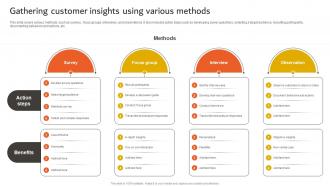
This slide covers various methods, such as surveys, focus groups, interviews, and observations. It also includes action steps such as developing survey questions, selecting a target audience, recruiting participants, documenting behaviors and actions, etc.
People who downloaded this PowerPoint presentation also viewed the following :
Developing An Effective Gathering Customer Insights Using Various Methods Strategy SS V with all 9 slides:
Use our Developing An Effective Gathering Customer Insights Using Various Methods Strategy SS V to effectively help you save your valuable time. They are readymade to fit into any presentation structure.








FAQs for Developing An Effective Gathering Customer Insights Using Various Methods
Businesses should prioritize transactional data, customer feedback surveys, social media analytics, website behavior tracking, and CRM interaction histories when developing customer insights strategies. These data sources work together by revealing purchasing patterns, sentiment trends, and engagement preferences, with retail and financial services companies finding that combining multiple sources delivers deeper personalization and significantly improved customer experiences.
Companies effectively segment their customer base through demographic analysis, behavioral tracking, purchase history evaluation, geographic location data, and psychographic profiling. These segmentation approaches enable organizations to deliver targeted marketing campaigns, personalized product recommendations, and customized service experiences, with many retailers and financial institutions finding that precise segmentation ultimately increases customer satisfaction and revenue conversion rates.
Customer feedback serves as a foundational data source for customer insights strategy, providing direct input on preferences, pain points, satisfaction levels, and behavioral drivers across touchpoints. This feedback enables organizations to validate assumptions, identify emerging trends, and refine product offerings, with many retail and financial services companies finding that systematic feedback integration ultimately delivers more targeted marketing strategies and enhanced customer experiences.
Organizations leverage social media data to enhance customer insights by monitoring sentiment analysis, tracking engagement patterns, analyzing demographic trends, identifying purchase behaviors, and mapping customer journey touchpoints. Through advanced analytics platforms, companies in retail, hospitality, and financial services can predict consumer preferences, personalize marketing campaigns, and improve product development, ultimately delivering more targeted customer experiences and competitive market positioning.
Predictive analytics enhances customer insights strategy by forecasting behavior patterns, identifying churn risks, personalizing recommendations, optimizing pricing models, and anticipating market trends. Through machine learning algorithms, organizations streamline segmentation accuracy, accelerate campaign targeting, and minimize acquisition costs, with many retail and financial services companies finding that predictive models ultimately deliver significantly improved customer lifetime value and competitive advantage.
Businesses ensure actionable customer insights by establishing clear metrics, creating cross-functional teams for implementation, and linking insights directly to specific business objectives like revenue growth or retention rates. Through systematic testing, regular measurement cycles, and strategic alignment between insights and operational capabilities, organizations across retail, financial services, and healthcare deliver measurable improvements in customer satisfaction and profitability.
Common pitfalls include collecting data without clear objectives, relying on outdated information, failing to integrate insights across departments, and neglecting to act on findings. Many organizations struggle with data silos, inconsistent measurement methods, and lack of stakeholder buy-in, ultimately missing opportunities to enhance customer experiences and gain competitive advantage in increasingly data-driven markets.
Businesses should measure customer insights success through revenue impact metrics, customer satisfaction improvements, decision-making speed, and behavioral prediction accuracy. Through advanced analytics platforms, organizations track conversion rate increases, retention improvements, and reduced time-to-market for new products, with many companies finding that comprehensive measurement frameworks ultimately deliver 15-30% better customer experiences and competitive advantage.
Customer insights tools include CRM platforms, social media analytics, survey software, web analytics, and AI-powered sentiment analysis systems. These technologies enhance customer understanding by tracking behavioral patterns, analyzing feedback across touchpoints, and identifying emerging trends, with many retail and financial services organizations finding that integrated analytics platforms deliver faster decision-making and more personalized customer experiences.
Companies foster data-driven customer insight cultures by implementing comprehensive training programs, establishing clear analytics governance frameworks, integrating customer data into regular business reviews, and creating cross-functional teams that combine marketing, sales, and analytics expertise. Through accessible dashboards and storytelling techniques, organizations like retail chains and financial services firms enhance decision-making speed, improve customer targeting accuracy, and ultimately deliver more personalized experiences while building competitive advantage.
Organizations should prioritize transparent data collection practices, explicit consent mechanisms, data minimization principles, robust security measures, and clear privacy policies when gathering customer insights. These ethical frameworks enable companies to build trust while delivering personalized experiences, with many retail and financial services firms finding that transparent practices ultimately enhance customer loyalty and competitive advantage.
Cross-departmental collaboration enhances customer insights strategies by combining diverse data perspectives, breaking down information silos, and creating comprehensive customer profiles that single departments cannot achieve alone. When marketing, sales, customer service, and product teams share insights, organizations develop more accurate customer understanding, enabling targeted campaigns, improved product development, and enhanced customer experiences that drive competitive advantage.
Customer personas significantly impact customer insights strategy development by providing focused segmentation frameworks, targeted data collection priorities, and clearer behavioral pattern identification. These detailed customer profiles enable organizations to streamline their research efforts, enhance survey design accuracy, and deliver more personalized experiences across touchpoints, with many companies finding that persona-driven insights strategies ultimately reduce acquisition costs while improving customer retention and satisfaction rates.
Businesses should revisit their customer insights strategy quarterly for tactical adjustments and conduct comprehensive annual revisions to align with market evolution and strategic goals. This balanced approach enables organizations to respond to shifting consumer behaviors, seasonal trends, and competitive dynamics while maintaining strategic coherence, with many companies finding that regular reviews enhance customer engagement and drive sustainable growth.
Storytelling communicates customer insights through narrative frameworks, data visualization, persona development, journey mapping, and case study presentations that transform raw data into compelling business narratives. These approaches enable stakeholders to emotionally connect with customer experiences, making complex behavioral patterns more memorable and actionable, ultimately driving strategic decisions and fostering organizational alignment around customer-centric initiatives.
-
Happy to incorporate such stunning templates in my presentation. Made my presentation look professional and engaging.
-
Slideteam offers pocket-friendly products. As a college student this is a really necessary thing to look at while paying for something.