


Developing Kaizen Mindset Training Ppt




Try Before you Buy Download Free Sample Product
 Impress Your
 Audience
 100%
100% Editable
 Save Hours
 of Time


The PPT Training Deck on Developing Kaizen Mindset presents a comprehensive guide on embracing and implementing the Kaizen philosophy in both professional spheres. It begins with an introduction to Kaizen, explaining its core concept and significance. Then, it details the numerous benefits of Kaizen for businesses and employees. It delves into the fundamental principles of Kaizen, such as viewing waste as an opportunity, recognizing the limitless potential for improvement, empowering people, and remaining open to change. The PowerPoint Module also provides a comparative analysis of Kaizen with other methodologies like Six Sigma and Lean. It also demystifies common myths about Kaizen, such as its focus solely on small improvements, being just a tool or a suggestion scheme, and the misconception that standard work stifles creativity. It concludes with an exploration of Kaizens dual nature. The Presentation also has Key Takeaways and Discussion Questions related to the topic to make the training session more interactive. The deck contains PPT slides on About Us, Vision, Mission, Goal, 30 60 90 Days Plan, Timeline, Roadmap, Training Completion Certificate, Energizer Activities, Client Proposal, and Assessment Form.
People who downloaded this PowerPoint presentation also viewed the following :
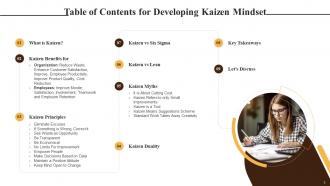
Content of this Powerpoint Presentation
Slide 3
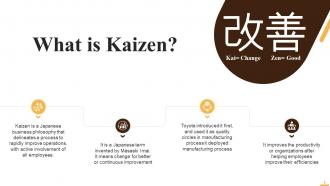
This slide provides an overview of Kaizen. It also explains that Kaizen is a business philosophy of Japan that consists of improvement and development of operations and employees working in the company.
Slide 4
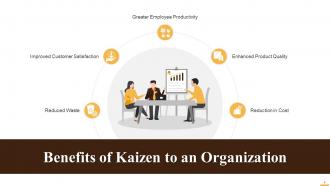
This slide showcases benefits of Kaizen such as reduced waste, improved customer satisfaction, improved employee productivity, improved product quality, and cost reduction.
Instructor’s Notes:
Benefits of Kaizen for continuous improvement are:
Reduce Waste:
- Implementation of Kaizen helps in the reduction of material waste and better utilization of resources that leads to better productivity of employees and the company
Improve Customer Satisfaction:
- If a customer requires specific technology to solve its problems, the company concerned can work with its customers in developing it
- This results in shared patents between the company and its customers
Improve Employee Productivity:
- When employees are involved in major decisions the company takes, it helps them gain confidence; with the enhanced motivation, productivity goes up
Improve Product Quality:
- Product quality can be improved with Kaizen, as it uses existing resources to get on the path of continuous improvement
Cost Reduction:
- Implementing low-quality re-design of the product or reducing waste costs is a feature of this philosophy that works wonders
Slide 5
This slide showcases benefits of Kaizen for employees working in an organization such as employee morale, employee satisfaction, employee involvement, and employee retention
Instructor’s Notes:
Kaizen benefits for employees are:
High Morale:
- Kaizen helps employees participate in decision-making, which makes employees feel more invested in the company's success
- Employees see their ideas and suggestion taken seriously taking their morale to higher levels, which is a definite aid to productivity
- Employees with high morale become more productive and stay with the company for a longer time
Enhanced Satisfaction:
- Kaizen helps employees to work in an open environment where employers are proactive in addressing employee concerns and problems
Greater Employee Involvement:
- Kaizen helps employees participate in brainstorming sessions to present their ideas as solutions to problems within the company
Improved Teamwork:
- It helps employees work together and come up with ways to improve quality and productivity
- It also improves employee communication and collaboration
Better Retention:
- Kaizen helps in retaining employees based on their productivity and satisfaction employees draw from being invited to contribute to decision-making
Slide 6
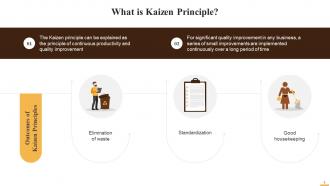
This slide showcases the introduction and outcomes of Kaizen principle. It also explains that for significant quality improvement in any business, a series of small improvements are implemented continuously over a long period of time.
Slide 7
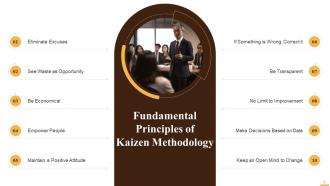
This slide showcases the fundamental principles of Kaizen. These are eliminate excuses; if something is wrong, correct it; see waste as opportunity; be transparent; be economical; set no limits for improvement; empower people; make decisions based on data; maintain a positive attitude, and keep mind open to change.
Instructor’s Notes:
Fundamental principles of Kaizen methodology are:
Eliminate Excuses:
- It is important to eliminate excuses that stop employees and the organization from improving
- Kaizen demands the shifting of energy from running away from the problem to looking into the issues and resolving these, no matter how trivial or significant they are
If Something is Wrong, Correct it:
- To succeed, it is important to correct all that is wrong
- In their attempts at innovation and improvement, employees make mistakes, but it is their duty to correct each one of these
See Waste as Opportunity:
- Each wastage is an opportunity for making improvement
- Every problem in an organization is an opportunity for employees to resolve it with elimination of waste
Be Transparent:
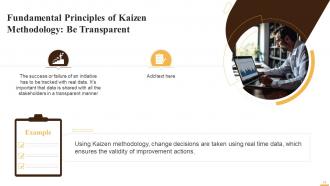
- Success or failure of an initiative has to be tracked with real data. It is important that data is shared with all the stakeholders in a transparent manner
Be Economical:
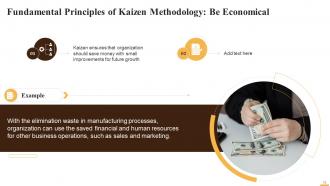
- It is important to save money with small improvements for future goals and progress
No Limit to Improvement:
- Improvement is a never-ending process, and there is always room for improvement in everything
- Both employees and organizations should strive for nothing but constant improvement till the end
Empower People:
- Kaizen helps organizations empower their employees by organizing them and setting goals for their team members, and providing them with systems and tools that help in achievement of goals
- Each individual should be responsible for bringing change in the organization and work to solve problems that hinder the growth of the company
Make Decisions Based on Data:
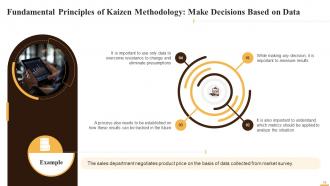
- While making any decision, it is important to track and measure results
- Understand which metrics should be applied to analyze the situation
- Working on how these results be tracked is also super-important
- It is important to use only data to overcome resistance to change and eliminate presumptions
Maintain a Positive Attitude:
- A positive mindset can help employee welcome new opportunities for improvement
- It helps to identify the opportunities that could help both the employees and the organization grow
Keep an Open Mind to Change:
- It is important to ask questions to experience constant improvement
- Always be open to change and discard fixed ideas
Slide 8
This slide showcases the Kaizen principle of eliminating excuse. It also explains that it is important to eliminate excuses that stop employees and the organization from getting on the road to improvement.
Slide 9
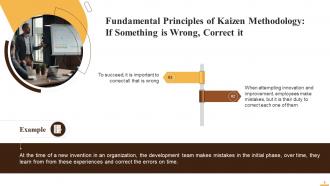
This slide showcases the Kaizen methodology that If something is wrong, correct it. It also explains that when attempting innovation and improvement, employees make mistakes, but it is their duty to correct each one of these.
Slide 10
This slide showcases the Kaizen methodology of seeing waste as an opportunity. It also explains that every problem in an organization is an opportunity for the employees to resolve with the elimination of waste.
Slide 11
This slide showcases the Kaizen methodology of ensuring transparency. It also explains that the success or failure of an initiative has to be tracked with real data.
Slide 12
This slide showcases the Kaizen methodology of be economical. It also explains that saving money with small improvements helps organizations achieve their future goals and progress faster.
Slide 13
This slide showcases the Kaizen methodology of no limits for improvement. It also explains that improvement is a never-ending process and both employees and organization should strive for nothing, but constant improvement.
Slide 14
This slide showcases the Kaizen methodology of empower people. It also explains that Kaizen helps organization empower their employees by organizing them and setting goals for their team members, and provide them with systems and tools that could help them in achieving their goals.
Slide 15
This slide showcases the Kaizen methodology of making decisions based on data. It also explains that it is important to use only data to overcome resistance to change and eliminate presumptions.
Slide 16
This slide showcases the Kaizen methodology of maintain a positive attitude. It also explains that a positive mindset can help employee welcome new opportunities and could help the organization grow.
Slide 17
This slide showcases the Kaizen methodology of having an open mind to change. It also explains that it is important to ask questions to experience continuous improvement.
Slide 18
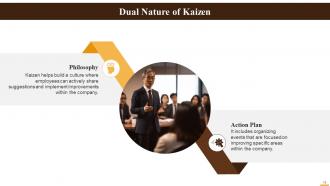
This slide illustrates the dual nature of Kaizen, i.e., a philosophy and action plan. It also explains that philosophically, Kaizen helps build a culture where employees can actively share suggestions and implement improvements within the company. It also explains that an action plan includes organizing events that are focused on improving specific area within the company.
Slide 19
This slide illustrates misconception about Kaizen such as it being only about cutting cost, it referring to only small improvements. Kaizen is a tool; it means a mere suggestions scheme, and that standard work takes away creativity.
Instructor’s Notes:
Misconceptions about Kaizen are:
Kaizen is About Cutting Cost:
- Kaizen focuses on cutting waste, which leads to cost reduction. It makes efforts to make on making work easier and less frustrating
- Kaizen helps to spend time on things that matter
Kaizen Refers to only Small Improvements:
- Japanese use Kaizen for any kind of improvement, either it is small, large, one-time, or continuous
Kaizen is a Tool:
- It is not a tool that anyone can use for their personal or professional use. Instead, it's a culture for continuous improvement
Kaizen Means Suggestions Scheme:
- Kaizen is not a suggestion scheme, but a vast umbrella that shelters all continuous improvement initiatives
Standard Work Takes Away Creativity:
- In an organization, fixed standards can make employees feel bored in their jobs and there is no room left for creativity
- The increasing complexity in a work environment can be improved by making organization standards more flexible. It helps the employees feel creative and important
Slide 20
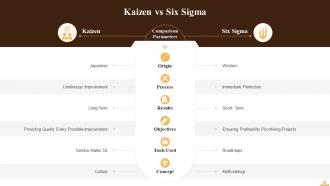
This slide compares Kaizen and six sigma based on different parameters such as origin, process, results, objectives, tools used, and concept.
Slide 21
This slide compares Kaizen and Lean. It also explains that Kaizen is used for continuous improvement, whereas lean is a set of management practices that improve speed and increase productivity by eliminating waste.
Slide 37 to 52
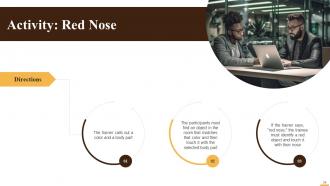
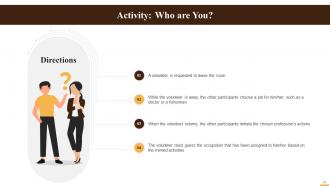
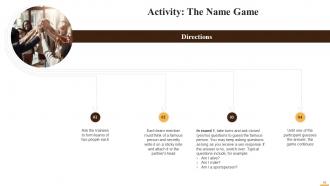
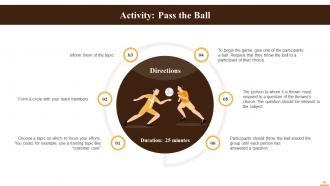
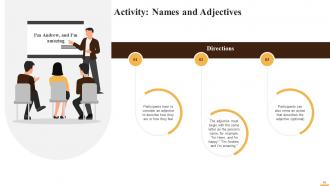
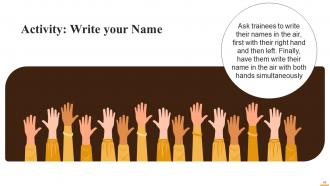
These slides contain energizer activities that a trainer can employ to make the training session interactive and engage the audience.
Slide 53 to 80
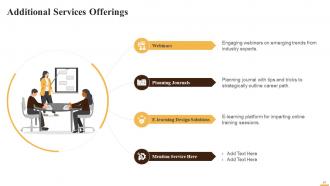
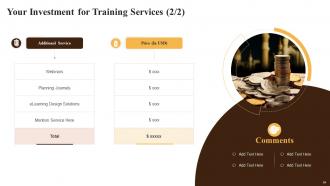
These slides contain a training proposal covering what the company providing corporate training can accomplish for prospective clients.
Slide 81 to 83
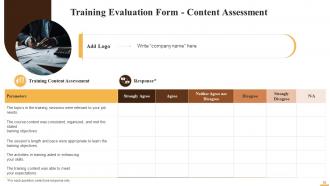
These slides include a training evaluation form for the instructor, content, and course assessment to assess the effectiveness of the coaching program.
Developing Kaizen Mindset Training Ppt with all 91 slides:
Use our Developing Kaizen Mindset Training Ppt to effectively help you save your valuable time. They are readymade to fit into any presentation structure.














































FAQs for Developing Kaizen
The Kaizen mindset originated in post-World War II Japan, combining continuous improvement philosophies with practical manufacturing applications, initially popularized by Toyota's production systems and quality management approaches. This methodology has evolved significantly in modern business practices, with organizations across healthcare, technology, and financial services adopting Kaizen principles to streamline operations, enhance employee engagement, and deliver sustained competitive advantage through incremental innovations.
A Kaizen mindset improves team collaboration by encouraging continuous feedback, shared problem-solving, and incremental process improvements that break down silos between departments. This approach fosters open communication through regular team reviews, standardized improvement practices, and collective ownership of outcomes, with many organizations finding that small, consistent changes ultimately deliver stronger cross-functional relationships and enhanced operational efficiency.
Kaizen initiatives include Toyota's continuous production line improvements, hospitals reducing patient wait times through workflow optimization, banks streamlining loan approval processes, and retailers enhancing inventory management systems. These approaches deliver measurable results by eliminating waste, reducing costs, and improving customer experiences, with many organizations finding that small, consistent improvements ultimately create significant competitive advantages across operations.
Leaders foster continuous improvement cultures by encouraging employee suggestions, implementing regular feedback loops, celebrating small wins, providing improvement training, and modeling open-mindedness to change themselves. Through structured approaches like suggestion systems and cross-functional teams, organizations streamline operations, enhance quality, and boost employee engagement, with many companies finding that empowered teams ultimately deliver faster innovation and stronger competitive advantage.
The primary principles of the Kaizen mindset include continuous improvement, employee empowerment, waste elimination, standardization, and incremental progress over dramatic overhauls. These principles drive effective change by fostering collaboration, reducing operational costs, and enhancing quality control, with many organizations finding that consistent small improvements ultimately deliver sustained competitive advantage and measurable efficiency gains.
The Kaizen mindset enhances employee empowerment by encouraging continuous improvement suggestions, giving workers ownership of process optimization, and fostering collaborative problem-solving across all organizational levels. This approach significantly boosts engagement through meaningful participation in operational decisions, with many manufacturing and service companies finding that empowered employees deliver innovative solutions, reduced waste, and ultimately stronger competitive advantage.
Kaizen implementation tools include visual management boards, standardized work procedures, root cause analysis techniques, employee suggestion systems, and continuous improvement workshops. These methodologies streamline operational efficiency by identifying waste, engaging frontline workers in problem-solving, and creating systematic feedback loops, with many manufacturing and service organizations finding that regular gemba walks and PDCA cycles ultimately deliver sustained productivity gains and enhanced quality outcomes.
Organizations measure Kaizen effectiveness through key performance indicators like cycle time reduction, defect rates, employee suggestion implementation, and cost savings per improvement project. These metrics, combined with employee engagement surveys and customer satisfaction scores, enable companies across manufacturing, healthcare, and service sectors to track operational efficiency gains, ultimately delivering measurable ROI and sustained competitive advantage.
Feedback serves as the foundation for sustaining Kaizen by enabling continuous learning, identifying improvement opportunities, and reinforcing positive behavioral changes. Through regular performance reviews, peer evaluations, and customer insights, organizations cultivate an environment where employees actively seek input, adapt processes, and drive incremental innovations, ultimately delivering enhanced operational efficiency and stronger competitive advantage.
Small incremental changes accumulate through compound effects, continuous employee engagement, and systematic process refinement, creating exponential improvement momentum over time. Manufacturing companies implementing daily 1% efficiency gains, retail organizations making minor customer service adjustments, and financial institutions streamlining small operational steps often discover these modifications ultimately deliver substantial cost reductions, enhanced productivity, and competitive advantages.
Kaizen mindset intersects with agile methodologies through shared principles of continuous improvement, iterative development cycles, team collaboration, and adaptive planning based on regular feedback. Both approaches emphasize incremental progress, cross-functional teamwork, and responsive adjustment to changing requirements, with many project teams finding that this strategic combination enhances delivery speed, reduces waste, and ultimately delivers superior outcomes while maintaining flexibility in increasingly dynamic business environments.
Organizations face challenges including employee resistance to change, lack of management commitment, insufficient training resources, and difficulty sustaining momentum beyond initial improvements. These obstacles can be overcome by starting with small pilot programs, providing comprehensive training across all levels, establishing clear communication channels, and creating recognition systems that celebrate incremental progress, with many companies finding that consistent leadership support and employee empowerment ultimately deliver lasting cultural transformation.
The Kaizen mindset integrates into remote and hybrid environments through regular virtual improvement sessions, collaborative digital feedback tools, and structured check-ins that encourage continuous enhancement of workflows and processes. Remote teams increasingly find that daily stand-ups, shared improvement dashboards, and cross-functional virtual workshops enable systematic optimization of communication, productivity, and team collaboration, ultimately delivering stronger performance outcomes.
The Kaizen mindset significantly enhances customer satisfaction and product quality through continuous improvement, rapid problem resolution, employee empowerment, and systematic feedback integration. Organizations implementing Kaizen principles consistently deliver superior products and services by identifying defects early, streamlining processes, and adapting quickly to customer needs, with many companies finding that this iterative approach ultimately creates sustainable competitive advantage and stronger customer loyalty.
Educational institutions can apply the Kaizen mindset by implementing continuous feedback loops, encouraging incremental teaching methodology improvements, fostering collaborative problem-solving among faculty, and regularly evaluating curriculum effectiveness through student outcomes data. Through systematic small changes, schools and universities streamline administrative processes, enhance student engagement, and adapt learning materials based on real-time feedback, ultimately delivering improved educational experiences and better preparing students for competitive job markets.
-
Very well designed and informative templates.
-
Exclusive and extensive collection of templates. Really helped me create a professional presentation in just no time.