

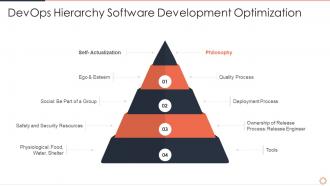
Devops engineer skills devops hierarchy software development optimization





Try Before you Buy Download Free Sample Product
 Impress Your
Audience
 100%
Editable
 Save Hours
of Time


Devops engineers are a specialized type of software engineer who work with the operations team to streamline software development and deployment. They often have a hierarchy of skills that allow them to optimize the entire software development process. This can include automating common tasks, improving communication between developers and operations staff, and making sure the final product meets the expectations of both groups. While not all devops engineers possess all these skills, they usually have several that make them indispensable members of a DevOps team. We hope you’ve found our devops engineer skills and hierarchy diagram helpful in understanding the different roles involved in optimizing software development. The slide team has years of experience helping organizations understand and implement DevOps, so be sure to download our devops powerpoint presentations for more information on this growing field.
People who downloaded this PowerPoint presentation also viewed the following :
Devops engineer skills devops hierarchy software development optimization with all 6 slides:
Use our Devops Engineer Skills Devops Hierarchy Software Development Optimization to effectively help you save your valuable time. They are readymade to fit into any presentation structure.





FAQs for Devops engineer skills devops hierarchy
Essential DevOps technical skills include cloud platforms (AWS, Azure), containerization technologies (Docker, Kubernetes), infrastructure automation (Terraform, Ansible), CI/CD pipeline tools, and scripting languages like Python or Bash. These skills enable engineers to streamline deployment processes, automate infrastructure management, and enhance collaboration between development and operations teams, ultimately delivering faster software releases and improved system reliability.
Collaboration and communication skills directly impact DevOps effectiveness by breaking down silos between development and operations teams, enabling faster problem resolution, and ensuring seamless integration processes. Strong interpersonal skills facilitate cross-functional alignment, reduce deployment errors through clearer handoffs, and accelerate incident response times, ultimately delivering improved software quality and operational efficiency.
Automation enhances DevOps processes by streamlining code deployment, enabling continuous integration and delivery, and minimizing manual errors across development pipelines. Through automated testing, infrastructure provisioning, and monitoring systems, organizations accelerate release cycles, improve software quality, and reduce operational overhead, ultimately delivering faster time-to-market and enhanced competitive advantage.
Cloud platform proficiency significantly enhances DevOps careers by enabling scalable infrastructure management, automated deployment pipelines, and cost-effective resource allocation across distributed systems. These skills allow DevOps professionals to streamline operations in financial services, healthcare, and retail environments, while delivering faster application releases, improved system reliability, and strategic competitive advantage in increasingly cloud-first business landscapes.
Version control best practices in DevOps include implementing branching strategies like GitFlow, maintaining atomic commits with clear messages, conducting thorough code reviews, and automating CI/CD integration. These practices streamline development workflows by reducing merge conflicts, enhancing collaboration transparency, and accelerating deployment cycles, with many organizations finding that structured version control ultimately delivers faster release frequencies and improved code quality across development teams.
Coding skills are highly valuable for DevOps careers, enabling automation script development, infrastructure as code implementation, and effective collaboration with development teams. While not always mandatory for entry-level positions, programming knowledge in Python, Bash, or PowerShell significantly enhances career prospects, with many organizations finding that DevOps professionals with coding abilities deliver faster deployments and streamlined operations.
Traditional IT operations involve siloed teams, manual processes, lengthy deployment cycles, and reactive problem-solving approaches. DevOps practices integrate development and operations teams, automate workflows, enable continuous deployment, and emphasize proactive monitoring, with many organizations finding that this strategic combination delivers faster time-to-market, reduced operational costs, and enhanced system reliability.
Understanding containerization tools like Docker enables DevOps professionals to streamline application deployment, enhance environment consistency, and accelerate development cycles across diverse infrastructure platforms. Through containerization, teams achieve faster deployment times, reduced configuration conflicts, and improved scalability, with many organizations finding that Docker expertise significantly enhances operational efficiency and competitive advantage.
Key DevOps performance metrics include deployment frequency, lead time for changes, mean time to recovery, change failure rate, and system availability uptime. These measurements enable organizations to assess delivery speed, quality consistency, and operational resilience across development cycles, with many enterprises finding that tracking these metrics simultaneously drives faster releases, reduced downtime, and ultimately enhanced competitive advantage.
CI/CD pipeline knowledge enhances DevOps practitioners by enabling automated testing, seamless deployment workflows, and rapid feedback loops that minimize manual errors and accelerate release cycles. This expertise allows professionals to streamline development processes, reduce deployment risks, and deliver faster time-to-market, with many organizations finding that skilled CI/CD practitioners significantly improve operational efficiency and competitive advantage.
DevOps engineers must consider secure coding practices, infrastructure security, automated vulnerability scanning, access controls, and compliance requirements throughout development pipelines. These security measures help organizations minimize risks by implementing continuous monitoring, encryption protocols, and threat detection systems, with many financial services and healthcare institutions finding that proactive security integration ultimately delivers faster, more reliable deployments.
Cultural awareness and adaptability improve DevOps outcomes by fostering cross-functional collaboration, reducing communication barriers, and enabling diverse teams to integrate seamlessly across development and operations workflows. Organizations with culturally adaptive DevOps practices experience faster deployment cycles, enhanced problem-solving capabilities, and stronger team cohesion, ultimately delivering more reliable software releases and improved operational efficiency.
Monitoring and logging enable DevOps professionals to maintain system reliability, detect issues proactively, and optimize performance through real-time visibility into applications and infrastructure. These practices streamline incident response, enhance troubleshooting capabilities, and support data-driven decisions, with many organizations finding that comprehensive monitoring ultimately delivers improved uptime, faster resolution times, and better user experiences.
Effective DevOps collaboration tools include Slack for communication, Jira for project management, Confluence for documentation, GitHub for version control, and Jenkins for CI/CD automation. These platforms streamline workflows by centralizing team coordination, automating deployment processes, and enhancing transparency across development cycles, with many organizations finding that integrated toolchains ultimately deliver faster releases and improved operational efficiency.
Continuous learning and certification demonstrate expertise in evolving DevOps tools, cloud platforms, automation frameworks, and security practices, making professionals more valuable to employers. These credentials enhance career prospects by validating skills in containerization, infrastructure as code, and CI/CD pipelines, with many organizations prioritizing certified professionals for senior roles, ultimately delivering faster promotions and higher compensation.
-
Informative design.