


Devops overview benefits culture performance metrics and implementation roadmap complete deck





Try Before you Buy Download Free Sample Product
 Impress Your
 Audience
 100%
100% Editable
 Save Hours
 of Time


This PowerPoint presentation covers details on DevOps. This PPT is the collection of templates including DevOps Overview, DevOps Benefits, DevOps Culture, DevOps Performance Metrics, DevOps Implementation Roadmap, etc. This PPT includes details on DevOps adoption, when to use and when not to go for DevOps, DevOps lifecycle, DevOps workflow, etc. These templates depict that DevOps is a set of practices, tools, and a cultural philosophy that automates and integrates software development and IT teams. This PPT also emphasizes team empowerment, cross-team communication and collaboration, and technology automation. This presentation also includes DevOps metrics that directly explain the performance of the DevOps software development pipeline and help identify and eliminate any bottlenecks in the process. You can use these metrics to track both technical capabilities and team processes. Download our 100 percent editable and customizable template, which is also compatible with Google Slides.
People who downloaded this PowerPoint presentation also viewed the following :
Content of this Powerpoint Presentation
Slide 1: This slide introduces DevOps Overview, Benefits, Culture Performance Metrics and Implementation Roadmap. State Your Company Name and begin.
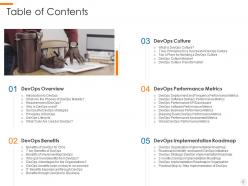
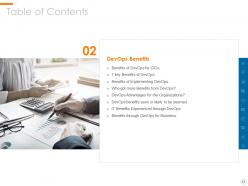
Slide 2: This slide shows Table of Content for the presentation.
Slide 3: This slide presents Table of Content highlighting Introduction to DevOps.
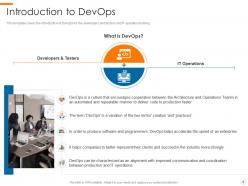
Slide 4: This slide displays introduction of DevOps for the developers, testers and IT operation training.
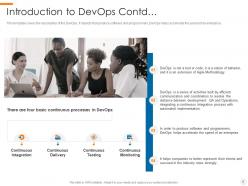
Slide 5: This template covers the description of the DevOps.
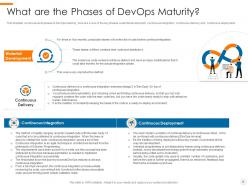
Slide 6: This slide shows several phases to DevOps maturity.
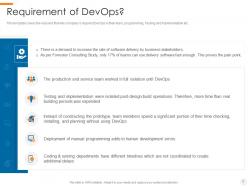
Slide 7: This slide presents reasons why company’s require DevOps in their team, programming, Testing, implementation, etc.
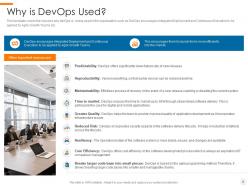
Slide 8: This template displays the reasons why devOps is being used in the organization.
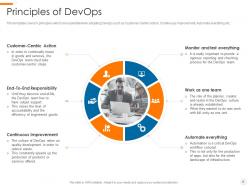
Slide 9: This template represents 6 principles which are essential when adopting DevOps.
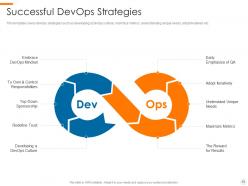
Slide 10: This template covers devOps strategies such as developing a DevOps culture, maximize metrics, understanding unique needs, adopt iteratively etc.
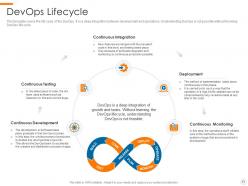
Slide 11: This template presents the life cycle of the DevOps.
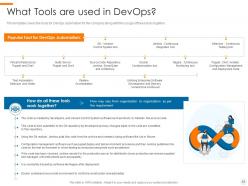
Slide 12: This slide displays the tools for DevOps automation for the company along with the usage of these tools together.
Slide 13: This slide shows Table of Content highlighting Benefits of DevOps for CIOs.
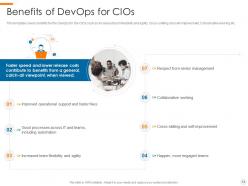
Slide 14: This slide represents benefits for the DevOps for the CIOs such as Increased team flexibility and agility, Cross-skilling and self-improvement, Collaborative working etc.
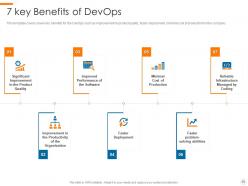
Slide 15: This template presents seven key benefits for the DevOps such as improvement in product quality, faster deployment, minimal cost of production for the company
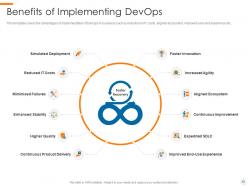
Slide 16: This slide displays the advantages of implementation of DevOps in business such as reduction in IT costs, aligned ecosystem, improved user end experience etc.
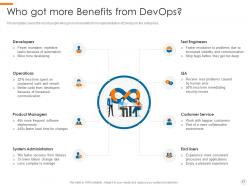
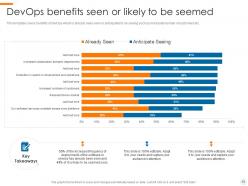
Slide 17: This slide represents the list of people who got more benefits from implementation of DevOps in the enterprise.
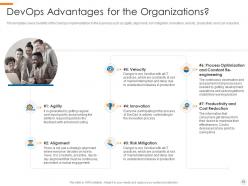
Slide 18: This slide shows benefits of the DevOps implementation in the business such as agility, alignment, risk mitigation, innovation, etc.
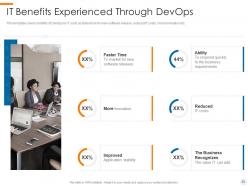
Slide 20: This slide presents benefits of DevOps in IT such as faster time for new software release, reduced IT costs, more innovation etc.
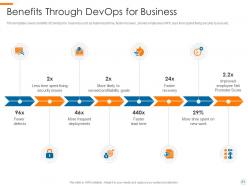
Slide 21: This slide displays benefits of DevOps for business such as faster lead time, faster recovery, proved employees NPS, less time spend fixing security issues etc.
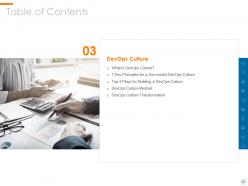
Slide 22: This slide represents Table of Content highlighting What is DevOps Culture?
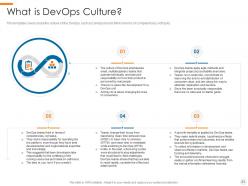
Slide 23: This template covers about the culture of the DevOps such as DevOps teams think in terms of competencies, not tasks.
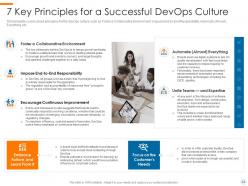
Slide 24: This slide shows 7 Key Principles for a Successful DevOps Culture.
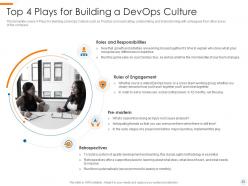
Slide 25: This template presents 4 Plays for Building a DevOps Culture such as Practice communicating, collaborating, and brainstorming with colleagues from other areas of the company.
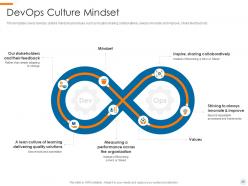
Slide 26: This template displays devOps culture mindset and values such as inspire sharing collaboratively, always innovate and improve, share feedback etc.
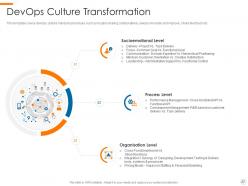
Slide 27: This slide shows devOps culture mindset and values.
Slide 28: This slide represents Table of Content highlighting DevOps Deployment and Frequency Performance Metrics.
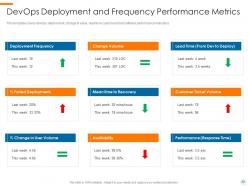
Slide 29: This slide shows DevOps Deployment and Frequency Performance Metrics.
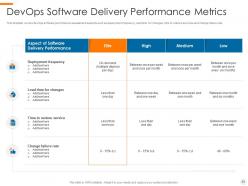
Slide 30: This slide presents devOps software performance assessment aspects such as deployment frequency, lead time for changes, etc.
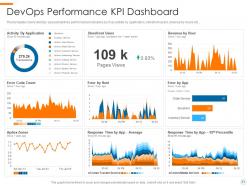
Slide 31: This slide displays devOps assessment key performance indicators such as activity by application, storefront users, revenue by hours etc.
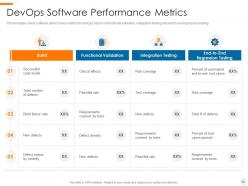
Slide 32: This slide shows software performance metrics for devOps based on functional validation, integration testing and end to end regression testing.
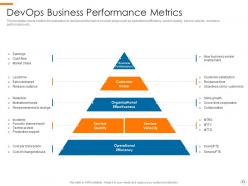
Slide 33: This slide represents metrics for evaluation of devOps performance on each stage such as operational efficiency, service quality, service velocity, business performance etc.
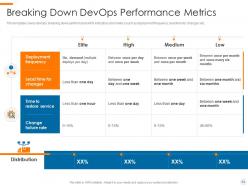
Slide 34: This slide shows devOps breaking down performance KPIs indicators and metrics such as deployment frequency, lead time for changes etc.
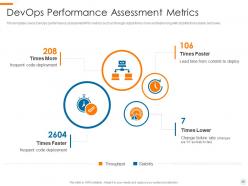
Slide 35: This slide presents DevOps performance assessment KPIs metrics such as through output times more and faster long with stability times faster and lower.
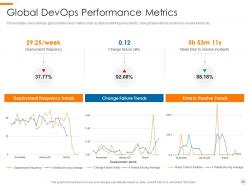
Slide 36: This slide displays devOps global performance metrics such as deployment frequency trends, change failure trends and time to resolve trends etc.
Slide 37: This slide represents Table of Content highlighting DevOps Organization Implementation Roadmap.
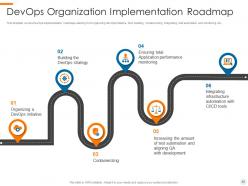
Slide 38: This slide shows DevOps implementation roadmaps from organizing devOps initiative.
Slide 39: This slide represents DevOps implementation roadmaps starting from organizing devOps initiative, then building, containerizing, integrating, test automation and monitoring etc.
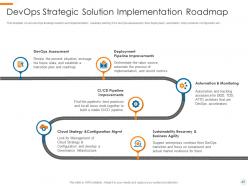
Slide 40: This slide presents DevOps Strategic Solution Implementation Roadmap.
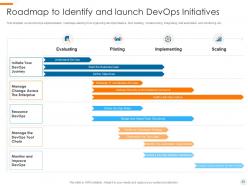
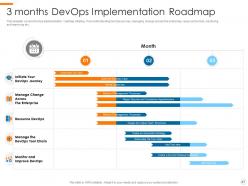
Slide 41: This slide displays DevOps implementation roadmap initiating from understanding DevOps journey, managing change across the enterprise, resource DevOps, etc.
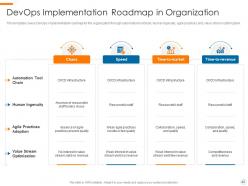
Slide 42: This template covers DevOps implementation roadmap for the organization through automation toolchain, human ingenuity, agile practices, etc.
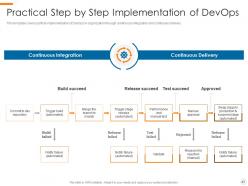
Slide 43: This slide shows Practical Step by Step Implementation of DevOps.
Slide 44: This slide presents Icons for DevOps Overview, Benefits, Culture Performance Metrics and Implementation Roadmap.
Slide 45: This slide is titled as Additional Slides for moving forward.
Slide 46: This is About Us slide to show company specifications etc.
Slide 47: This is Our Mission slide with related imagery and text.
Slide 48: This slide shows Post It Notes. Post your important notes here.
Slide 49: This is Our Team slide with names and designation.
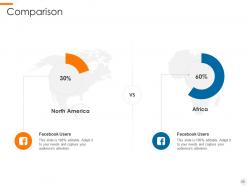
Slide 50: This is a Comparison slide to state comparison between commodities, entities etc.
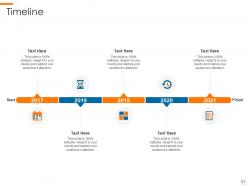
Slide 51: This is a Timeline slide. Show data related to time intervals here.
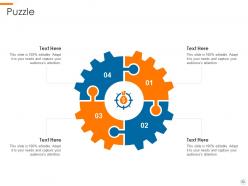
Slide 52: This slide shows Puzzle with related icons and text.
Slide 53: This is a Thank You slide with address, contact numbers and email address.
Devops overview benefits culture performance metrics and implementation roadmap complete deck with all 53 slides:
Use our Devops Overview Benefits Culture Performance Metrics And Implementation Roadmap Complete Deck to effectively help you save your valuable time. They are readymade to fit into any presentation structure.






FAQs for Devops overview benefits culture performance metrics and implementation
Oh dude, DevOps is basically getting your dev and ops people to actually work together instead of that whole "here's my code, good luck" thing. Automation is huge - set up CI/CD pipelines and monitor everything you can. Honestly, the biggest game-changer is making everyone own the whole process, not just their little piece. Keep iterating based on what customers actually want. Measure stuff so you catch problems before they blow up. My advice? Pick one project to test it out first, then spread it around once you've got it down.
So DevOps basically gets your dev and ops people actually talking to each other instead of working in separate bubbles. You'll automate the boring stuff - testing, deployments, monitoring - which honestly saves everyone's sanity. No more massive code dumps that break everything at once. Instead you're pushing small changes that are way easier to fix when something goes wrong. The whole continuous integration thing means fewer of those late-night "everything's on fire" calls. I'd start with whatever manual process annoys your team most and automate that first.
Dude, automation is literally what makes DevOps work. Without it you're stuck doing the same boring stuff over and over - deployments, testing, setting up servers. It's such a waste of time and you'll mess things up way more often than a script will. I learned this the hard way at my last job lol. Start with whatever manual task pisses you off the most and automate that first. Then keep going - CI/CD, monitoring, infrastructure stuff. The whole point is freeing up your brain for actual problem-solving instead of clicking buttons all day. Your future self will thank you.
Look, there are four metrics that actually tell you if your DevOps is working: how often you deploy, how long it takes to get code into production, recovery time from incidents, and what percentage of deployments break things. They're called DORA metrics or whatever, but honestly they just make sense. Don't try to tackle all four at once though - that's a recipe for burnout. Pick one, figure out where you're at now, then slowly work on improving it. I'd probably start with deployment frequency since it's pretty straightforward to measure.
Honestly? Cultural pushback is your biggest enemy here. Devs hate taking on deployment stuff and monitoring responsibilities. Operations teams don't want to give up their infrastructure control either - can't really blame them though. Tool selection will drive you crazy too since there's literally hundreds of options to pick from and somehow make work together. Oh, and legacy systems? Total pain to modernize. My advice: pick one small project first. Prove it actually works before trying to convert everyone. Way better than endless meetings about why DevOps is theoretically amazing.
Basically DevOps just gets your dev and ops people actually talking to each other instead of working in separate bubbles. Teams share tools, everyone owns deployments together, and you stop having that whole "not my problem" thing when stuff breaks. Honestly the finger-pointing was getting old anyway. Both sides end up caring about features AND keeping things running smoothly. Try having them join each other's standups first - seriously, you'll realize how much everyone's been working blind. The shared responsibility thing takes some getting used to but it's way better than the old throw-it-over-the-wall approach.
Git is your starting point - GitHub or GitLab, doesn't really matter which. Then grab a CI/CD tool like Jenkins or GitHub Actions for automated builds. Docker's pretty much essential these days, and Kubernetes if you need orchestration (though honestly K8s is way overkill for most small projects). Infrastructure as code is huge - Terraform or Ansible will save you tons of headaches later. Oh, and you'll definitely want monitoring like Prometheus or DataDog. My advice? Start with just Git plus basic CI/CD, then add stuff as you actually need it. Don't go overboard right away.
Honestly, CI/CD is what makes DevOps actually work instead of just being buzzword soup. When someone pushes code, automated pipelines handle all the building, testing, and deployment stuff. No more debugging why something works fine locally but explodes in production - been there, done that! Tests run automatically so you catch bugs way earlier. Your code stays deployment-ready all the time. The whole thing forces dev and ops people to stop working in separate bubbles since everyone uses the same automated flow. Just start with one app though. Don't try to automate everything at once or you'll lose your mind.
Dude, IaC is like your get-out-of-jail-free card for infrastructure headaches. Instead of clicking around AWS console at 2am (been there), you write code that defines everything. Version control your servers the same way you do your app code. No more "snowflake" boxes that everyone's scared to restart. Configuration drift becomes ancient history, and scaling actually makes sense. Your ops people won't hate you anymore because they can rebuild anything from scratch. Honestly, the peace of mind alone is worth it. Just start with one service - try Terraform or CloudFormation and see how it feels.
Honestly, DevOps is a game-changer for incident response. When dev and ops teams actually talk to each other instead of pointing fingers, everything gets faster. Your monitoring catches problems way earlier, and automated rollbacks can sometimes fix stuff before users even know something broke. Developers start caring about production because - shocker - they're responsible for it too. Cross-train everyone so devs understand ops and vice versa. Oh, and those post-mortems? They become "how do we not do this again" sessions instead of witch hunts. Set up some automated workflows and you'll cut your response times in half, I swear.
Okay so there's four metrics you actually want to watch. Deployment frequency is huge - basically how often you're shipping code. Lead time matters too (commit to deploy time), plus mean time to recovery when stuff breaks. Oh and change failure rate. Lines of code and that other fluff? Total waste of time honestly. DORA's research proves these four are what actually matter. Set your baselines first, then check progress every quarter or so. If you're deploying more often with faster lead times and quicker fixes, you're crushing it. Way better than tracking random vanity stats that don't tell you anything useful.
So basically, DevSecOps just means you're running security checks throughout your whole dev process instead of waiting until the end. You set up automated scans and vulnerability testing right in your CI/CD pipeline - catches problems way earlier when they're actually fixable. It's like... okay this analogy is kinda dumb but it's having speed bumps throughout the neighborhood instead of just a stop sign at the exit. Start small though. Just add some basic security scans to whatever pipeline you've got running now, then build on that. Way less painful than trying to bolt everything on at once.
Forget the theory stuff and just get your teams breaking things right away. Pair up your DevOps people with developers so they learn while doing actual work. PowerPoint training is basically useless – I've sat through way too many of those. Pick one tiny pipeline to automate first, then build from there. Oh and use your company's actual tools, not some random examples from a course. The magic happens when people can mess up without consequences. Give them space to fail and tinker around. That's honestly when it clicks for most folks.
Dude, cloud is seriously a must-have for DevOps stuff. You can get environments running in minutes instead of waiting forever for new hardware. Scaling happens automatically when traffic spikes, and most providers already have CI/CD tools built right in - no extra setup headaches. I mean, doing DevOps without cloud at this point is like... why would you torture yourself? My buddy's team tried staying on-premises last year and they were constantly fighting fires. Start with whatever fixes your biggest pain point first, then add more services as you go. Makes everything so much smoother.
Dude, the payoff is honestly massive once you get through the initial setup pain. Deployments get way faster and you'll have way fewer "oh shit" moments in production. Your teams actually start collaborating instead of that classic blame game nonsense. Infrastructure becomes rock solid and you can pivot when the market goes crazy - which it always does, right? I know it feels like extra work at first, but seriously the cultural change alone is worth it. Less putting out fires, more actual building. My advice? Pick one small project first to show everyone it works.
-
Qualitative and comprehensive slides.