Devops quality assurance and testing it determine software testing initiatives in devops dashboard
Try Before you Buy Download Free Sample Product
Audience
Editable
of Time
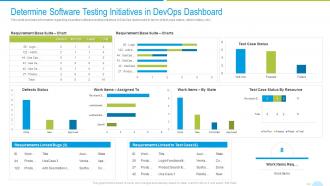
This slide provides information regarding essential software testing initiatives in DevOps dashboard in terms of test case status, defect status, etc.
People who downloaded this PowerPoint presentation also viewed the following :
Devops quality assurance and testing it determine software testing initiatives in devops dashboard with all 7 slides:
Use our Devops Quality Assurance And Testing It Determine Software Testing Initiatives In Devops Dashboard to effectively help you save your valuable time. They are readymade to fit into any presentation structure.
FAQs for Devops quality assurance and testing it determine software testing initiatives
Key components include automated testing frameworks, continuous integration pipelines, test-driven development practices, performance monitoring tools, and cross-functional collaboration protocols. These elements streamline quality assurance by enabling faster feedback loops, reducing manual bottlenecks, and ensuring consistent code quality, with many organizations finding that integrated testing approaches ultimately deliver accelerated deployment cycles and enhanced software reliability.
Automated testing integrates throughout the DevOps lifecycle by enabling continuous validation, rapid feedback loops, and seamless deployment pipelines. Through automated unit, integration, and deployment testing, organizations streamline development cycles, minimize manual errors, and accelerate release frequencies, with many software companies finding that embedded testing ultimately delivers faster time-to-market and enhanced product reliability.
Continuous testing ensures software quality in DevOps by automating validation throughout the development pipeline, detecting defects early, and providing real-time feedback on code changes. This approach enables teams to release more frequently while maintaining reliability, with organizations like Netflix and Amazon leveraging continuous testing to deploy thousands of updates daily, ultimately delivering faster time-to-market and enhanced customer experiences.
Teams can measure DevOps testing effectiveness through deployment frequency, lead time for changes, mean time to recovery, and change failure rates, alongside test coverage metrics and automated test execution times. These measurements enable organizations to track operational efficiency, identify bottlenecks in their CI/CD pipelines, and optimize testing processes, ultimately delivering faster releases and improved software quality.
Common challenges include cultural resistance between development and testing teams, insufficient test automation coverage, managing complex CI/CD pipeline configurations, and maintaining test data quality across environments. These integration hurdles often result in delayed releases, inconsistent testing standards, and resource bottlenecks, with many organizations finding that strategic tool consolidation and cross-functional training ultimately streamline workflows and enhance deployment reliability.
DevOps testing initiatives accelerate release cycles by automating test execution, enabling continuous integration and deployment, implementing parallel testing processes, and providing rapid feedback loops. These approaches streamline quality assurance by catching defects earlier, reducing manual testing bottlenecks, and facilitating seamless code integration, with many organizations finding significantly shorter development timelines and enhanced deployment frequency.
Essential DevOps testing tools include Jenkins for continuous integration, Selenium for automated web testing, Docker for containerized test environments, Kubernetes for orchestration, and monitoring platforms like Nagios or Prometheus. These frameworks streamline testing by enabling automated deployments, consistent test environments, and real-time feedback loops, with many organizations finding that integrated tool chains reduce deployment failures while accelerating release cycles.
Developers and testers collaborate more effectively through shared ownership of quality, integrated testing throughout development cycles, cross-functional team structures, and continuous communication channels. This strategic combination enables faster feedback loops, reduces defect resolution time, and streamlines delivery pipelines, with many organizations finding that collaborative DevOps practices ultimately deliver higher-quality software and enhanced competitive advantage.
Microservices significantly reshape testing strategies in DevOps by requiring distributed testing approaches, contract testing, service virtualization, and comprehensive monitoring across independent services. Organizations like Netflix and Amazon leverage automated testing pipelines, API testing frameworks, and fault injection techniques to ensure seamless integration, while maintaining rapid deployment cycles and system reliability across their microservices architectures.
Shift-left testing enhances software quality by identifying defects earlier in development cycles, reducing remediation costs, and accelerating deployment timelines through integrated automated testing frameworks. By embedding quality assurance throughout the pipeline, organizations streamline code reviews, minimize production incidents, and deliver more reliable applications, with many enterprises finding that early detection strategies ultimately reduce debugging time by up to 80%.
Organizations can ensure comprehensive test coverage by implementing automated testing frameworks, establishing clear testing metrics and KPIs, integrating continuous testing throughout the development pipeline, conducting regular code reviews, and maintaining detailed test documentation. These practices streamline quality assurance by reducing manual effort, accelerating feedback cycles, and enhancing defect detection, with many development teams finding that strategic test automation ultimately delivers faster releases and improved software reliability.
Performance testing integrates into DevOps through automated testing pipelines, continuous monitoring, shift-left testing practices, infrastructure as code validation, and real-time performance feedback loops. These approaches enable organizations to detect bottlenecks early, validate system scalability automatically, and maintain optimal application performance throughout development cycles, with many financial services and e-commerce companies finding that continuous performance validation significantly reduces production issues while accelerating release velocity.
Version control for test scripts is absolutely critical in DevOps environments, ensuring consistency, traceability, collaboration, and rollback capabilities across development cycles. Through centralized repositories like Git, teams streamline test script management, track changes seamlessly, and maintain synchronized testing protocols, with many organizations finding that proper version control reduces deployment errors and accelerates release cycles significantly.
**INPUT**: What strategies can be employed to ensure security testing is integrated into DevOps? **OUTPUT**: Security testing integration in DevOps involves implementing automated security scans, static code analysis, vulnerability assessments, dependency checks, and infrastructure-as-code security validation throughout the pipeline. These strategies streamline compliance while accelerating delivery cycles, with many financial services and healthcare organizations finding that early security integration reduces remediation costs and enhances overall system resilience.
Organizations leverage AI and ML in DevOps testing through intelligent test automation, predictive defect analysis, automated test case generation, and smart test environment provisioning. These technologies streamline testing cycles by identifying high-risk code changes, optimizing test execution sequences, and automatically generating regression tests, with many development teams finding significantly faster release cycles and enhanced software quality.
-
It saves your time and decrease your efforts in half.
-
Excellent template with unique design.