


Devsecops Best Practices For Secure Devsecops Performance Monitoring Dashboard




Try Before you Buy Download Free Sample Product
 Impress Your
Audience
 100%
Editable
 Save Hours
of Time


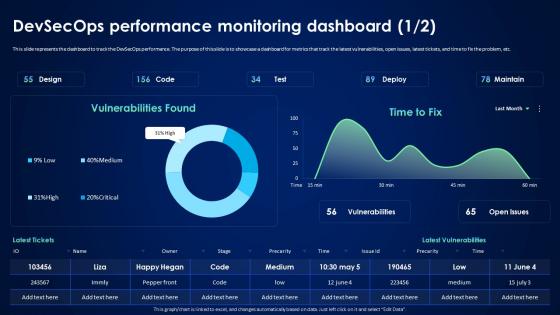
This slide represents the dashboard to track the DevSecOps performance. The purpose of this slide is to showcase a dashboard for metrics that track the latest vulnerabilities, open issues, latest tickets, and time to fix the problem, etc.
People who downloaded this PowerPoint presentation also viewed the following :
Devsecops Best Practices For Secure Devsecops Performance Monitoring Dashboard with all 11 slides:
Use our Devsecops Best Practices For Secure Devsecops Performance Monitoring Dashboard to effectively help you save your valuable time. They are readymade to fit into any presentation structure.








FAQs for Devsecops Best Practices For Secure Devsecops
DevSecOps integrates security throughout the development lifecycle, emphasizing shift-left security testing, automated vulnerability scanning, continuous compliance monitoring, and shared security responsibility across teams. While traditional DevOps focuses on speed and deployment efficiency, DevSecOps embeds security controls into CI/CD pipelines, enabling organizations to deliver secure applications faster while maintaining robust protection against threats and regulatory compliance.
Organizations effectively integrate security into CI/CD pipelines through automated security scanning, secure code reviews, vulnerability assessments, infrastructure-as-code security policies, and continuous compliance monitoring at every deployment stage. These DevSecOps practices enable teams to identify threats early, reduce remediation costs, and maintain robust security posture, with many enterprises finding that embedded security accelerates delivery while strengthening overall system resilience.
Automated security testing tools serve as the backbone of DevSecOps by integrating vulnerability scanning, code analysis, dependency checking, and compliance monitoring directly into CI/CD pipelines. These tools enable organizations to identify security flaws early in development cycles, reduce manual testing overhead, and maintain consistent security standards across deployments, with many financial services and healthcare institutions finding that automated testing accelerates secure software delivery while minimizing costly post-production vulnerabilities.
Collaboration can be enhanced through shared tooling, cross-functional training, integrated communication platforms, joint sprint planning, and embedded security champions within development teams. These practices streamline workflows by breaking down silos, establishing common metrics, and creating shared accountability, with many organizations finding that unified dashboards and regular cross-team retrospectives ultimately deliver faster deployment cycles and improved security posture.
Organizations should track security issue resolution time, vulnerability detection rates, deployment frequency, mean time to recovery, and compliance audit pass rates. These metrics enable teams to measure both security posture and operational efficiency, with many financial services and healthcare organizations finding that tracking automated security test coverage and policy violation rates ultimately delivers faster, more secure deployments while maintaining competitive development velocity.
Threat modeling integrates into the software development lifecycle through early design phase risk assessment, automated security testing during development sprints, and continuous vulnerability evaluation at each deployment stage. Organizations like financial services firms and healthcare providers use systematic threat identification tools during planning, code review checkpoints, and production monitoring, ultimately delivering more secure applications while reducing costly post-deployment security remediation efforts.
Organizations face challenges including cultural resistance to security integration, skills gaps in security automation, tool complexity across development pipelines, compliance requirements, and legacy system integration. These obstacles present both implementation hurdles and strategic opportunities, with many enterprises finding that gradual adoption, comprehensive training, and executive support ultimately streamline workflows and enhance competitive positioning.
**INPUT**: How can "shift-left" security practices improve early detection of vulnerabilities? **OUTPUT**: Shift-left security practices enhance early vulnerability detection by integrating automated security testing, code analysis, and threat modeling directly into development workflows, enabling developers to identify issues during coding rather than post-deployment. This approach streamlines remediation costs, accelerates release cycles, and strengthens overall application security, with many organizations finding that early detection reduces fixing costs by up to 100 times compared to production discoveries. [Word count: 60 words]
Essential training for DevSecOps transitions includes security fundamentals, automated testing tools, compliance frameworks, threat modeling, and secure coding practices. These programs enhance team capabilities by integrating security knowledge with development workflows, infrastructure management, and continuous monitoring, with many organizations finding that comprehensive upskilling ultimately delivers faster deployments and stronger security postures.
Compliance requirements significantly influence DevSecOps implementation by mandating automated security controls, continuous auditing processes, and comprehensive documentation throughout development pipelines. Financial services and healthcare organizations find that regulatory frameworks like SOX, HIPAA, and PCI-DSS actually accelerate DevSecOps adoption, enabling faster compliance verification, reduced audit costs, and streamlined regulatory reporting while maintaining security standards.
DevSecOps secret management best practices include automated secret rotation, centralized secret stores like HashiCorp Vault or AWS Secrets Manager, encryption at rest and in transit, least-privilege access controls, and never hardcoding credentials in source code. These approaches streamline security by eliminating manual processes, reducing exposure windows, and enabling audit trails, with many financial services and healthcare organizations finding that automated secret management significantly reduces breach risks while accelerating deployment cycles.
Organizations leverage container security within DevSecOps by integrating automated vulnerability scanning, implementing runtime protection monitoring, establishing secure image registries, enforcing access controls, and conducting continuous compliance checks throughout development pipelines. These practices enable financial services, healthcare systems, and retail platforms to detect threats early, streamline deployments, and maintain regulatory compliance, ultimately delivering faster secure releases while reducing operational risks.
Continuous monitoring and logging in DevSecOps enables real-time threat detection, compliance tracking, automated incident response, and comprehensive audit trails throughout the development lifecycle. These capabilities streamline security operations by identifying vulnerabilities early, accelerating remediation processes, and ensuring regulatory compliance, with many financial services and healthcare organizations finding that proactive monitoring ultimately delivers faster incident resolution and enhanced operational security.
Infrastructure as Code (IaC) enhances DevSecOps efforts by automating security controls, enabling consistent configurations, and integrating security scanning directly into deployment pipelines. Through IaC platforms, organizations streamline compliance monitoring, reduce configuration drift, and accelerate incident response, with many financial services and healthcare institutions finding that automated infrastructure provisioning ultimately delivers enhanced security posture and operational efficiency.
Strategies include implementing security-as-code practices, conducting automated vulnerability scans, integrating threat modeling into design phases, establishing continuous security testing, and embedding security champions within development teams. These approaches streamline security integration by automating compliance checks, identifying risks early, and fostering security-conscious culture, with many organizations finding that proactive security measures ultimately reduce remediation costs while accelerating secure delivery.
-
Informative and engaging! I really like the design and quality of the slides.
-
What an exhaustive collection of templates you guys have there in slideteam. Impressive!!!