


Difference Equifax And Transunion Credit Bureaus Credit Scoring And Reporting Complete Guide Fin SS





Try Before you Buy Download Free Sample Product
 Impress Your
Audience
 100%
Editable
 Save Hours
of Time


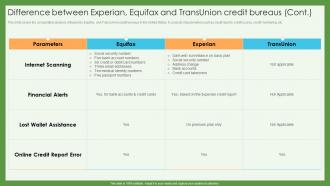
This slide covers the comparative analysis of Experian, Equifax, and TransUnion credit bureaus in the United States. It consists of parameters such as credit reports, credit scores, credit monitoring, etc.
People who downloaded this PowerPoint presentation also viewed the following :
Difference Equifax And Transunion Credit Bureaus Credit Scoring And Reporting Complete Guide Fin SS with all 10 slides:
Use our Difference Equifax And Transunion Credit Bureaus Credit Scoring And Reporting Complete Guide Fin SS to effectively help you save your valuable time. They are readymade to fit into any presentation structure.









FAQs for Difference Equifax And Transunion Credit Bureaus Credit Scoring And Reporting Complete
Equifax and TransUnion collect consumer credit data through similar networks of lenders, creditors, and financial institutions, but differ in their reporting timelines, data partnerships, and geographical focus areas. While both bureaus receive information from banks, credit card companies, and mortgage lenders, TransUnion often emphasizes faster reporting cycles and broader rental payment tracking, whereas Equifax maintains stronger relationships with certain regional lenders, ultimately delivering slightly different credit profiles that can impact loan approvals and interest rates.
Equifax and TransUnion use different proprietary algorithms and data weighting methods in their credit scoring models, leading to variations in how they calculate creditworthiness from the same financial information. While both bureaus utilize similar core factors like payment history and credit utilization, their distinct mathematical approaches and data sources often produce different scores for the same individual, with many lenders now using multiple bureau reports to gain comprehensive risk assessments.
Credit report accuracy between Equifax and TransUnion depends on data source timing, creditor reporting practices, dispute resolution processes, and verification procedures used by each bureau. While both maintain similar standards, differences in creditor relationships and update frequencies can create variations, with financial institutions often finding that cross-referencing both reports provides the most comprehensive view for lending decisions.
Equifax and TransUnion typically update consumer credit information monthly, though some creditors report updates weekly or bi-weekly, with both bureaus processing data continuously as they receive it from lenders. This regular updating enables financial institutions to access current credit profiles for loan approvals and risk assessments, ultimately delivering more accurate lending decisions and competitive rates for consumers.
Beyond credit reporting, Equifax and TransUnion offer identity theft protection, credit monitoring, fraud detection services, employment verification, tenant screening, and marketing analytics solutions. These diversified services enable businesses across financial services, healthcare, and retail sectors to streamline risk assessment, enhance customer onboarding processes, and deliver more personalized experiences while maintaining regulatory compliance.
Both Equifax and TransUnion handle disputes through online portals, phone systems, and mail submissions, typically investigating claims within 30 days as required by federal law. These bureaus contact data furnishers to verify disputed information, update records when inaccuracies are confirmed, and provide written results to consumers, ultimately enabling individuals to maintain accurate credit profiles for better financial opportunities.
Equifax and TransUnion provide identity theft protection through credit monitoring services, fraud alerts, credit freezes, identity monitoring, and dark web scanning capabilities. These bureaus enable consumers to detect suspicious activities early, receive real-time alerts about credit inquiries, and quickly respond to potential fraud, with many financial institutions integrating these protective services to enhance customer security and reduce identity theft risks.
Equifax and TransUnion offer credit monitoring services with similar pricing structures, typically ranging from $14.95 to $29.95 monthly for comprehensive plans that include multi-bureau monitoring, identity theft protection, and credit score tracking. While both bureaus provide competitive basic monitoring options, TransUnion often delivers slightly lower entry-level pricing, with Equifax focusing on premium features, ultimately enabling consumers to choose based on their specific financial monitoring needs and budget requirements.
Equifax and TransUnion significantly influence mortgage lending decisions by providing credit scores, payment histories, debt-to-income ratios, and risk assessments that lenders use to evaluate borrower eligibility and loan terms. These bureaus enable financial institutions to streamline approval processes, minimize default risks, and offer competitive rates, with many mortgage companies finding that comprehensive credit bureau data ultimately delivers faster underwriting and more accurate lending decisions.
Consumer rights remain largely consistent across Equifax and TransUnion, as both must comply with identical federal regulations including the Fair Credit Reporting Act, providing free annual reports, dispute resolution processes, and fraud alert services. While the core legal protections are uniform, differences may emerge in customer service experiences, online platform usability, and response timeframes for disputes, with many consumers finding that comparing both reports provides more comprehensive credit monitoring and faster issue resolution.
Equifax typically processes credit report corrections within 30 days of receiving a dispute, while TransUnion follows a similar timeline, though both bureaus often resolve straightforward disputes within 15-21 days. These correction timeframes enable consumers and financial institutions to maintain accurate credit profiles, streamline loan approvals, and enhance customer experiences, with many lenders finding that faster dispute resolution ultimately delivers improved operational efficiency.
Equifax presents credit information in a more detailed, section-based format with comprehensive account histories, while TransUnion uses a streamlined layout emphasizing visual clarity and simplified categorization. These different approaches enable lenders, financial institutions, and consumers to analyze creditworthiness through varying perspectives, with many finding that reviewing both formats delivers more comprehensive insights for loan approvals and financial decision-making.
Both Equifax and TransUnion offer credit monitoring services, dispute resolution tools, identity theft protection, credit score simulators, and personalized improvement recommendations through their consumer platforms. These bureaus enable individuals to track their credit profiles, identify reporting errors, and receive strategic guidance on payment timing and debt management, with many consumers finding that consistent monitoring and proactive dispute resolution significantly accelerate their credit improvement outcomes.
Information accuracy from Equifax and TransUnion significantly impacts consumers' credit scores, loan approvals, and borrowing costs, as discrepancies between bureaus can create varying creditworthiness assessments. These variations affect mortgage rates, credit card approvals, and rental applications, with many consumers finding that regularly monitoring both reports enables them to identify errors early and maintain optimal credit standing across all financial institutions.
Equifax and TransUnion provide businesses with comprehensive risk assessment through extensive consumer databases, advanced analytics platforms, real-time fraud detection, identity verification services, and predictive scoring models. These strategic capabilities enable financial institutions, retailers, and healthcare organizations to streamline loan approvals, minimize default risks, and enhance customer onboarding processes, ultimately delivering competitive advantage through faster decision-making and improved operational efficiency.
-
Excellent work done on template design and graphics.
-
One word for SlideTeam–Versatile!