


Different aspects that decide devops success it powerpoint presentation slides





Try Before you Buy Download Free Sample Product
 Impress Your
 Audience
 100%
100% Editable
 Save Hours
 of Time


Investing in these critical areas is directly proportional to fuel DevOps culture: automation, orchestration, abstraction, idempotency, and composability. Cross-functional teams, monitoring and KPIs, service ownership, etc., are the critical success factors of DevOps. Here is a professionally designed template of Different Aspects that decides DevOps Success IT that allows sharing work at every pipeline level. It covers the details about various concerns that occur before DevOps implementation. Not only this, but it also talks about statistics associated with DevOps implementation and the benefits associated with DevOps implementation. The template also includes details about considerations essential for DevOps implementation and crucial strategies for effective DevOps adoption. The main stages associated with DevOps and different phases of the DevOps lifecycle can be shown in a concise way utilizing this PowerPoint template. It caters to details regarding essential factors involved in the DevOps process, essential elements involved in DevOps implementation, and critical measures of DevOps success. The given slide showcases DevOps performance success factors, various metrics associated with DevOps system effectiveness, roles and responsibilities associated with the DevOps team, and addresses new roles essential for successful DevOps. It is useful in elucidating cost elements associated with DevOps implementation, including team training cost, and selecting suitable DevOps management solutions. It also addresses the impact of the successful implementation of the DevOps system and dashboard for tracking DevOps activities. Get access to Different Aspects that Decide DevOps success template and select suitable management solutions. Download it now.
People who downloaded this PowerPoint presentation also viewed the following :
Content of this Powerpoint Presentation
Slide 1: This slide displays the title i.e. 'Different aspects that decide DevOps Success (IT)' and your company name.
Slide 2: This slide showcases the agenda for the project.
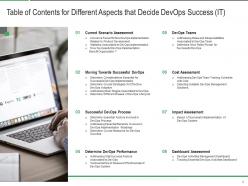
Slide 3: This slide presents the table of contents for the project.
Slide 4: This slide exhibits the title for current scenario assessment.
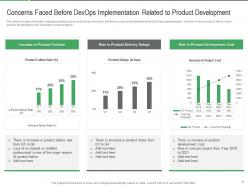
Slide 5: This slide provides information regarding existing concerns faced by firm due to ineffective product development before DevOps implementation in terms of rise in product failure, etc.
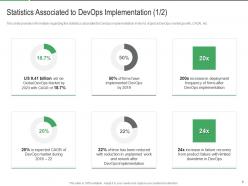
Slide 6: This slide provides information regarding the statistics associated to DevOps implementation in terms of global DevOps market growth, CAGR, etc.
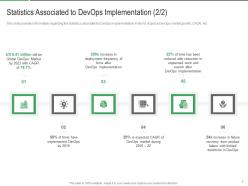
Slide 7: This slide provides information regarding the statistics associated to DevOps implementation in terms of global DevOps market growth, CAGR, etc.
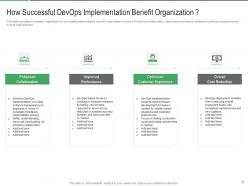
Slide 8: This slide provides information regarding how successful implementation benefit organization in terms of enhanced collaboration, improved performance, optimized customer experience and overall cost reduction.
Slide 9: This slide describes the title for moving towards successful DevOps.
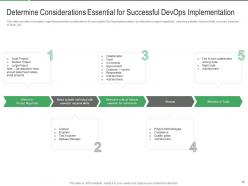
Slide 10: This slide provides information regarding essential considerations for successful DevOps implementation by determine project magnitude, selecting suitable required skills, process, selection of tools, etc.
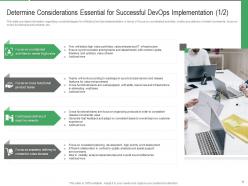
Slide 11: This slide provides information regarding crucial strategies for effective DevOps implementation in terms of focus on coordinated activities, continuous delivery of small increments, focus on cross functional product teams, etc.
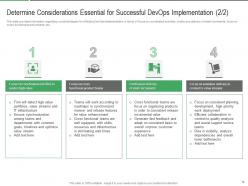
Slide 12: This slide provides information regarding crucial strategies for effective DevOps implementation in terms of focus on coordinated activities, continuous delivery of small increments, focus on cross functional product teams, etc.
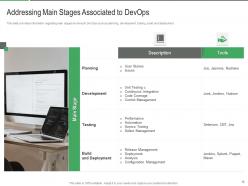
Slide 13: This slide provides information regarding main stages involved in DevOps such as planning, development, testing, build and deployment.
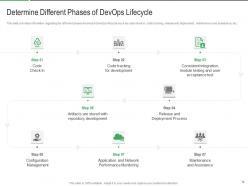
Slide 14: This slide provides information regarding the different phases involved in DevOps lifecycle such as code check in, code tracking, release and deployment, maintenance and assistance, etc.
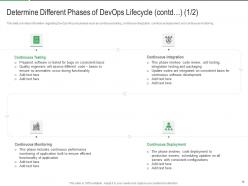
Slide 15: This slide provides information regarding DevOps lifecycle phases such as continuous testing, continuous integration, continuous deployment and continuous monitoring.
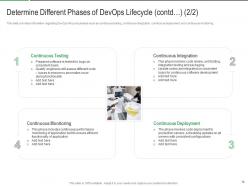
Slide 16: This slide provides information regarding DevOps lifecycle phases such as continuous testing, continuous integration, continuous deployment and continuous monitoring.
Slide 17: This slide displays the title for successful DevOps process.
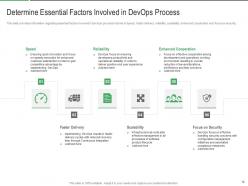
Slide 18: This slide provides information regarding essential factors involved in DevOps process in terms of speed, faster delivery, reliability, scalability, enhanced cooperation and focus on security.
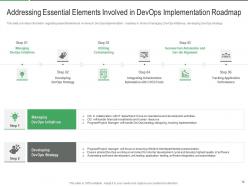
Slide 19: This slide provides information regarding essential elements involves in DevOps implementation roadmap in terms of managing DevOps initiatives, developing DevOps strategy.
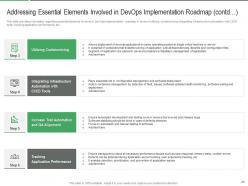
Slide 20: This slide explains regarding essential elements involves in DevOps implementation roadmap in terms of utilizing containerizing, tracking application performance, etc.
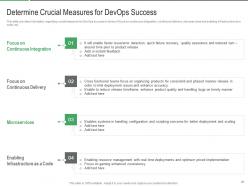
Slide 21: This slide provides information regarding crucial measures for DevOps success in terms of focus on continuous integration, continuous delivery, microservices and enabling infrastructure as a code, etc.
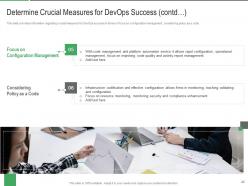
Slide 22: This slide provides information regarding crucial measures for DevOps success in terms of focus on configuration management, considering policy as a code.
Slide 23: This slide presents the title for determining the DevOps performance.
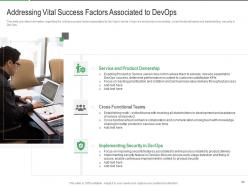
Slide 24: This slide provides information regarding the critical success factors associated to DevOps in terms of service and product ownership, cross functional teams and implementing security in DevOps.
Slide 25: This slide provides information regarding the critical success factors associated to DevOps in terms of executing DevOps CI/CD automation toolset, tracking and KPIs.
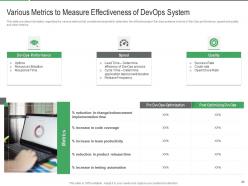
Slide 26: This slide describes the various metrics that considered essential in determine the effectiveness of DevOps systems in terms of DevOps performance, and other metrics.
Slide 27: This slide exhibits the title for DevOps teams.
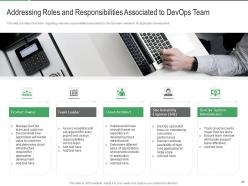
Slide 28: This slide provides information regarding roles and responsibilities associated to DevOps team members for application development.
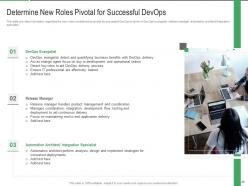
Slide 29: This slide explains the new roles considered as pivotal for successful DevOps in terms of DevOps evangelist, release manager, etc.
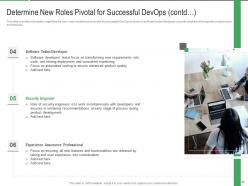
Slide 30: This slide describes the new roles considered as pivotal for successful DevOps in terms of software tester/developer, security engineer professional.
Slide 31: This slide displays the title for cost assessment.
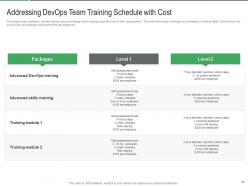
Slide 32: This slide spells out devops team training schedule with costs.
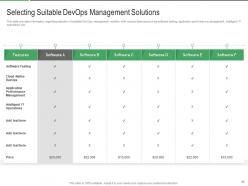
Slide 33: This slide provides information regarding selection of suitable DevOps management solution with various features like software testing, intelligent IT operations, etc.
Slide 34: This slide presents the title for impact assessment.
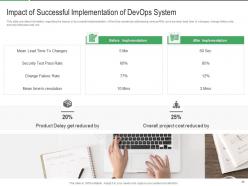
Slide 35: This slide provides information regarding the impact of successful implementation of DevOps system by addressing various KPIs such as mean lead time to changes, etc.
Slide 36: This slide exhibits the title for dashboard assessment.
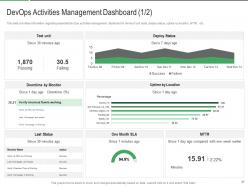
Slide 37: This slide provides information regarding essential DevOps activities management dashboard in terms of unit tests, deploy status, uptime by location, MTTR, etc.
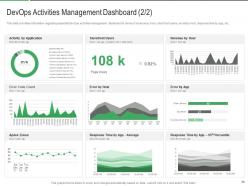
Slide 38: This slide provides information regarding essential DevOps activities management dashboard in terms of revenue by hour, storefront users, errors by host, response time by app, etc.
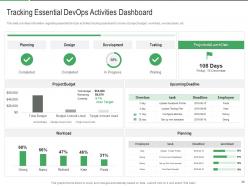
Slide 39: This slide provides information regarding essential DevOps activities tracking dashboard in terms of project budget, workload, overdue tasks, etc.
Slide 40: This slide displays the title for additional slides.
Slide 41: This is the icons slide for DevOps success (IT).
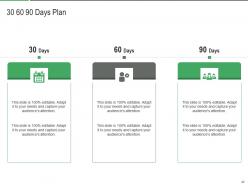
Slide 42: This slide explains the 30-60-90 days plan of the project.
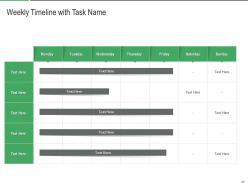
Slide 43: This slide describes the weekly timeline of the project with task's name.
Slide 44: This slide demonstrates the roadmap of the company for process flow.
Slide 45: This slide showcases the vision, mission and goal of the company.
Slide 46: This slide explains about the company and their professional, creativity and talents.
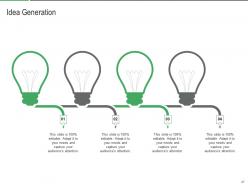
Slide 47: This slide displays the idea generation of the company.
Slide 48: This slide spells out about the team members of the project with their photo, name and designation.
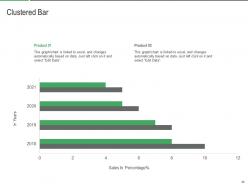
Slide 49: This slide presents yearly sales clustered bars for different products. The bars are linked to Excel.
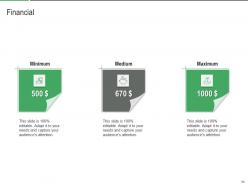
Slide 50: This slide exhibits the financials of the company.
Slide 51: This is the thank you slide with contact details of the company including email address, phone no, etc.
Different aspects that decide devops success it powerpoint presentation slides with all 51 slides:
Use our Different Aspects That Decide DevOps Success IT Powerpoint Presentation Slides to effectively help you save your valuable time. They are readymade to fit into any presentation structure.














FAQs for Different aspects that decide devops success it
DevOps success requires cultural shifts including breaking down silos between development and operations teams, embracing shared responsibility for outcomes, fostering continuous learning mindsets, and prioritizing collaboration over blame. These transformations enable organizations to streamline deployment processes, accelerate feedback loops, and enhance product quality, with many companies finding that cultural alignment ultimately delivers faster innovation cycles and improved customer experiences.
Organizations can measure DevOps success through deployment frequency, lead time for changes, mean time to recovery, change failure rates, and customer satisfaction metrics. These indicators enable teams to track operational efficiency, service reliability, and business outcomes across development cycles, with many enterprises finding that regular measurement of these factors delivers faster releases, reduced downtime, and improved competitive advantage.
Automation streamlines DevOps workflows by eliminating manual processes, reducing human error, and accelerating deployment cycles through continuous integration and delivery pipelines. These automated systems enable faster code testing, seamless infrastructure provisioning, and consistent environment management, with many organizations finding that strategic automation delivers significantly reduced time-to-market and enhanced operational efficiency.
Cross-functional teams significantly enhance DevOps success by breaking down silos, accelerating communication, and enabling shared accountability across development, operations, and quality assurance functions. These collaborative structures streamline decision-making, reduce handoff delays, and foster continuous integration practices, with organizations like Netflix and Amazon finding that unified teams deliver faster deployments, improved system reliability, and enhanced customer experiences.
Essential DevOps pipeline tools include Jenkins or GitLab CI/CD for automation, Docker for containerization, Kubernetes for orchestration, Terraform for infrastructure management, and monitoring solutions like Prometheus or Datadog. These technologies streamline deployment cycles, enhance collaboration between development and operations teams, and minimize downtime, with many organizations finding that integrated toolchains deliver faster releases and improved system reliability.
CI/CD practices enhance software quality by automating testing, reducing integration conflicts, enabling faster bug detection, and ensuring consistent deployment processes across environments. Through automated pipelines, organizations streamline code validation, minimize human error, and accelerate feedback loops, with many software companies finding that continuous practices ultimately deliver more reliable applications and improved customer experiences.
DevOps adoption challenges include cultural resistance to collaboration, legacy system integration complexities, skill gaps in automation tools, and establishing consistent deployment pipelines across teams. Organizations overcome these by implementing gradual cultural change programs, investing in cross-functional training, modernizing infrastructure incrementally, and creating clear governance frameworks, with many enterprises finding that dedicated DevOps centers of excellence accelerate transformation success.
DevOps improves collaboration by implementing shared tools and workflows, establishing cross-functional teams, creating unified communication channels, and aligning development and operations goals around common objectives. These practices streamline project handoffs, enhance transparency through continuous integration pipelines, and enable faster issue resolution, with many organizations finding that operational efficiency increases significantly while deployment conflicts decrease substantially.
Feedback is crucial in DevOps, enabling continuous improvement through automated monitoring, user analytics, performance metrics, and stakeholder input at every development stage. Through real-time dashboards and integrated feedback loops, organizations streamline issue resolution, enhance product quality, and accelerate delivery cycles, with many finding that systematic feedback collection ultimately delivers faster innovation and improved customer experiences.
Effective DevOps risk management strategies include automated testing pipelines, continuous monitoring systems, infrastructure as code, gradual deployment techniques, and comprehensive backup protocols. These approaches streamline risk mitigation by enabling faster incident detection, reducing manual errors, and ensuring rapid recovery capabilities, with many organizations finding that strategic automation ultimately delivers enhanced operational resilience and competitive advantage.
Cloud computing significantly enhances DevOps success factors by providing scalable infrastructure, automated provisioning, and seamless integration capabilities that accelerate deployment cycles. Through cloud platforms, organizations streamline resource management, reduce infrastructure bottlenecks, and enable continuous delivery pipelines, with many enterprises finding that cloud-native approaches ultimately deliver faster time-to-market and improved operational efficiency.
Training necessary for strong DevOps culture includes cross-functional collaboration workshops, automation tool proficiency, continuous integration practices, cloud platform management, and cultural mindset development programs. Organizations increasingly find that combining technical skills training with soft skills development, particularly in communication and problem-solving, delivers faster deployment cycles and improved team cohesion, ultimately enabling more agile responses to market demands.
Organizations should track deployment frequency, lead time for changes, mean time to recovery, change failure rate, and customer satisfaction scores to evaluate DevOps performance. These metrics enable teams to measure delivery speed, quality, and reliability across development cycles, with many financial services and e-commerce companies finding that consistent monitoring ultimately delivers faster releases and improved operational efficiency.
Regulatory and compliance requirements significantly influence DevOps practices by necessitating automated compliance checks, audit trails, and enhanced security controls throughout development pipelines. Financial services and healthcare organizations implement continuous compliance monitoring, automated testing for regulatory standards, and immutable deployment records, while maintaining rapid delivery cycles, ultimately enabling faster compliance verification and reducing manual oversight costs.
DevSecOps best practices include integrating security automation into CI/CD pipelines, implementing shift-left security testing, establishing continuous compliance monitoring, creating cross-functional security training, and embedding security champions within development teams. These approaches streamline security by automating vulnerability scanning, enabling early threat detection, and fostering security-conscious development cultures, with many organizations finding that proactive security integration reduces remediation costs while accelerating secure software delivery.
-
Wonderful templates design to use in business meetings.