

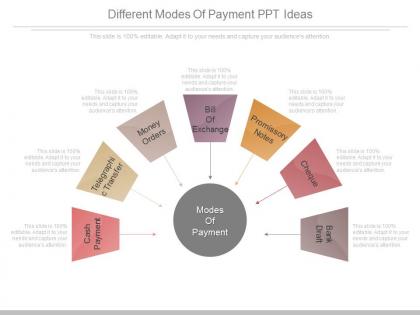
Different modes of payment ppt ideas




Try Before you Buy Download Free Sample Product
 Impress Your
 Audience
 100%
100% Editable
 Save Hours
 of Time


Encourage them to assemble with our Different Modes Of Payment Ppt Ideas. They contain an attractive force.
People who downloaded this PowerPoint presentation also viewed the following :
Different modes of payment ppt ideas with all 7 slides:
Display your firm fundamentals on our Different Modes Of Payment Ppt Ideas. They will be bullish about your chances.






FAQs for Different modes of
The most commonly used e-commerce payment modes include credit and debit cards, digital wallets like PayPal and Apple Pay, bank transfers, buy-now-pay-later services, and cryptocurrency options. These payment methods streamline checkout processes by offering flexibility, enhanced security, and faster transaction processing, with many retailers finding that multiple payment options significantly reduce cart abandonment and enhance customer satisfaction.
Mobile wallets enhance security through advanced encryption, tokenization, biometric authentication, and multi-factor verification, while traditional cards rely primarily on chip technology and PIN protection. Through tokenized transactions, mobile wallets eliminate actual card number exposure during purchases, with many financial institutions finding that contactless payments reduce fraud risks and deliver faster, more secure customer experiences.
Blockchain revolutionizes payment systems by enabling peer-to-peer transactions, eliminating intermediaries, reducing processing times, and enhancing security through cryptographic verification. Financial institutions and retailers increasingly adopt blockchain-based solutions for cross-border payments, smart contracts, and digital currencies, ultimately delivering lower transaction costs, faster settlement times, and enhanced transparency.
Businesses can choose suitable payment modes by analyzing customer demographics, transaction volumes, geographical reach, and preferred shopping channels. Companies should evaluate factors like processing fees, security requirements, and integration capabilities, with retail businesses often finding that offering multiple options—from digital wallets to traditional cards—maximizes conversion rates and enhances customer satisfaction.
Payment gateways serve as secure intermediaries between merchants and financial institutions, encrypting sensitive data, processing transaction authorization, and facilitating fund transfers in real-time. These platforms streamline e-commerce operations by handling fraud detection, compliance requirements, and multiple payment methods, with retailers and service providers finding that robust gateways ultimately deliver faster checkout experiences and reduced cart abandonment rates.
Cryptocurrency acceptance significantly influences consumer behavior by attracting tech-savvy demographics, enabling faster cross-border transactions, and providing enhanced privacy options. While some consumers embrace the innovation and potential cost savings, others remain cautious due to volatility concerns, with many retailers finding that offering crypto payments ultimately expands their customer base and competitive positioning.
Peer-to-peer payment apps offer instant transfers, lower fees than traditional banking, enhanced convenience for splitting bills, and seamless integration with mobile devices. While these platforms streamline personal transactions and enable quick money exchanges between friends, they also present security vulnerabilities and limited dispute resolution, with many users finding that balancing convenience against potential fraud risks requires careful platform selection.
International transactions require additional payment modes like wire transfers, letters of credit, documentary collections, and foreign exchange services, while domestic transactions typically rely on simpler methods like ACH transfers, checks, and local card networks. Cross-border payments involve currency conversion, correspondent banking relationships, and enhanced compliance requirements, with many financial institutions finding that international processing takes longer and costs more due to regulatory oversight and multiple intermediary banks.
Transaction processing speed is influenced by network infrastructure, security verification protocols, intermediary involvement, and technological architecture across payment modes. Traditional bank transfers require multiple clearinghouse approvals and regulatory checks, while digital wallets and contactless payments leverage direct APIs and streamlined authentication, enabling retailers and financial institutions to process transactions within seconds rather than days, ultimately delivering faster customer experiences and improved operational efficiency.
Businesses enhance user experience by offering multiple payment options through increased convenience, reduced cart abandonment, and broader customer accessibility across different demographics and preferences. By integrating credit cards, digital wallets, bank transfers, and buy-now-pay-later services, retailers streamline checkout processes while accommodating diverse financial behaviors, ultimately delivering higher conversion rates and customer satisfaction.
Different modes of payment present compliance challenges including PCI DSS requirements for card processing, anti-money laundering regulations for digital wallets, cross-border transaction monitoring for international transfers, and data protection standards for stored payment information. Financial institutions navigate these complexities by implementing robust security frameworks, automated compliance monitoring, and regular auditing processes, ultimately ensuring regulatory adherence while maintaining seamless customer payment experiences.
Subscription-based services are driving automated, recurring payment adoption through seamless credit card processing, digital wallets, and direct bank transfers, while reducing traditional cash transactions. These models enable businesses to streamline revenue collection, enhance customer retention through frictionless experiences, and deliver predictable cash flow, with many organizations finding that automated billing ultimately reduces operational costs and improves financial forecasting.
Emerging contactless payment trends include biometric authentication, wearable device integration, voice-activated transactions, blockchain-based systems, and IoT-enabled payments. These technologies streamline customer experiences by reducing transaction times, enhancing security protocols, and enabling seamless omnichannel interactions, with many retailers and financial institutions finding that contactless solutions drive higher customer satisfaction and operational efficiency.
Cultural differences significantly shape payment preferences through factors like trust in digital systems, banking infrastructure, cash-based traditions, and regulatory environments. In Asia, mobile payments dominate due to smartphone adoption, while European consumers favor card transactions and bank transfers, and many developing regions still rely heavily on cash, with businesses increasingly adapting their payment strategies to match local cultural expectations and technological readiness.
Cash production requires significant resources including cotton, linen, metals, and energy-intensive printing processes, while digital payments reduce paper waste, eliminate physical transportation, and minimize storage infrastructure. However, digital systems demand substantial energy for data centers and server operations, with many financial institutions finding that strategic combinations of both methods optimize environmental impact while delivering operational efficiency and enhanced customer experiences.
-
Very well designed and informative templates.
-
Excellent Designs.