

Digital Audit Findings For Email Marketing Campaign





Try Before you Buy Download Free Sample Product
 Impress Your
Audience
 100%
Editable
 Save Hours
of Time


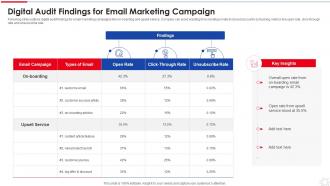
Following slide outlines digital audit findings for email marketing campaigns like on boarding and upsell service. Company can avoid wasting time sending emails to closed accounts by tracking metrics like open rate, click-through rate and unsubscribe rate.
People who downloaded this PowerPoint presentation also viewed the following :
Digital Audit Findings For Email Marketing Campaign with all 6 slides:
Use our Digital Audit Findings For Email Marketing Campaign to effectively help you save your valuable time. They are readymade to fit into any presentation structure.





FAQs for Digital Audit Findings For
Common digital audit metrics include website traffic and conversion rates, page load speeds and mobile responsiveness, SEO rankings and keyword performance, social media engagement rates, and customer acquisition costs. These metrics enable organizations to streamline their digital strategies by identifying performance gaps, optimizing user experiences, and enhancing online visibility, with many businesses finding that comprehensive measurement ultimately delivers improved ROI and competitive advantage.
User experience factors significantly influence digital audit outcomes by revealing usability gaps, navigation inefficiencies, accessibility barriers, and conversion obstacles that directly impact business performance. Through comprehensive UX analysis, organizations streamline customer journeys, enhance engagement metrics, and minimize bounce rates, with many retail and financial services companies finding that improved UX delivers higher conversion rates and competitive advantage.
SEO plays a central role in digital audit findings by revealing technical issues, content gaps, keyword performance, site structure problems, and user experience deficiencies. Through comprehensive SEO analysis, organizations identify opportunities to enhance search visibility, streamline website performance, and improve organic traffic, with many businesses finding that addressing SEO findings delivers significantly better online competitiveness.
Digital audit results guide content marketing strategies by revealing content gaps, identifying high-performing topics, analyzing competitor positioning, and uncovering audience engagement patterns across channels. Through these insights, marketing teams can prioritize resource allocation, optimize underperforming content, and develop targeted campaigns that resonate with specific customer segments, ultimately delivering higher conversion rates and stronger brand positioning in an increasingly competitive digital landscape.
Effective digital audit tools include Google Analytics for web performance tracking, SEMrush for SEO and competitive analysis, Screaming Frog for technical site crawling, Hotjar for user behavior insights, and GTmetrix for speed optimization. These platforms streamline comprehensive assessments by identifying performance gaps, security vulnerabilities, and optimization opportunities, with many organizations finding that strategic tool combinations deliver enhanced operational efficiency and competitive advantage.
Compliance issues significantly impact digital audit findings by highlighting regulatory gaps, inadequate controls, and potential legal vulnerabilities across systems and processes. These findings often reveal weaknesses in data governance, security protocols, and documentation standards, with many organizations discovering that addressing compliance deficiencies ultimately enhances operational transparency, reduces risk exposure, and strengthens their competitive position in regulated markets.
Website audits focus specifically on site performance, SEO, user experience, technical functionality, and content quality, while broader digital audits encompass comprehensive evaluation across all digital touchpoints, including social media presence, email marketing effectiveness, mobile applications, and integrated customer journey mapping. Through strategic digital auditing, organizations streamline their entire digital ecosystem by identifying cross-platform inconsistencies, optimizing resource allocation, and enhancing omnichannel experiences, ultimately delivering competitive advantage and improved customer engagement.
Businesses should conduct comprehensive digital audits quarterly, with lighter monthly reviews of key performance metrics, security vulnerabilities, and user experience indicators. This strategic cadence enables organizations to identify emerging issues, adapt to evolving technologies, and maintain competitive advantage, with many enterprises finding that regular auditing ultimately delivers improved operational efficiency and enhanced customer experiences.
Digital audits identify automation opportunities by analyzing repetitive manual processes, data entry workflows, communication bottlenecks, reporting tasks, and compliance procedures across organizational systems. Through comprehensive process mapping and workflow analysis, organizations can streamline operations, reduce human error, and accelerate service delivery, with many companies finding that automated solutions deliver significant cost savings while enhancing operational efficiency.
Social media metrics factor into digital audits by measuring audience engagement, brand reach, conversion rates, content performance, and competitive positioning across platforms. These analytics reveal customer sentiment patterns, demographic insights, and campaign effectiveness, while identifying optimization opportunities that enhance overall digital strategy, ultimately delivering improved brand visibility and stronger customer relationships in an increasingly social-driven marketplace.
Common digital audit pitfalls include inadequate scope definition, insufficient stakeholder involvement, overlooking mobile performance metrics, ignoring security vulnerabilities, and failing to benchmark against competitors. These oversights can compromise audit accuracy and strategic value, with many organizations finding that comprehensive planning, cross-departmental collaboration, and systematic methodology ultimately deliver more actionable insights and sustainable digital improvements.
Businesses effectively implement digital audit recommendations through prioritized roadmaps, dedicated cross-functional teams, and phased rollouts with clear timelines and success metrics. Organizations like retail chains and financial services firms streamline implementation by focusing on high-impact areas first, allocating specific budgets for each recommendation, and establishing regular progress reviews, ultimately delivering improved user experiences and competitive advantage.
Cross-device compatibility in digital audit findings reveals how consistently your digital presence performs across smartphones, tablets, desktops, and various operating systems, directly impacting user experience and conversion rates. Poor compatibility often results in lost revenue, reduced engagement, and competitive disadvantage, while strong cross-device performance enhances customer satisfaction, streamlines user journeys, and ultimately delivers broader market reach and improved business outcomes.
Digital audits address privacy and data protection concerns by evaluating data collection practices, assessing security protocols, reviewing compliance frameworks, and identifying vulnerability gaps across systems. Through comprehensive assessments, organizations strengthen encryption standards, enhance access controls, and ensure regulatory compliance, with many financial institutions and healthcare providers finding that regular audits significantly reduce breach risks while building customer trust.
Emerging digital audit trends include AI-powered analytics, real-time continuous monitoring, cloud-based audit platforms, automated compliance tracking, and integrated cybersecurity assessments. These technologies streamline audit processes by enhancing data accuracy, reducing manual oversight, and enabling predictive risk analysis, with many organizations finding that automated systems deliver faster compliance verification and significantly improved operational transparency.
-
Top Quality presentations that are easily editable.
-
SlideTeam, Please don’t stop sharing discount coupons! I love your occasional discounts and tend to buy your products around that corner.